An Exhaustive Exegetical Extravaganza

In the Beginning: Listening to Genesis 1 and 2, Cornelis Van Dam.  Grand Rapids: Reformation Heritage Books, 2021.  Hardcover, 371 pages.

Dr. C. Van Dam begins his latest book by explicitly laying out his presuppositions.  He’s upfront about his non-negotiable assumptions and biases.  As I review his book, it’s appropriate that I share mine too.  I share his presuppositions about Scripture as the trustworthy Word of God, but I also bring a personal bias to the table.  Back in the day, Van Dam was my Old Testament professor at the Canadian Reformed Theological Seminary.  I had an affectionate nickname for him in view of his ability to put the smack-down on unbelieving or shoddy scholarship:  “Wham-Bam-Van-Dam.”  This was always said with the greatest admiration for Dr. Van Dam.  As a seminary professor he was nothing if not thorough and careful.

This new book exhibits that same kind of comprehensive and precise approach to the two opening chapters of Scripture.  Van Dam leaves no stone unturned.  In the Beginning is an exhaustive treatment not only of the meaning of these two chapters, but also the various challenges that have been raised in Old Testament scholarship regarding them.  What you’re looking at here is not just a commentary on Genesis 1-2, but far more.

Over the last decade or so John Walton has become well-known for his views on the early chapters of Genesis.  Walton argues that we often misunderstand Genesis 1-2 because we don’t take into account the ancient Near Eastern context of these chapters.  Once we do that, says Walton, then we can see that Genesis 1-2 was never meant to be taken literally as history.  The history can then be filled in with what science teaches us, including what science says about human origins.  In chapter 2 of In the Beginning, Van Dam discusses Walton’s views at length and explains how and where they fail to do justice to the character of Scripture as the Word of God.  In my view this is the most important chapter of the book. 

To whet your appetite further, let me share a selection of questions that Dr. Van Dam answers elsewhere in the book:

  • Can new scientific data be regarded as general revelation given by God?
  • What is the relationship of Scripture to science?  Is Scripture a scientific textbook?
  • Can geology give us a history of creation?
  • Was Herman Dooyeweerd faithful to Scripture in his view of origins?
  • How are we to evaluate Meredith Kline’s Framework Hypothesis?
  • Did the ancient Israelites believe that heaven was a solid vault above us?
  • Why is there no mention of evening and morning with the seventh day in Genesis 1?
  • What does Scripture mean when it says that God created through his Son?
  • Can the breath of life in Genesis 2:7 be equated with the Holy Spirit?
  • Was there animal death before the fall into sin?
  • Why did God create everything with an appearance of age?  Was he being deceptive in so doing?

Those are just a few of the questions answered.  There are far more.  What I appreciate about Van Dam’s answers is that he bases them on what Scripture says.  He doesn’t want to go beyond Scripture and so he’ll sometimes say, “Scripture doesn’t say more than this – this is as far as we can go.”

If I would venture some respectful disagreement, it would be in the final chapter where the author briefly discusses whether there’s a need for new confessional formulations to address the challenges of evolution.  In 2014-15, I was involved with an effort to add some clarification to article 14 of the Belgic Confession in the Canadian Reformed Church.  That effort was ultimately unsuccessful.  I don’t regret having made the effort, nor do I think it unnecessary to this day. 

Van Dam argues that Scripture is clear and our “confessions faithfully reflect that testimony” (p.300).  However, that fails to account for those who have argued that the Three Forms of Unity provide the latitude needed to hold to forms of theistic macro-evolution.  Their arguments have persuaded some.  This wiggle-room ought to be addressed, especially if there is openness to theistic macro-evolution in your churches.

Van Dam also posits that “A difficulty with preparing a new formulation asserting the historicity of Genesis 1 and 2 is the temptation to go beyond what Scripture says, in other words, to provide specifics about that which Scripture gives no additional detail” (pp.300-301).  The proposal to add clarification to BC 14 was to state what Scripture states:  that Adam was created from dust (Gen.2:7) and Eve from Adam’s side (Gen. 2:21-22).  As a consequence:  “They were created as the first two humans and the biological ancestors of all other humans.  There were no pre-Adamites, whether human or hominid.”  If one thinks that this infringes upon the freedom of exegesis, then one is willing to grant the latitude for theistic evolutionary accounts of human (and other) origins.    

That criticism notwithstanding, In the Beginning was a delight to read – personally it brought me back to many of the OT lectures I enjoyed from Dr. Van Dam in my seminary years.  While I found it enjoyable, there may be others who will find it tough-going at times.  It’s not highly technical, but in places Van Dam does go academic.  It’s not a book you’d necessarily be giving out as gifts to those doing profession of faith.  It would, however, be a great gift for someone doing post-secondary studies, whether in the sciences or in the humanities.  And it’s definitely a recommended read for those who’ve completed such studies. 

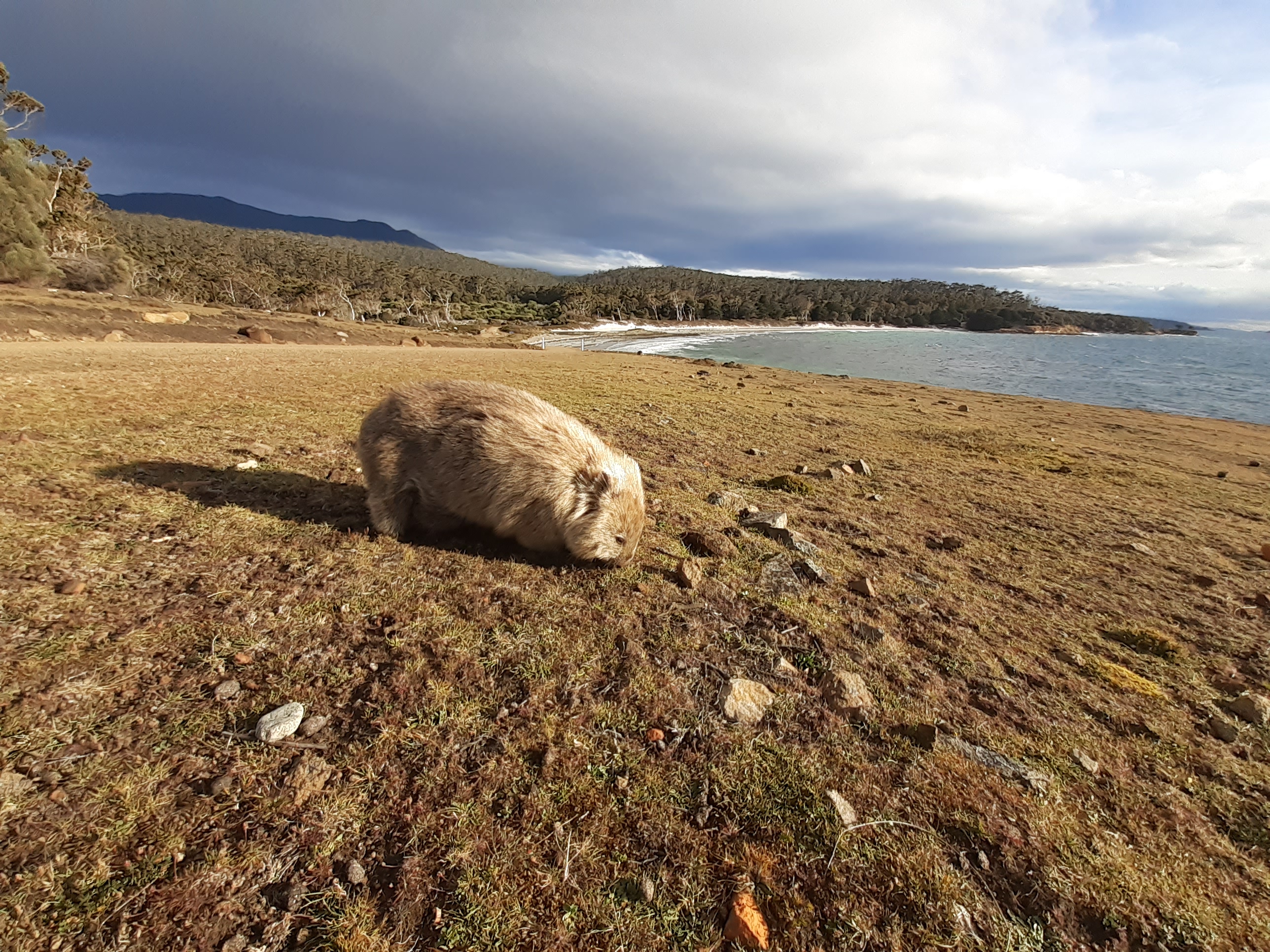
The Wacky Wombat

Common Wombat on Maria Island, Tasmania

Back when I was a missionary in British Columbia, we had a friend visit from Australia.  I asked him, “Have you ever seen a bear in the wild?”  He hadn’t.  “Would you like to see one?”  He certainly did, but expressed his doubts whether I could just conjure up a wild bear for him.  We drove for about 15 minutes north and arrived at the fish-counting weir on the Babine River.  And sure enough, as always at that time of year, there were grizzly bears about, fishing for spawning salmon.  Our Aussie friend was duly impressed. 

Now if you were to visit our part of Australia today, I’d ask you, “Have you ever seen a wombat in the wild?”  The wombat is as close as we get to a bear here in Tasmania.  We’d have to drive a little bit, but there are some spots here where I can guarantee you’d see one — places like Maria Island, Cradle Mountain, or Narawntapu.  And there are plenty of other places where, even if we didn’t see an actual wombat, we could definitely see evidence of them. 

The main evidence you’d find would be their droppings.  They’re rather distinctive.  Wombat droppings are cubic, you see.  Yep, they’re the only animals in the world that poop cubes.  How does a wombat manage this feat?  According to a recent study of wombat intestines, rather than being consistent like most animals, wombats have areas of varying thickness and stiffness.  The droppings go through grooved tissues and irregular contractions and this produces cubes.  Now not all wombat droppings are perfect cubes, but apparently the more cubic they are, the healthier the wombat.

When most people think of marsupials, they think kangaroos.  However, wombats are marsupials too.  The wombat’s pouch faces backwards between its legs.  So you could very well see a momma wombat wandering away with a baby wombat peeking out from the pouch. 

Wombat on Maria Island, Tasmania

Wombats are also renowned road kill in Tasmania and elsewhere.  Adult wombats can be a meter long and weigh in at 35 kg or 77 lbs.  They are like little bears.  If you hit one with your vehicle, you’re going to feel it and it’s going to do some damage.  This is because a wombat is not only large and heavy, but also built tough.  Wombats may look soft and cuddly, but they’ve been designed like a tank.  It’s especially their backsides that present a formidable wall – they have four fused bony plates.  They use their backsides for defence and mating.  When they’re in their burrows and an animal threatens to invade, they’ll just stick their bony butts out.  They’ve been known to crush their enemies with their ample derrieres.  Male and female wombats bite each other in their solid back ends as part of their mating rituals – and are none the worse for it.

Other wacky wombat facts:

  • Baby wombats hiccup when they’re stressed.
  • Wombat digestive processes include fermentation, a process which lasts weeks.
  • Some early European arrivals mistook the wombat for a badger.  Hence Tasmania has a “Badger Beach” on its north coast. 
  • Wombats create lengthy and complex burrow systems.  In 1960, a 15 year old Australian schoolboy began exploring wombat burrows by crawling through them.  Peter Nicholson’s research is still used today.
  • There are three species of wombats:  the common, the northern hairy-nosed, and the southern hairy-nosed.  All are only found in Australia (in the south and east).
  • The Latin name of the common wombat is vombatus ursinus – literally, “wombat bear.”  If you know your Heidelberg Catechism history, Zacharias Ursinus’ original German surname was Baer (=Bear).   

God has certainly put fascinating creatures on this earth.  Wombats are among them, animals that illustrate our Maker’s creative genius.  Here we have an animal that looks a little bear, but could hardly be more different than a bear.  I can’t help but exclaim with the psalmist, “O LORD, how manifold your works!  In wisdom have you made them all; the earth is full of your creatures” (Psalm 104:24).                          

The Eccentric Echidna

For the last few years I’ve been privileged to live in Tasmania, Australia’s smallest and arguably most beautiful state.  One of the wonderful things about Tasmania is the opportunity to regularly encounter unique wildlife.  We have some of the most interesting creatures in the world and with many of them, you don’t have to travel far to meet them. 

For example, I take a daily walk which brings me through a nearby bushland reserve.  During the warmer months, I frequently encounter the oddly fascinating echidna.  I’ll be walking along and an echidna will be foraging for food in the dirt at the side of the track.  If I walk up slowly from behind, usually I won’t be noticed.  But if I am noticed, the echidna doesn’t scurry away like most creatures might.  Instead, it freezes in place, tucks its head down and hopes for the best. 

If you’ve never seen one, an echidna is best described as a cross between a porcupine and a hedgehog.  It has quills like a porcupine, but unlike a porcupine the quills can’t be released as a defensive measure.  You don’t see Tasmanian dogs with echidna quills stuck in their noses!  If you’re careful, you can pick up an echidna – though you probably really shouldn’t.    

Echidnas are a type of monotreme.  Monotremes are egg-laying mammals.  The only other example is another Australian oddball, the platypus.  Female echidnas lay a single egg into a pouch – they don’t lay them on the ground in a nest, so you’re unlikely to find any echidna eggs.  The egg is incubated in the pouch and in 7-10 days the baby echidna (known as a ‘puggle’) hatches.  It stays in the pouch feeding on its mother’s milk until its ready for the outside world, about 6-8 weeks.  The development of the puggle’s sharp spines is what marks the moment – momma echidnas don’t like being poked.

They’re renowned for their slow metabolism and their typically low body temperature.  In the winter months, echidnas enter into a type of hibernation known as torpor.  By Canadian standards, winters in my home city of Launceston are quite mild.  Occasionally it does fall below freezing, but most of the time daytime highs are 10-14 degrees Celsius.  Despite that, you’ll seldom see an echidna in the winter.  Even those relatively mild winter temperatures will put them into a state of torpor.

Other fun facts about echidnas:

  • They don’t have teeth. Instead they have rough pads on their tongues and roofs of their mouths between which they grind their food.
  • Male echidnas have a spurs on their hind legs which secrete a smelly substance thought to play a role in communication. 
  • Male echidnas also have four penises, but only two are functional at any given moment. 
  • Apparently because of their slow metabolism, echidnas can live up to 50 years.
  • Historically they were used for food by First Nations. After all, they are easy to catch.

I’ve always had a fascination with wildlife, so my regular encounters with echidnas never get old.  I love watching them waddle along and intently search for insects.   But more than that, for me seeing echidnas is a moment to stop and praise God, the Creator of these amazing creatures.  It’s doxological.  Echidnas are unique animals, purposefully designed for their environment and also to bring adoration to their Maker.  When I see one, I always try to remind myself that my Father, who holds all things in his hand, has put this one echidna on my path so that I would see it and praise his handiwork.  Echidnas truly are eccentric members of the animal world, but like us, they were put on this planet for the glory of God.

Book Review: Understanding Scientific Theories of Origins (Part 5 — Final)

See here for Part 1, here for Part 2, here for Part 3, and here for Part 4.

The Extent of the Flood

As already mentioned, USTO disparages a “Bible-first” approach.  Instead, the Bible has to be understood, not only on its own terms, but also in terms of what God is revealing in the “second book” of scientific evidence.  Not surprisingly, this leads USTO to reject the notion of a global flood in the days of Noah.  They grant that the Bible describes some cataclysmic event of massive proportions; however USTO insists that it was not global.  Moreover, “the event is described with a specific theological and literary goal in mind” (241).  It is not meant to provide us with a “hydro-geological” explanation.

Once again we are presented with a false dilemma:  a global flood versus a “specific theological and literary goal.”  This dilemma is false because if we understand the text to be referring to a global flood, that certainly does not rule out a theological and literary goal.  Creationists understand that God reveals what he does in Genesis 6-9 for a theological purpose, but that by no means rules out the historical fact of what it describes.

In Genesis 6-9, one of the key issues is how we understand the Hebrew word kol (all).  USTO concludes that the Hebrew word kol in the Flood story is used rhetorically – it simply means that a large area was inundated and large numbers of people were affected.  Kol can be used rhetorically – no one questions that.  However, Scripture must interpret Scripture.  USTO ignores the key section in Genesis 6.  In Genesis 6:5-7, God observes the wickedness of human beings “in the earth.”  USTO would translate that as “in the land,” and yes, the Hebrew word for ‘earth’ can also be translated ‘land.’  But verse 6 militates against that, because it speaks of God’s creation of human beings “on the earth.”  God did not create human beings “in the land,” i.e. in some region now under his scrutiny.  This is universal language.  That becomes further evident when Genesis 6:7 refers to the animals.  God plans not only to destroy humanity, but also the “animals and creeping things and birds of the heavens” which he created at the beginning (cf. Gen. 7:4).  This too favours a global understanding.  Later in chapter 6, God speaks of “all flesh” having corrupted its way on the earth.  Are we to imagine that there were pockets of humanity which were immune to this trend?  Genesis 6:17 says, “For behold, I will bring a flood of waters upon the earth to destroy all flesh in which is the breath of life under heaven.  Everything that is on the earth shall die.”  Notice the mention of “under heaven.”  All flesh “under heaven” is slated for destruction.  Again, that distinctly favours a global understanding of this event.

Moreover, the building of the ark itself witnesses to a global flood.  The ark was built by Noah, not only to save him and seven others of his family, but also to save the animals.  USTO has no explanation as to why the animals had to enter the ark if the Flood was something less than global.

In a sidebar, USTO interacts briefly with the New Testament mentions of the Flood.  They claim that none of the New Testament passages “make a statement about its geographical scope” (243).  Luke 17:26-27 is mentioned:

Just as it was in the days of Noah, so will it be in the days of the Son of Man.  They were eating and drinking and marrying and being given in marriage, until the day Noah entered the ark, and the flood came and destroyed them all.

USTO claims that this is just speaking about “how people were living their lives day by day and were caught by surprise when judgment came” (243).  But what is the nature of the judgment to come?  It’s universal.  Just as the Flood destroyed all the ungodly in the days of Noah, “so will it be in the days of the Son of Man.”  In case you miss the point, in the next three verses, Christ speaks about the days of Lot and the wholesale destruction of Sodom:  “fire and sulfur rained from heaven and destroyed them all.”  No one escaped, except Lot.  Clearly, Christ understood the Flood to be an event which destroyed all human beings except Noah and his family.

According to USTO, 2 Peter 2:5 “references God sparing Noah” (243).  2 Peter 2:5 says, “…if he did not spare the ancient world, but preserved Noah, a herald of righteousness, with seven others, when he brought a flood upon the world of the ungodly…”  It beggars belief to argue that Peter believed the flood to be anything less than global.  It was the “ancient world” which was not spared and the flood came upon “the world of the ungodly.”  The natural reading is to understand these terms globally and universally.

USTO also adopts an unnatural reading of 2 Peter 3:5-6.  They argue that it just speaks about the world being deluged and destroyed and the Greek word for ‘world’ (kosmos) is being used in its broadest sense, and therefore it’s not referring to the extent of the Flood.  However, when you look at these verses in context, beginning with verse 4, it becomes evident how implausible that interpretation is:

They will say, ‘Where is the promise of his coming?  For ever since the fathers fell asleep, all things are continuing as they were from the beginning of creation.  For they deliberately overlook this fact, that the heavens existed long ago, and the earth was formed out of water and through water by the word of God, and that by means of these the world that then existed was deluged with water and perished.

Notice how Peter writes about the creation of the earth – he is quite evidently not speaking about the creation of some portion of the planet.  The same entire planet that was created was deluged with water.

If God is revealing through the scientific evidence that a global flood never happened, then we need to revisit our interpretation of Genesis and somehow bring it into alignment with this newer divine revelation.  That is what USTO is doing.  However, it is a revisionist approach to the Bible.   It simply does not honour the Bible as God’s Word.  We honour God’s Word when we take it on its own terms and then evaluate what we observe in the world around us in the light of what God has said.  As the Psalmist says, “….in your light do we see light” (Ps. 36:9).

Conclusion

There are a fair number of other concerns I could mention, but having covered the most important, I’ll bring this lengthy review to a close here.  I began by saying that USTO could be described as the theistic evolution “Bible.”  I said that intentionally because USTO not only contains content from the written Bible as we know it, but it also presents scientific evidence as a second “book” with additional revelation from God (albeit with a “provisional authority”).   Whether this is a legitimate method of approaching origins is really the key issue.  Because I am a Reformed Christian, I emphatically deny that it is.

I believe the Bible alone is our inspired, infallible, inerrant source for doctrine and life.  The Bible teaches that about itself.  Therefore, God’s Word always has to be our starting point.  It is not that the Bible is a “textbook” for science, as USTO and others allege creationists to believe.  Rather, science can only honour God when it takes its starting point from what God has said in the Bible.

I tried, but I could not read this book dispassionately.  In this book, I heard the whispers of Satan in the Garden of Eden:  did God really say?  If someone is questioning my Father or twisting his words, even if it’s done with the greatest sophistication, I cannot remain dispassionate.  I also think of the sad fact that this book comprises course material at Wheaton College.  Scores of impressionable youth have been and are being fed this content.  Because it is happening at a Christian institution, they could be led to believe that this is an acceptable Christian approach.  It is not.  It is unbelief.  I pray for students at Wheaton College that God will help them with his Spirit and Word to discern the truth regarding origins.

Book Review: Understanding Scientific Theories of Origins (Part 4)

See here for Part 1, here for Part 2, and here for Part 3.

Functional Kenotic Christology

Another major theme running through USTO is the theological significance of the incarnation.  According to USTO, the Holy Spirit’s work in the incarnation and in the life of Jesus is a parallel or analogy for how he continues to work in ongoing creation.  As the Nicene Creed says, the Holy Spirit is “the Lord and giver of life.”

A Bible-believing Reformed Christian will have no trouble with the Nicene Creed’s confession of the Holy Spirit.  He is the giver of life.  The Bible teaches that this is true for spiritual life (1 Cor. 12:3) as well as for physical life (Ps. 104:30).

However, USTO works that out in ways that are not only wrong, but verging on heretical.  The error is subtle and not easily discerned.  Here are some quotes to illustrate the teaching I’m concerned about here:

Jesus was fully and authentically human because of the energizing and enabling work of the Spirit. (25)

Jesus lived a perfect life of obedience to the Father because he was enabled to freely and perfectly rely on the Spirit’s power to lead a humble, obedient life…In short, Jesus was sustained by the Spirit, perfected by the Spirit, served the Father’s purposes by the Spirit, lived, died, and lived again through the Spirit. (26)

Instead, what is most remarkable about Jesus is that he lived as an embodied person in perfect relationship with the Father, always enabled by the Spirit.  Moreover, he was sustained by the Spirit in his relationships with other persons and all of creation. (600-601)

All Jesus’ miracles were performed through the power of the Spirit. (601)

And Jesus’ humanity is the ultimate model from which we can learn by the Spirit’s power to exercise our capacities as means through which God is restoring all of creation.  (605)

There are many more such quotes from the book – as I said, it’s an important theme strung from start to finish.

The emphasis is on Jesus as a human being empowered by the Holy Spirit to do amazing things, including obeying God fully.  This parallels what creation can do in cooperation with the Holy Spirit – continue its evolutionary development.  It also illustrates what it means to bear the image of God as human beings.

This teaching has a name:  functional kenotic Christology (FKC).  In God’s providence, while I was reading USTO, I was also reading Stephen J. Wellum’s God the Son Incarnate: The Doctrine of Christ.  Wellum identifies FKC as a contemporary challenge to orthodox Christology.  FKC is entrenched in “evangelical” theology; some of its advocates include well-known names like William Craig, J.P. Moreland, and Millard Erickson.  According to Wellum, FKC is sometimes associated with “Spirit-Christology” and it’s here that you find mention of Colin Gunton.  Gunton was a British theologian whose work is cited extensively in USTO, including in the portions speaking about Jesus’ reliance upon the Holy Spirit.

Let me explain a little more about FKC.  FKC does not deny the divinity of the Son of God.  It teaches that when the Son of God took on a human nature, his divine attributes became latent.  They were fully there, but not being used.  The Son of God chose to live his incarnate life within the bounds of his human nature, including all of its limitations.  This is the “kenotic” element of FKC.  “Kenosis” is the theological term derived from the Greek used in Philippians 2:7 to refer to Christ emptying himself.  Wellum explains further:

Thus when it comes to how Jesus has supernatural knowledge and exercises supernatural power in his miracles, FKC insists that Jesus does so, not by the use of his divine attributes, but by the power of the Spirit.  Thus, in all of the incarnate Son’s actions, even actions traditionally viewed as divine actions (such as his miracles), Jesus performs them by the Spirit, in a way similar to other Spirit-empowered men and parallel to the Spirit’s work in us.  This is why Jesus can serve as our example, as he shows us how to live our lives in dependence on the Spirit – although he is the paradigm, interpreted more quantitatively than qualitatively.  (God the Son Incarnate, 383).

The “functional” element of FKC comes from the manner in which this teaching addresses the work that Jesus did.

Debates about the doctrine of the person of Christ raged on through the early church.  However, eventually the church adopted what’s known as the Chalcedonian Definition.  Chalcedon is not officially part of our Reformed creeds and confessions, but the content of Chalcedon is found in both the Athanasian Creed (articles 29-37) and the Belgic Confession (articles 18 and 19).  Advocates of FKC affirm Chalcedon formally, but as Wellum points out, “they depart from it at significant points” (Wellum, 396).  This is particularly in regard to how they define “person,” their equating “person” with “soul,” and in their endorsement of the idea that the incarnate Son of God has only one will (monothelitism).

Wellum offers an extensive critique of FKC.  I’ll just briefly summarize it – interested readers should go and check it out for themselves.  He notes two main problems.

First, FKC does not readily account for what the Bible says about the divinity of Christ in his earthly life and ministry.  The works Jesus does are “ultimately acts identified with Yahweh” (Wellum, 406).  If you survey texts like John 5:16-30, Col. 1:17, and Heb. 1:3, it is clear that “in his state of humiliation, the Son continues to exercise his divine attributes as the Son in relation to and united with the Father and the Spirit” (Wellum 406).

Second, FKC sounds Trinitarian enough (and so does USTO), but in reality it fails to do justice to the Trinity, especially in developing Father-Son-Spirit relations.  If the incarnate Son never uses his divine attributes, then his actions on earth were either purely human, or they are the actions of the Holy Spirit.  Where there are actions surpassing what normal humans can do, the Son of God appears to be merely passive in his own actions.  Moreover, the work of the Father in all of this is ignored.  Wellum writes, “…it is not enough to focus simply on the Son-Spirit relations; we must also account for John’s Gospel, for example, which stresses predominantly the Father-Son relations” (408).

FKC is not a theological peccadillo.  This is a major concern.  Most readers of USTO are not going to have enough theological training to discern it.  USTO makes it sound plausible – and they have some Bible texts that apparently support their claims.  Moreover, it is a central part of their effort to integrate evolution with biblical teaching.  It has sometimes been said that acceptance of evolutionary theory requires an overhaul of every area of theology.  The presence of FKC in USTO illustrates that this overhaul is underway.

Click here to continue to Part 5 (the final part)…