Book Review: No Christian Silence on Science

No Christian Silence on Science: Science from a Christian Perspective, Margaret Helder.  Edmonton: Creation Science Association of Alberta, 2016.  Softcover, 110 pages.


Many people have heroes.  Also when it comes to science, there are names held in awe:  Galileo, Newton, and yes, for some, Darwin.  I have a scientific hero too, but she’s not as well-known as the other scientists I just mentioned.  For many years, my scientific hero has been Dr. Margaret Helder, a Canadian botanist and prolific writer.  I’ve always admired not only her faithfulness to biblical truth, but also her courage and passion for that truth.  I’m thankful for what God has done through her efforts.

No Christian Silence on Science is a collection of essays illustrating how Christians should think about science.  Dr. Helder helps readers recognize that Christians are up against a clash of worldviews.  She points out some of the pitfalls that inevitably threaten believers who venture into science.  She lays out lessons to be learned from history — for instance, a self-taught naturalist named Philip Henry Gosse.  In his opposition to Darwin, Gosse “showed more zeal than common sense” (page 108).  Dr. Helder also tackles the question of whether Christians who take the Bible seriously can make any accommodations for biological macro-evolution or geological old-earth positions.

This little book is especially going to be helpful for university students taking advanced science courses.  There are sections that are quite technical.  I don’t have any formal science education beyond high school and an intro physics course in university, so the discussion in chapter 2 about “clustered regularly interspaced short palindromic repeats” (CRISPRS) was a bit beyond my ken.  For Christian post-secondary students, chapter 4 is explicitly directed towards equipping them for navigating the academic scientific environment.  Not only is there a helpful academic orientation, but also concrete advice.  For example, Dr. Helder reminds students that at first glance it may appear that creation-based resources are inadequate for answering the challenges encountered at a secular university.  But:  “What the student must remember is that there are conservative scholars who support a young earth position, and there are technical documents in this genre as well” (page 85).  Seek and ye shall find!

However, I don’t want to leave the impression that this book is going to be an impossible read for the non-scientists.  There’s plenty here that’s both accessible and fascinating.  Take two of the appendices to chapter 2.  One is about the echolocation abilities of bats.  The other is about a favourite food of some bats:  tiger moths.  Some species of bat use sound to locate their prey — and this echolocation system is quite sophisticated.  In fact, “some echolocating bats can control the width of the ultrasonic beam which they emit” (page 52).  The tiger moth, on the other hand, is able to evade bats 93% of the time.  One of the ways it does this is through its own generation of high-pitched sounds.  These sounds actually jam the bat’s echolocation system.  Dr. Helder’s conclusion:  “This is clearly a matter of programming in the insect brain as well.  This creature is clearly designed.  Without the hardware, the software would be irrelevant, and vice-versa” (page 56).

If you know a young Christian who’s studying science, this book would be a great gift.  After all, the author takes the Bible seriously as God’s Word and our ultimate authority in life.  She also has the scientific expertise to demonstrate how Darwinian explanations of origins are inadequate.  That one-two punch makes this book highly recommended.


My Father the Artist

It must have been 1979.  I was six years old and living in Whitehorse, in the Yukon Territory.  My mom and dad took my sister and me to the nearby Takhini Hot Springs.  After an afternoon’s swim we were in the cafeteria waiting for an order of French fries.  Dad grabbed a tray liner, flipped it over, and began doodling.  He showed me how you could quickly draw a little beach scene with sea gulls wheeling around.  His sea gulls were merely glorified versions of the letter “M,” but to a little kid this was enough to impress me with my father’s artistic ability.

As the years went on, I soon came to realize that my father wasn’t exactly Robert Bateman.  Dad has many other great abilities, but art doesn’t rank.  I’ve inherited his artistic talents, although I certainly do appreciate beautiful art.

I have the opportunity to do that almost every day.  One of the best things of living here in Australia is the freedom to walk year round.  Even in the winter, there’s no snow or ice with which to contend.  I enjoy a daily walk year round and, as I do so, I encounter artistry every single time.

As I walk along one of Launceston’s main thoroughfares, I see these beautiful flowers.  They’re present all year long — even in the Tasmanian winter.  These flowers come in two different varieties:  white and pink/mauve.


It turns out that these plants aren’t native to Tasmania.  They’re called Osteospermum and they originate from South Africa.  Though I don’t recall ever seeing them, I’m told that they can grow in Canada as well.

The thing that gets me when I see these flowers is not only the fact that they’re blooming in winter, but also the symmetry and the stunning combination of colours.  There is beauty with Osteospermum — there is artistry!  Every time I see these flowers, year round (!), I’m faced with the fact that my Father is an amazing artist.

In this world, there are exhibits of symmetry and beauty that defy explanation from a Darwinist perspective.  In Darwinism, every feature of the natural world requires an explanation related to natural selection.  There must be a clear advantage for a given plant or animal to be one way versus others.  But in reality there are many features that are just beautiful and have no clear natural selection advantage.  What evolutionary advantage accrues from combining white, blue and purple in the Osteospermum flower?  None.  It’s just simply beautiful.  It’s simply artistry.  It testifies to the fact that my Father has an eye for beauty.

If you’d like to see more examples of this, check out this 20 minute video:

My earthly father may not be much of an artist, but my heavenly Father leaves me in awe every day!


The Big Bang and Genesis

bigbangWhen I was a seminary student, we had the privilege of having Dr. Margaret Helder as a guest speaker.  Having grown up in Edmonton, Dr. Helder was not a stranger to me.  She had occasionally been a guest speaker at our Christian school in Alberta.  However, on this particular occasion at the Canadian Reformed Seminary in Hamilton, I heard her say something that I couldn’t recall having heard before.  I don’t remember if it was part of her original presentation or in reply to a question, but she pointed out that the so-called Big Bang and Genesis are incompatible.  I don’t remember the exact reasons she gave as to why that was, but it sounded quite reasonable to me at the time and, since then, I’ve kept it in the back of my mind.

I thought about this again recently as I encountered a book which suggested that the Big Bang and Genesis are compatible.  Gregory Koukl’s new book The Story of Reality is generally a recommended overview of the Christian worldview (a review will be appearing shortly on my blog Yinkahdinay).  In chapter 7, Koukl is answering two objections to the Christian view of God as Creator.  The second has to do with miracles.  After all, creation is a miracle.  He notes that all scientists “pretty much agree that the universe had a beginning.”  That beginning was the Big Bang where “all things exploded into existence in a fraction of an instant.”  Then he says this (page 51):

I know the Big Bang idea is controversial with some Christians, but I think that’s because they haven’t realized how well it fits the Story [the Christian worldview laid out in the Bible], which basically says the same thing.

So according to Koukl, the Big Bang fits with Genesis 1:1, “In the beginning, God created the heavens and the earth.”  Reading this gave me occasion to look a little more into this and refresh my memory as to why Dr. Helder had told a group of seminary students and professors otherwise.

I found this article on creation.com to be especially helpful:  The Big Bang is not a Reason to Believe.  If you don’t have the time or inclination to read the whole article, this chart about sums it up — each flash on this chart represents a conflict between the chronology of Genesis 1-2 and Big Bang cosmology:

russ-humphreys-idea

Does the Big Bang really fit the story that well?  Perhaps if you define “Big Bang” in some way that doesn’t reflect how it’s really being used in astrophysics.  Maybe that’s what Koukl has done.  Or perhaps if you insist that Genesis 1-2 don’t give us a chronologically accurate, historic account of the origins of the universe.  Of course, that second option could find you up against Jesus Christ, who clearly taught that Adam and Eve were created at the beginning (Matthew 19:4).  No, I still think that Dr. Helder was right.  There’s no reconciling the Big Bang and God’s Word.

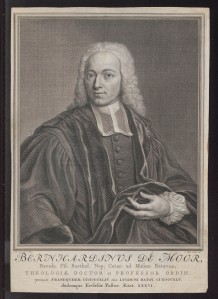
De Moor on Science and Scripture

de-moor-21

One of the reasons history is exciting is that you often find others who have dealt with similar questions to the ones you’re dealing with.  No, they’re not usually identical questions, but they are sometimes similar.  When it comes to these similar questions, it’s also interesting to compare the answers given in history to the answers we come up with today.  Here at Creation Without Compromise we’re especially interested in the questions and answers that have to do with the relationship between science and Scripture.

Today’s venture into history takes us to the late 1700s.  By and large Reformed theology had been devastated by philosophical influences associated with the Enlightenment.  There were only a few holdouts who could be described as confessionally Reformed and orthodox.  One of them was Bernhard De Moor (1709-1780).

After serving for several years as a pastor, De Moor took up a position as professor of theology at the University of Leiden.  In this capacity, De Moor lectured at length on a textbook published by his teacher and friend Johannes à Marck.  These lectures were later published in massive seven-volume set with the catchy title, Commentarius perpetuus in Johannis Marckii Compendium theologiae christianae didactico-elencticum.  De Moor’s book is regarded as the high water-mark of Reformed orthodoxy.  It was a comprehensive overview of Reformed theology as it stood at that time.

Dr. Steven Dilday has taken on the massive task of translating De Moor’s magnum opus into English.  He has been making it freely available online here.  He began in late 2012 and, at this moment, he is currently in chapter 2.  This is obviously going to be a project that stretches over many years!

One of the topics dealt with in chapter 2 has to do with the relationship between science and Scripture.  I would like to briefly survey what De Moor writes on this.  Here we can observe a Reformed theologian from about 200 years ago dealing with questions similar to what we face today.  If you’re interested in reading the English translation of Dr. Dilday for yourself, the topic begins at this blog post.  But I think you will find my summary a little easier reading…

Broadly speaking, De Moor is dealing with Scripture in chapter 2.  In section 21, he begins by noting that the Bible does have a primary subject:  true religion.  The Bible is mainly about “the right manner of coming to know and of worshipping/serving God for the salvation of man as sinner and the glory of God…”  However, Scripture does also speak of other things related to this primary subject.  These other things include natural, historical, and genealogical matters.

 From there, section 22 of chapter 2 deals with the fact that Scripture speaks truly.  De Moor insists that God’s Word speaks truly about all things, including natural things.  This is directly connected to the fact that the One who inspired these writings is the Spirit of Truth.

Here one has to remember that De Moor is commenting or lecturing on a textbook of Johannes à Marck.  De Moor mentions that à Marck points out an alternative hypothesis, namely that “Scripture in natural matters speaks according to the erroneous opinion of the common people.”  The philosopher Baruch Spinoza advocated this position, and so did theologian Christoph Wittich.  De Moor also notes that the English theologian Thomas Burnet took this position in regards to what Scripture says about creation and the Flood.  Just prior to that, he also points out that this was the view of Balthasar Bekker (1634-1698), a Dutch theologian heavily influenced by Cartesian rationalism.

Now I want to pause here for a moment and mention something important about Bekker.  Bekker argued the hypothesis mentioned by De Moor in relation to demons.  Specifically, Bekker taught that the angels (including demons) are not real, but the good angels in Scripture merely speak metaphorically of God’s omnipotence. Bekker also taught the Eve was not tempted by a literal snake in the garden, nor was Christ literally tempted by Satan – it was merely a dream.  At issue was Bekker’s way of interpreting Scripture.  Dutch theologian Wilco Veltkamp has written a dissertation which delves into this.  In a December 2011 article in Nader Bekeken (see here), he explained the connection between the hermeneutics of Bekker and that of theistic evolutionists today.  The connection is a refusal to start with the authority of Scripture and submit to Scripture through to the end of an issue.

Going back to De Moor, this hypothesis gets several points in response, beginning with the observation that its foundation is preconceived human opinion rather than Scripture.  De Moor points that the Bible was inspired in all things by the Spirit of Truth.  Scripture calls God the God of Truth. This hypothesis makes him a liar.  Moreover, God is omniscient and he knows that of which he speaks.  He would also never deceive us or leave us in error.  If this hypothesis were true, De Moor writes, we are at liberty to interpret Scripture as we please and there would no longer be any certainty as to what it actually says.  De Moor quotes Augustine as he insists that none of the canonical writers erred.  He finishes responding to this hypothesis with a reference to article 5 of the Belgic Confession, “We believe without any doubt all things contained” in these canonical writings.

De Moor then adds some nuance to the discussion.  He notes that while the Holy Spirit “never speaks according to the errors of the common people,” he can accurately relate errors made by people.  Further, De Moor acknowledges that Scripture does sometimes speak according to external appearances.  For example, the Greek in Acts 27:27 literally says that the sailors with Paul suspected that some country was “drawing near to them.”  Of course, the land wasn’t approaching the ship, but it is common to speak in that fashion and no one errs in so speaking.

There is one more objection that De Moor addresses – this one also comes from Spinoza.  It’s one that is still trotted out today, albeit in a different form:  Scripture is not designed to teach us concerning natural matters or science.  Instead, the intent of Scripture is to make people obedient.  Today’s version usually refers to faith or salvation rather than obedience.  But certainly we do hear today as well that the Bible is not a “textbook for science” and such things.  How does De Moor respond?  He affirms again the primary purpose of Scripture is to teach true religion.  However, that primary purpose does not exclude subordinate ends such as teaching people the magnificent natural works of God.  One does not rule out the other.  Finally, it would out of place to suppose that the Holy Spirit would use errors to carry out his purposes.  He would never give anything contrary to the truth – it would be out of character for him.

De Moor concludes this section with an intriguing reference to an Order of the States of Holland and West-Friesland, dated September 30, 1656.  This order actually prohibited the interpretation of Scripture by nature, rather than the other way around.  In other words, at one point there was Dutch legislation maintaining that Scripture is to be the lens through which we interpret nature.  De Moor deems this legislation “altogether pious.”

It’s important to remember the era in which De Moor lived – it was the heyday of Enlightenment rationalism.  The Bible was under attack by those who said that it could stand in the face of reasoned scrutiny and scientific developments.  Intelligent people could not take the Bible seriously at face value.  In that milieu, De Moor stood for the absolute authority of the Word of God.  He promoted confidence in the infallible and inerrant Scriptures, also when it came to the relationship between Scripture and science.  He was not a rationalist – no, he was addressing rationalism and doing so on the basis of Scripture.  Those promoting theistic evolution today, especially in Reformed churches, need to ask themselves whether they are carrying on the heritage of theologians like De Moor or betraying it.