Should We Change the Belgic Confession?

There is currently a proposal circulating in our churches regarding article 14 of the Belgic Confession. This proposal, aimed for the floor of Synod 2016, seeks to address theistic evolution by making a change to the opening of article 14. This change will ensure that theistic evolution is officially recognized as unbiblical by our churches. Last week, I addressed those who might instinctively recoil at the thought of changing our beloved Belgic Confession. Can we actually make any substantial changes? As we saw, not only is this permissible in principle (and even necessary at times), but in fact it has happened several times throughout the 454 year history of the Confession, even as recently as 1983. The CanRC Belgic Confession in 2015 is quite different than the Belgic Confession first written in 1561.   I concluded that the question is not “Can the Confession be changed?” The question needs to be: “Should the Confession be changed?” That’s the question I want to address in this post.

A Weighty Argument

One of the weightiest arguments against making the proposed change is that our Three Forms of Unity are already clear on the matter. For example, QA 7 of the Heidelberg Catechism clearly says that Adam and Eve were our first parents. In its current formulation, article 14 of the Confession says that God “created man of dust from the ground.” Some would argue that these statements, especially taken together, settle the matter once and for all. Our current confessions already rule out such notions as Adam and Eve sharing ancestry with primates. Why make a change when our existing Three Forms of Unity are already sufficient?

In ground 4, the proposal acknowledges that, taken in the right way, our existing Three Forms of Unity should rule out any notions of theistic evolution. When the Catechism was first written, we can say with confidence that “first parents” meant what it appears to mean. When the Belgic Confession was first written “dust from the ground,” it meant what Calvin understood: Adam’s “dead body was formed out of the dust of the earth.”[1] Before the moment described in Genesis 2:7, there was absolutely no man-like creature, human or hominid (some kind of biological pre-cursor to man with an evolutionary history). In Genesis 2:7, a creature was formed from literal inanimate dust, God breathed life into his nostrils, and only then he became a living being. For centuries, orthodox Reformed confessors have recognized this as the plain meaning of the first sentence of article 14.

Laying Out the Problem

Yet here we are in 2015 dealing with this problem in our churches. And there is obviously a problem. Let me lay it out. We have a situation where some of us are saying that our confessions clearly rule out theistic evolution: as a Reformed confessor you cannot say that the creature who became Adam came into existence through the meeting of a hominid sperm and a hominid egg, nor can you say that the creature who became Eve was at one point a hominid toddler bouncing on her hominid father’s knee. You cannot say that Adam and Eve, as biological creatures, had parents or grandparents. I reckon that all this is correct and I have made similar assertions.

However, on the other hand, we have Reformed Academic saying things like this (see original source here):

We are all in agreement with all of Scripture and the Reformed confessions, including notably that Adam and Eve were real humans, in a real Eden with real trees (including a real tree of the knowledge of good and evil), and upon a real temptation by the real devil in the form of a real snake, really sinned, so there was a real Fall.

Statements like this are intended to put us all at ease. In essence, they’re saying, “Look, there’s no issue here. We believe the Reformed confessions too. We even believe in a real historical Adam who was the first human being. What’s the problem?”

The problem is outlined in the BC 14 proposal. The problem is that a CanRC scientist involved with Reformed Academic is on public record (see here) as being a supporter of evolution, by which is meant, “biologically, Homo Sapiens evolved through natural processes from ancestral forms in common with primates.”  If he is not a theistic evolutionist (as he claims), why has he never protested his inclusion on this list of “Prominent Christians Who Support Evolution”?  The problem is when another CanRC scientist argues publically that even our Lord Jesus, as a true human being, shared a common ancestry with chimpanzees (see here). The problem is that these scientists are outspoken and influential representatives of this way of thinking. They are regarded as leaders not only in their fields, but in the churches – they have even served as office bearers. The problem is when Reformed Academic and a fair number of others in our churches think that the above-mentioned views are tolerable — their voices can be heard loud and clear on social media.  The problem is further evidenced when the above-mentioned scientists refuse to answer publically five carefully worded questions posed by fellow CanRC scientist Dr. John Byl (see the bottom of this post).  If they’re not theistic evolutionists (or evolutionary creationists, or whatever the nom du jour), why not just give clear answers to these questions and be done with it?  There is obviously a pervasive multi-faceted problem regarding origins and it is not going away. Our church federation is not helped by anyone, especially those in leadership positions, naively pretending that there is little or no problem.  We need to deal with it. The question is: what is the best way to deal with it?

Moving Forward with Eyes Wide Open

First, we need to see that proponents of theistic evolution might readily agree that Adam and Eve are our first parents, as stated in QA 7 of the Catechism. Reformed Academic says that they have zero problem with that – rather, they affirm it wholeheartedly. But we need to ask: what would they mean when they say that? A theistic evolutionist would mean that Adam and Eve were the first Homo sapiens, and that they were endowed with the image of God in some fashion. This endowment supposedly makes them our “first parents” in the sense of being the first humans (the first Homo sapiens), although they are not our first parents in a purely biological sense. This is one way that some associated with Reformed Academic and others can insist that their views fall within the bounds of the Reformed confessions in their current state.

There is also another way. Proponents of theistic evolution might readily agree that man was created from dust, as the Belgic Confession says in article 14. Reformed Academic says that they have no problem with that either. But what do they mean when they affirm what BC 14 says? They could mean that humans are material and descended from lowly origins. They are descended from earlier life-forms (hominids) who may have originally emerged from the dust or dirt of the earth. In other words, to put it technically, the current wording of article 14, “dust from the ground” could still be understood mediately, as if the dust is indeed at the most remote origins of humans, but not the immediate material cause of Adam and Eve. In this way, theistic evolutionists can claim with a straight face that they maintain the Reformed confessions all the while holding something contrary to the teaching of Scripture. Whether we like it or not, even if we insist that what they’re saying is contrary to the true meaning of the Three Forms of Unity, our existing wording is being perceived as leaving this kind of “wiggle room.” That perception accounts for the present confusion in our churches about this matter.

Our situation is somewhat analogous to the situation with the Remonstrants before the Synod of Dort 1618-19. It could have been argued that the Heidelberg Catechism and the Belgic Confession were sufficiently clear to deal with the theology of the Remonstrants. The problem was that Arminius himself maintained that he was being faithful to the Confessions. Roger Nicole writes:

His attitude toward confessional standards was open to question, for a theologian of his caliber must have realized that there was a substantial rift between his views and the system of teaching as well as the express utterances of the Heidelberg Catechism and the Belgic Confession. Nevertheless, he paraded under the flag of allegiance and under the vows of conformity from the time of his ordination to his death. He repeatedly promised not to teach anything from the pulpit or the university chair which might be out of keeping with the standards.[2]

It was eventually recognized that the language of the Catechism and the Confession were often being reinterpreted to suit Remonstrant ends. Clarification was needed – Arminianism had to be clearly ruled out. The confusion was resolved by the Synod of Dort. We see the same confusion happening in our day with those advocating for theistic evolution and its toleration. Arguments and assertions are made that our confessions can be interpreted in such a way as to accommodate theistic evolution. In this present context, we need to have an unambiguously clear statement that theistic evolution is outside the bounds of biblical orthodoxy.

Despite the foregoing, even if the existing wording of our confessions is deemed sufficient, the churches need to know this officially, via some decision of an ecclesiastical assembly. In a discussion at Reformed Academic (see here), Rev. John van Popta made the same point:

I do think, however, that the teaching that Adam and therefore Jesus Christ share ancestry with “primitive parents” is a teaching that the church should examine and decide whether or not it falls within the pale of orthodoxy.

Naturally, given the widespread nature of this false teaching, it would be best to have this examination and decision come from our broadest assembly, namely a general synod. But if our broadest assembly is going to clear up the confusion in any helpful manner at all, it needs to have the matter put on its agenda in an ecclesiastical way. Whatever one might think about the idea of changing article 14, it remains that this proposal would put the matter on the agenda of a synod.  A synod could then decide the best way to deal with it for the good of our federation.

Conclusion

Indeed, the best way to tackle the issue at hand is to make the proposed change to article 14. Doing this has strong historical precedent. It is a proven way to deal with serious doctrinal errors in Reformed churches. Moreover, any other options are not presently realistic or helpful (more on that next time). Whatever we do, as Canadian Reformed Churches, we cannot let this matter rest and allow this false teaching to continue unarrested. The need for a clear message is urgent. To adapt the old adage: all it takes for false teaching to triumph is for faithful men to do nothing. It is high time for faithful men to do something bold to put the brakes on this dangerous and evil error in our midst.

[1] Calvin, Commentary Upon the Book of Genesis (Grand Rapids: Baker, 1979), 112.

[2] Quoted by Louis Praamsma, “The Background of the Arminian Controversy,” in P. Y. De Jong (ed.), Crisis in the Reformed Churches: Essays in Commemoration of the Great Synod of Dort 1618-19 (Grandville: Reformed Fellowship, 2008 reprint), 46.

 

Can We Change the Belgic Confession?

Original Belgic Confession -- not exactly your CanRC BC!
Original 1561 Belgic Confession — not exactly today’s CanRC BC.

There is an overture circulating in the Canadian Reformed Churches which proposes a change to article 14 of the Belgic Confession (you can find it here). The change is intended to address theistic evolution. The hope is that this overture will find its way to the table of General Synod 2016. My purpose in this article is not to defend the overture as such. Instead, I want to tackle the broader question of whether the Belgic Confession may be changed. Upon first reading this overture, some readers will instinctively recoil at the idea. To address that reaction, in this article I will review some of the substantial changes that have already taken place in the 454 year history of the Confession. We’ll briefly consider some of the differences that currently exist between the CanRC edition of the Belgic Confession and the editions used by other Reformed Churches. Finally, we will hear some voices from the past about the possibility or desirability of making changes to our confessions.

Changes Prior to 1944

When the Belgic Confession was first written in 1561 it still needed a lot of refining. The Reformed churches of the Low Countries had put much effort into producing their confession, but the atmosphere of persecution meant that initial collaboration was minimal. The original format of the Confession was rough and in need of some editorial work. A synod was held in Antwerp in 1566. This synod made many changes to the Belgic Confession. Some of the changes were merely editorial – the synod pared down some of the original wordiness of the Confession and also deleted at least one witty remark from Guido de Brès.[1] But there were also several substantial changes made.

For example, Synod Antwerp 1566 revised article 5 to add a third function of Scripture: “confirming of our faith.” “Proceeding from the Father and the Son” was added to article 8. In article 16, the statement “the fall into which they had fallen” was replaced with “the fall into which they had thrown themselves.” Article 36 saw many changes at this Synod and one of the most substantial was the addition of an explicit renunciation of the Anabaptists.[2]

For the next 53 years, the text of the Confession remained relatively static. However, with the Synod of Dort of 1618-19 we again see some substantial changes. We often associate the Synod of Dort only with the Canons of Dort. The reality is that this Synod also made some significant changes to the Belgic Confession.

As a result of objections made by the Arminians, changes were made to many of the articles, many either cosmetic in nature or related to formulations.[3] However, there were also more weighty changes. For example, the attribute “almighty” was added to article 1. God’s preservation was added to article 2, as were the words “more clearly and fully.” One of the most significant revisions was made in article 22 in response to a theological controversy over the imputation of the active obedience of Christ. In Reformed orthodoxy, we believe that when Jesus Christ was obedient to God’s law when he lived on this earth, he did it in our place. His obedience is credited to our accounts before God. The German theologian Johannes Piscator had denied this. His teaching on this point had already been condemned and ruled unorthodox by the French Reformed churches and the English. The Synod of Dort followed suit by adding these words (in bold ) to article 22, “…and as many holy works as he has done for us and in our place.”[4] This change made it clear that the imputation of the active obedience of Christ was (and is) the doctrine of the Reformed churches. One is not permitted to deny this doctrine.

Finally, we should note a substantial change made in more recent times. At the Synod of Utrecht 1905, a group of theologians (including Abraham Kuyper) proposed a change to article 36 so that this article would better conform to biblical teaching about the civil government. As a result, these words were deleted: “all idolatry and false worship may be removed and prevented, the kingdom of antichrist may be destroyed.” Since then these words have often been relegated to a footnote in most editions of the Belgic Confession, including ours.

CanRC Changes

At Synod 1983, a new English edition of the Belgic Confession was adopted by the Canadian Reformed Churches. This edition featured many departures from previous editions. As in previous times, some of the changes were merely cosmetic, fixing up the wording here, or a formulation there. However, there were also several changes made that were more substantial. In fact, Synod 1983 considered these changes to be of such a weight that “the churches abroad” should be informed. Let’s briefly note just three of those changes.

In article 1, the words “which we call God” were deleted since it was felt that we do not call him “God” on our own initiative. Paul was no longer to be recognized as the author of Hebrews in article 4 and the book of Lamentations in that same article was to be mentioned as a separate book (previously it was included as part of Jeremiah). Article 9 saw several changes, including “always been maintained in” becoming “always been maintained and preserved.”

As a result of Synod 1983, the Canadian Reformed Churches have a faithful and elegant rendition of the Belgic Confession, but one that differs substantially in several places from editions used in other churches.

Other Reformed Changes

Our churches are not the only ones who have made changes to the Belgic Confession over the years. There are several significant differences that exist in the editions of the Belgic Confession held by our sister churches and others.   Let me give two examples.

The first is with what the RCUS did with article 15. Our edition says regarding original sin: “It is not abolished nor eradicated even by baptism, for sin continually streams forth like water welling up from this woeful source.” However, the edition of the RCUS says (bold added): “Nor is it altogether abolished or wholly eradicated even by regeneration; since sin always issues forth from this woeful source, as water from a fountain…” “Baptism” has been replaced by “regeneration.” It is not immediately clear why this change was made. The change has no basis in the original 1561 text, in the French or Dutch texts adopted by the Synod of Dort, or in the Latin text commissioned by Dort.

The second example is found not only with the RCUS, but also with the URCNA, FRCNA and others. In article 29, our CanRC edition reads regarding the true church, “It practices the pure preaching of the gospel…” Most other English editions read (bold added), “If the pure doctrine of the gospel is preached therein…” The word “therein” did not appear in the original Belgic Confession of 1561. It also never appears in any subsequent French, Dutch, or Latin editions. “Therein” seems appear out of thin air in the English edition adopted by the Reformed Dutch Church in the United States of America (now known as the Reformed Church of America) in 1792. It has remained with most English versions ever since.[5] Why or how it was originally added is unclear. What is clear is that this word became a substantial issue later on in debates about the missionary relevance of the Belgic Confession in the Christian Reformed Church.[6] Some argued that this word gives the impression that the preaching of the gospel is only meant for inside the church.

Our Forefathers

What have those who have gone before us said about this matter of changing the confessions? Above we already noted Dr. Abraham Kuyper’s involvement in making a substantial change to article 36. From his involvement in that endeavour, we can draw the conclusion that he was not averse to making changes he thought were necessary. However, Kuyper is often portrayed as a villain in our tellings of church history, so perhaps some would not be so impressed with his take on this. Then let’s turn to one often portrayed as a hero in our tellings of church history: Dr. Klaas Schilder. He said, “Every confession is capable of being revised. Of course, not every three years. It is a sign of impotence that we are still unable to do that. We have clung too much to traditions and had too little opportunity for study.”[7] For Schilder too, revision of the Confession, whether by addition or subtraction, could not be automatically ruled out. In fact, remarkably, he described the inability to do it as impotence.

As for Canadian Reformed theologians, we could turn to the late Dr. Jelle Faber. Dr. Faber was a student of Schilder and perhaps had learned something from him on this. In a 1979 Clarion article, Faber discussed article 36 of the Confession. He concluded (bold added), “Let us not return to 1561; let us also not undo the decision of 1905 – as some of our Dutch brothers propose – but let us rewrite the entire third passage of Article 36 of our Belgic Confession.”[8] Some twenty years later, Faber was speaking along similar lines: “The Canadian Reformed Churches have modernized the English text and in the course of this process they have even made some changes in the content of the confessions.”[9] Of course Faber would say this – he was personally involved with making all of those changes. He was on the committee that produced the revised Belgic Confession for Synod 1983. Therefore, we can conclude that also the esteemed Dr. Faber was not opposed in principle or practice to making changes to the Belgic Confession.

Conclusion

The case is solid that Reformed churches and theologians have never regarded the Belgic Confession to be an historical document that may never be changed. In fact, many changes have been made for several reasons, including as a response to serious doctrinal error. The Confession has never been a static document. What we call the Belgic Confession in our Book of Praise is not exactly the Belgic Confession that was written by Guido de Brès in 1561. It is not even a translation of the 1561 Confession – rather, it is what we call an edition. Like it or not, the fact is that we already have a Canadian Reformed edition of the Belgic Confession.

Moreover, we have sister churches who have their own different editions of the Confession. They have either made their own changes or not followed the changes we made. This has never proven to be any difficulty in our relationship with these churches – we can be confident that changing article 14 would not break this pattern. In fact, given the strong stand of some of our sister churches (RCUS and URCNA) on the issue of origins, we might expect that this proposed change would rather be encouraged and welcomed. At Classis Ontario West of March 11, 2015, fraternal delegates from the OPC, URCNA, and RCUS actually encouraged our churches to take this kind of action against the doctrinal error we’re facing.

We have always said that only the Word of God is infallible, inerrant, and unchangeable. In principle, we have always maintained that the confessions are man-made documents bearing ecclesiastical authority. The confessions of the church need to reflect the teaching of the Word of God in ways that are relevant to the life of the church today. If there is an obvious need to make a change, the change can and must be made.

So the question is not: can we make any changes to the Belgic Confession? History is full of instances where changes have been made, both by ourselves and others. History provides instances where our theologians have argued for changes. The question really becomes: is a particular issue of such weight and significance that a change should or even must be made to the Confession? That is the question our churches need to be considering today as they discuss this particular proposal.


[1] In article 34 on baptism, de Brès wrote of how it profits us not just once, but through our whole life. The original Belgic Confession added, “otherwise we would always need to have our heads in the water.”

[2] For documentation of all these changes and more, see Nicolaas H. Gootjes, The Belgic Confession: Its History and Sources (Grand Rapids: Baker Academic, 2007), 122-131.

[3] Gootjes, The Belgic Confession, 153-158.

[4] Gootjes, The Belgic Confession, 151-152.

[5] For some discussion of this change, see Wes Bredenhof, To Win Our Neighbors for Christ: the Missiology of the Three Forms of Unity (Grand Rapids: Reformation Heritage Books, 2015), 26-28.

[6] Wes Bredenhof, For the Cause of the Son of God: The Missionary Significance of the Belgic Confession (Fellsmere: Reformation Media & Press, 2011), 238.

[7] Quoted by J. Douma, The Ten Commandments: Manual for the Christian Life (Phillipsburg: P & R, 1996), 69.

[8] J. Faber, “The Civil Government in Article 36 B.C.,” Clarion 28.24 (December 1, 1979): 512.

[9] J. Faber, “The Confessional History of the Canadian Reformed Churches,” Clarion 48.4 (February 19, 1999): 80.

A Retracted Statement?

A proposal is going to Regional Synod East in November which puts forward a change to article 14 of the Belgic Confession. This proposal is designed to clear up the confusion that currently exists in the Canadian Reformed Churches regarding origins. We have those who claim that the Three Forms of Unity in their existing state rule out any notion of human evolutionary origins. On the other hand, we have Reformed Academic asserting, and I quote, “Theistic evolution is not outside the boundaries of the Three Forms of Unity.” There are a fair number who agree with Reformed Academic. Who is right? Our churches urgently need clarity on this question.

The proposal quotes from two outspoken scientists in our churches. They are quoted partly as representatives of the view that theistic evolution should be tolerated – after all, they are founding editors of Reformed Academic, men who stand behind the quote above. One of those scientists is Dr. Jitse Van der Meer. He proceeds beyond the view that theistic evolution should be tolerated. He is quoted in the proposal as writing, among other things, the following:

Fourthly, there is the irreversible hierarchical structure of the classification of living things. If animals living today would have been created by fiat creation rather than by evolutionary creation, there would have been no hierarchical branching pattern unless the Creator would have wanted those who investigate such matters to believe there had been a history which never actually occurred. Since the Creator does not deceive us I am led to the conclusion that He created animals by means of an evolutionary process thereby giving us a real evolutionary history.

Dr. Van der Meer made this statement in a public online discussion with one of the Providence office bearers. You can find the original context here at Reformed Academic – the quotation can be found in the comments of Dr. Van der Meer on January 2.

The use of this quote in the proposal has been disputed. In this blog post, Rev. Bill DeJong alleges that this statement was retracted. Moreover, he claims (under point 9), that this retraction was done publically and the drafters of the proposal completely ignored this. Of course, this calls into question the integrity of the drafters and the credibility of the proposal. Regrettably, others have echoed these claims. These claims therefore deserve some further investigation.

I have searched on Reformed Academic for Dr. Van der Meer’s public retraction of this statement made in response to Providence deacon Herman van Barneveld. I have not been able to find it. Dr. Van der Meer did not retract this statement in the following comments under that blog post, nor did he issue a retraction of that statement in any subsequent blog post on Reformed Academic. One would think that this blog would be the natural place to issue such a public retraction. Moreover, if it was publically retracted, why is the statement still out there on the blog as if it continues to be Dr. Van der Meer’s position? It’s still there, still sowing confusion. If I had made a statement and later learned that I was in error, I would want to make an effort to correct my error. If it was a public error, I would want to make the correction publically and remove the error.

Readers should notice that Rev. DeJong and others have supplied no reference to support their claim. I want to ask Rev. DeJong: where, exactly, did Dr. Van der Meer publically retract that statement made in the context of his response to Herman van Barneveld? Rev. DeJong needs to provide the evidence to support his claim. And then a follow-up question: if Dr. Van der Meer perhaps retracted a similar statement used in a different context, where did he retract that and exactly why? Did he perhaps change his mind? Or was it merely a matter of proof-reading/editing with no real change in his position?

Now I know that my colleague Rev. DeJong wants to promote justice and truth – and I respect him for that. However, these same virtues also behoove him to share with his readers the whole story behind this “retraction.”  Once the entire body of evidence is considered in context, I believe it will be clear that the drafters and adopters of this proposal acted honestly and with the integrity expected of office bearers in Christ’s church.

Adam in the New Testament (review) — Rev. Peter Holtvlüwer

Versteeg_Adam.indd

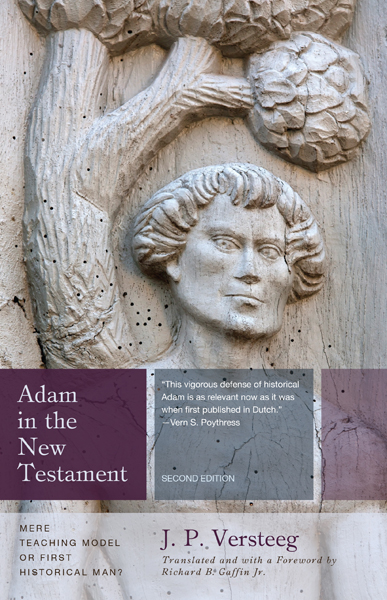
Today we are pleased to present a review of an important little book first published in Dutch several decades ago.  According to Dr. Vern Poythress, “This vigorous defense of historical Adam is as relevant now as it was when first published in Dutch.”  We couldn’t agree more.  This review by CanRC pastor Rev. Peter Holtvlüwer (Spring Creek CanRC, ON) was first published in Clarion and is republished here with permission.

***************************

Adam in the New Testament: Mere Teaching Model or First Historical Man? by J.P. Versteeg. Translated by Richard B. Gaffin Jr. (Phillipsburg, NJ: P & R Publishing, 2012). First edition 1978. Apprx. $12 from your local Christian book seller.

This is a great book for evangelical and especially Reformed scientists, scholars, teachers and ministers – let me tell you why.

Pressure from Science

Under the pressure of scientific discovery and evolutionary theory, more Reformed scholars and scientists are feeling the academic heat to drop the long-held Christian conviction that the human race began with one man, Adam, as Genesis 1-3 relates. Websites like Biologos (whose authors describe themselves as “evangelical Christians”) openly accept evolution of humans from earlier life forms and consequently think that, at best, Adam and Eve were one pair of humans along the way.

PCA ruling elder and Old Testament scholar Dr. Peter Enns is a leading figure calling for also Reformed Christians to reject the Genesis account of Adam as historical, insisting that God did not intend it to literally describe human origins. For those of us working in a secular scientific or academic environment, such a call is tempting. Why stand against much of what our colleagues believe to be true if we really don’t need to?

But that call is shown by this book to be the Siren calling from the rocks, leading ultimately to the sinking of our faith. This little gem of a book (it’s only 67 pages) speaks as freshly and incisively to the subject as it first did in 1978. Translator Richard B. Gaffin, OPC minister and retired professor of Westminster Theological Seminary, has helped the Reformed and evangelical communities by making this essay of Rev. J.P. Versteeg widely available once again. Rev. Versteeg served as New Testament Professor at the Theological University of the Christelijke Gereformeerde Kerken in Nederland (in Apeldoorn) (sister churches to the Free Reformed Churches of North America). In it he demonstrates that at stake in Adam’s historicity is nothing less than the gospel itself.

Adam a Historical Person?

The beauty of this book is that Versteeg moves the controversy concerning the historicity of Adam away from the immediate context of Genesis 1-3 and looks at it from the perspective of the New Testament. This has the advantage of getting away from the scientific controversies surrounding the origins of the world and of mankind and concentrating instead on what Christ and the Apostles believed and taught about Adam. Since the Bible is its own best interpreter, this approach is surely worthwhile and can be a corrective should current scientific theory press a person to take a wrong turn in Genesis 1-3.

Versteeg’s essay was, naturally, written in his context – the Netherlands in the mid-1970s. But he addresses a teaching then prevalent which is resurfacing in our time on this side of the ocean, namely that Adam was used by the New Testament writers as a sort of “teaching model.” This view teaches that for Paul and the other NT authors, Adam is no more than a pedagogical example to explain some truth about Christ and Christianity. The authors did not assume or need to believe that Adam was a real man, the first man, created in the literal manner described in Genesis 1 and 2. In a careful, judicious and highly readable manner, Versteeg challenges and refutes that claim as he exegetes each passage in the NT where Adam is mentioned by name.

Gaffin on Peter Enns

Another valuable contribution this book makes is Gaffin’s introductory essay in which he outlines the present-day controversy. This helps a reader to get a feel for the various arguments being made today. Gaffin uses the writings of Peter Enns as an example, providing quotations and footnotes and evaluating his writings fairly but firmly. He draws out the dangerous consequences of Enns’ views. It takes courage to publicly address a former colleague (both were professors at Westminster Theological Seminary) on his erroneous teaching (which is also done publicly) but how necessary it is to preserve the church from error! We may thank the Lord for the courage and clarity which Dr. Gaffin has been given and now presents to us in his essay. This essay alone is easily worth the price of the book.

Though others will benefit from this book, I would especially urge every minister, teacher, academic, scholar and scientist in Reformed or evangelical circles to read this book. It may confirm you in the ancient teaching of the church and the historic Reformed conviction concerning Adam or it may gently correct your thinking on the topic. It will certainly educate you on the finer points of exegeting what the Bible itself says about Adam. I hope it will help you withstand pressures to set aside the clear teaching of Scripture in favour of man’s scientific theory. Whatever the case, it definitely won’t leave you unaffected. Edifying and recommended!

Response to Dr. J. Visscher

Our purpose at Creation Without Compromise is to provide Reformed church members with resources to defend and promote the biblical teaching on origins.  We also aim to provide tools to office bearers to fulfill their subscription vows.  In that light, the CWC team is convinced that the proposal to add some words to article 14 of the Belgic Confession is worthy of careful consideration by all Canadian Reformed office bearers.  This is why you can find the proposal on our website.  The issues need to be studied and weighed carefully.  Objections have been expressed against this proposal.  Most recently, Clarion (June 5, 2015) featured an editorial by Dr. J. Visscher expressing his disagreement with the proposal.  To assist our readers in making a responsible judgment, over the next while we will post several articles related to the proposal.  We begin today with a response to Dr. Visscher.

****************************

I would like to thank Dr. James Visscher for his response to the proposal to make a change to article 14 of the Belgic Confession. This provides an opportunity to address both his concerns and similar ones that have recently been expressed by others. Since most of his concerns are actually dealt with in the proposal itself and its supporting appendices, I will try to be succinct.

There is first an apparent ethical issue: names are named without any apparent due process. In response, the proposal is not about these individuals as such – indeed, they are only mentioned in the first ground of ten to prove that a certain problematic way of thinking exists in our churches. The individuals mentioned have publically written myriads of words. They are outspoken representatives of a way of thinking that either holds theistic evolution as credible, or at least wants to leave room for theistic evolution in our churches. If one pays attention to social media, one soon hears a fair number of these voices in our churches. Moreover, those involved with drafting and adopting this proposal have in fact at various times and places interacted with these brothers. To suggest that anyone has been condemned “rashly and unheard” is hardly, if at all, credible.

Dr. Visscher further notes that one of those mentioned in the proposal has publically claimed that he is not a “theistic evolutionist.” Why did he then allow his name to be included and remain on an online list of evangelical Christians who believe that evolution is true? Readers should further remember that, to his dying day, Jacob Arminius claimed to be faithful to the Belgic Confession and Heidelberg Catechism. More to the point, in the 1990s in the CRC, Dr. Howard Van Till also claimed that he was not a theistic evolutionist.

Finally under the heading of ethical concerns, Dr. Visscher mentions a case brought before a Regional Synod East. This discipline matter was dealt with in closed session and I fail to see how it can be discussed publically without the consent of all parties involved. What if one of the parties plans to appeal to General Synod? Moreover, if we are going to publically comment on decisions made in closed session by a Regional Synod, why not go all the way and actually share with readers the full text of the decision? As it stands, readers are only hearing one side of the story (see Prov. 18:13 & 17).

Dr. Visscher’s next set of concerns are about whether doctrinal issues should be addressed by a change to the Confession. He disagrees with the proposal’s approach. In response, I would ask Dr. Visscher how serious and widespread a theological error would have to be before the church federation rises to some kind of action and then, what action should she take? Dr. Visscher is long on critique and short on a constructive alternative. Moreover, in ground 2, the proposal proves that the error being addressed is not only unbiblical, but also an attack on the very gospel itself. As is documented in Appendix 3, the Reformed churches have in the past responded to these types of grave challenges with confessional additions (the Canons of Dort) or amendments (Belgic Confession art. 22). There are precedents. Finally, Dr. Visscher anecdotally mentions some of his professors who warned against “tampering” with the confessions. Again, I would direct readers to Appendix 3 for published quotes to the contrary from some of our theological forefathers, including Dr. J. Faber and Dr. K. Schilder. These men committed themselves in writing to the very opposite view that Dr. Visscher mentions. Why doesn’t he interact with this material?

Then there is “the textual issue.” Dr. Visscher feels that the existing confessions address the problem of theistic evolution quite adequately. This is precisely the point at issue. Reformed Academic asserts, and I quote, “Theistic evolution is not outside the bounds of the Three Forms of Unity.” Dr. Visscher and others say that it is; Reformed Academic claims that it isn’t and they have others who agree with them. Who is right? This is the question this proposal has been drafted to answer as it (hopefully) is discussed at General Synod 2016.

The last issue Dr. Visscher raises is about our sister-church relationships, especially those with whom we share the Belgic Confession. It should first be noted that the Canadian Reformed Churches already have their own unique edition of the Confession – again, readers should refer to Appendix 3 for the evidence. The Belgic Confession we have in our Book of Praise is not the Belgic Confession as originally written by Guido de Brès in 1561, nor is it the exact Confession of, say, the RCUS or URC. This has never been an issue. Moreover, at Classis Ontario West of March 11, 2015 there were fraternal delegates from the OPC, URC, and RCUS present as this proposal was discussed. They contributed to the discussion and all encouraged us to proceed in this direction. Contrary to the belief of Dr. Visscher (and others who share his opinion), we should expect that our faithful sister churches would be more concerned about our tolerating theistic evolution than about us making a change to the Belgic Confession to address theistic evolution. They would be far more concerned about us taking no action than taking this action. Finally, the proposal does leave the door open for Synod to decide that this is a substantial change (requiring discussion with sister churches) rather than a clarification (see Process, point 5).

Reactions like that of my colleague give the impression of being conservative. However, this type of reaction will end up sacrificing biblical orthodoxy on the altar of maintaining a human document as an immutable historical artifact. This is a “conservatism” that does not serve the ongoing defence and maintenance of biblical truth. Our confessions need to be living documents, expressing the biblical faith of the church and also, where necessary, responding to the most egregious errors of our day.

In conclusion, I urge readers to study the proposal for themselves — you can find it by clicking here. Also, please study carefully the three appendices (find them here) – these contain important supporting material. All of this is available online right here at creationwithoutcompromise.com