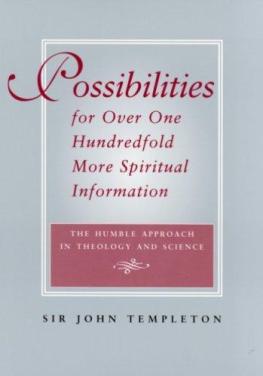
“The Humble Approach”

9781890151331-usPossibilities For Over One Hundredfold More Spiritual Information: The Humble Approach in Theology and Science. Sir John Templeton. Templeton Foundation Press. Philadelphia and London. 2000.

Sir John Marks Templeton (1912-2008) is best known as the creator of the Templeton Growth Fund, an investment fund established in 1954, which made him a very wealthy man. Two years before his death in 2008, Templeton, who was born in Tennessee and later became a British citizen, found himself in 129th place on the Sunday Times‘ “Rich List.” But Templeton was not only an investor and a money-maker; he was also well-known as a philanthropist, through the work of his charitable organization, the Templeton Foundation. Established in 1987, the Templeton Foundation offers over seventy million dollars’ worth of research grants each year. The Foundation is currently headed by Templeton’s daughter, Heather Templeton Dill, and it is an important source of funding for a number of individuals and organizations, including the BioLogos Foundation and the Canadian Scientific and Christian Affiliation.

One of the Templeton Foundation’s purposes is to advance what Templeton called “Humility-In-Theology” – “helping spiritual information to multiply over 100 fold about every two centuries, especially by encouraging people of all religions to become enthusiastic (rather than resistant) to new additional spiritual information, especially through science research, to supplement the wonderful ancient scriptures” (Templeton, 180).

“Humility” was an important word for Sir John Templeton, as can be seen from the title of this book, as well as throughout its pages. Templeton’s philosophy of humility, and the way it shaped his thinking and his philanthropically efforts, is central to his thinking. For example, Templeton writes, “Although we seem to be the most sophisticated species at present on our planet, perhaps we should not think of our place as the end of cosmogenesis.” We must resist the pride that might tempt us to think that we are creation’s final goal, and seek to become “servants of creation or even helpers in divine creativity.” We may be “a new beginning, the first creatures in the history of life on earth to participate consciously in the ongoing creative process” (p. 41).

Templeton argues that theologians need to be “humble and open-minded,” and that most of the world’s religions exhibit a “tendency for dogma or hierarchy to stifle progress.” Humility should lead religious leaders to “re-form dogma in a more open-minded and inquiring way as a beginning point for continual improvements” (p. 41). Templeton claims not to want to quarrel with any theologian, and that we must “happily admit” that a particular theologian may be right. “But,” he writes, “let us listen most carefully to any theologian who is humble enough to admit also that he may be wrong – or at least that the door to great insights by others is not closed” (p. 50).

The great problem, for Templeton, is egotism, which has led to many mistaken ideas throughout history – including the notions that the stars and the sun revolve around mankind, and that humanity is as old as the universe. “Egotism is still our worst enemy… Only by being humble can we learn more,” Templeton writes (p. 59).

So where did this understanding of “humility” lead Sir John Templeton? Sadly, it led him to practically reject the Bible as the completed Word of God, his perfect self-revelation. The Bible, which Templeton includes as simply one of the  “ancient scriptures” of all the world’s religions, was written in a different context than today. We now know that the universe is much larger, much older, and far more complex than the ancients believed. And so we are confronted with a challenge: “to enrich understanding and appreciation for the old with a welcoming of concepts and perspectives which may represent truly new insights and creative improvements, which can leverage the power of the past into a forward-looking adventure of learning more and more about the wonders of god and his purposes through ongoing creativity.” Since our understanding of the universe has been “vastly enlarged,” we should no longer be limited in our expression of spiritual truths to “obsolete words, limited concepts, and ancient thought patterns.” The tremendous development in human understanding, Templeton writes, allow us a “fuller and wider interpretation of divine revelation today” (p. 47-48).

Ideas have consequences. While Templeton was an elder in a Presbyterian congregation (Presbyterian Church – USA), and even sat on the Board of Princeton Theological Seminary, he did not “limit” himself to the doctrines of orthodox Christianity. His “humble approach” led him to declare, “I have no quarrel with what I learned in the Presbyterian Church. I am still an enthusiastic Christian,” and then to ask, “But why shouldn’t I try to learn more? Why shouldn’t I go to Hindu services? Why shouldn’t I go to Muslim services? If you are not egotistical, you will welcome the opportunity to learn more” (http://www.christianitytoday.com/ct/2008/julyweb-only/128-31.0.html). The sad fact is, however much one claims to be “an enthusiastic Christian,” believing that the teachings of religions that deny Christ can be positively appropriated by a Christian makes one, for all intents and purposes, anything but.

And this unfortunate truth is also clearly revealed in Templeton’s book. While Templeton denied being a pantheist (one who believes that the universe is God, and God is the universe), his understanding of the nature of God can only be described as a form of panentheism, which declares that God and the universe are distinct, but that the world is “in” God. Traditional pantheism serves a useful purpose, in Templeton’s mind, but he admits that it is incompatible with the Christian understanding of God. And so he turns to the teaching of the Unity School of Christianity for his conception of God: “God is also me: and I am a little part of him.” As little parts of God, “we may realize the mutual unity of god and his creation. We may conceive that our own divinity may arise from something more profound than merely being ‘god’s children’ or being ‘made in his image'” (p. 86; note that the use of the word “god” as written is in the original).

At this point, it must be said that, for all his self-proclaimed “humility,” Templeton’s foundational beliefs are, in Christian perspective, anything but humble; they are, in fact, blasphemous. True humility is expressed in Psalm 8:

“O LORD, our Lord, how majestic is your name in all the earth! You have set your glory above the heavens… When I look at your heavens, the work of your fingers, the moon and the stars, which you have set in place, what is man, that you are mindful of him, and the son of man that you care for him?” (Ps. 8:1,3, ESV).

True humility is expressed in humble submission to the LORD, the Creator, who has revealed himself clearly and completely in his Word – those “ancient Scriptures” which we humans have not outgrown, or surpassed, with all of our scientific understanding.

True humility is acknowledging our origins as the direct creation of God, acknowledging the reality of the Fall into sin, and its enduring impact on humanity and all of creation, God’s provision of a Way of salvation, and the fact that we can do nothing in ourselves to merit that salvation. We are created in God’s image. That image has been badly marred by sin. But in Christ, that image is being restored among God’s people.

True humility is submitting ourselves to Jesus Christ, who declared that he, and only he, is the Way, the Truth, and the Life.

Templeton’s “humility” is, at bottom, and however unwittingly, the height of human arrogance and pride in disguise. In refusing to submit to God’s perfect Word, Templeton set a man on the throne in God’s place. And now, through the work of his Foundation, Templeton’s utopian vision for human society, based in anything but the Word of God, is continuing to be spread.

Templeton foresaw a “glorious” future, and thanks to his great financial savvy, his legacy lives on. His Foundation has three billion dollars in its reserve fund, and that money is being spent to promote that legacy, with a very definite, and very long-term, goal in mind. Templeton’s vision of the future is summed up in two citations in his book. He first cites Marceline Bradford:

“…Millions of intellectuals the world over have become disenchanted with backward-looking religious institutions… In order to recapture the great thinking minds of the world, the clergy must turn their heads 180 degrees from past to future. With feet planted squarely in the present and eyes directed to the future, leaders can find factual bases in science for viable, solid, dynamic doctrines. For science and rationality are enemies not of religion – only of dogmatism” (Templeton, p. 47).

Next, he cites Ralph Wendell Burhoe, who was awarded the Templeton Prize in 1980:

“…At several points in the next few years and decades the traditional theological and religious communities will find the scientific revelations a gold mine, and… by early in the third millennium A.D. a fantastic revitalization and universalization of religion will sweep the world. The ecumenical power will come from a universalized and credible theology and related religious practices, not from the politics of dying institutions seeking strength in pooling their weaknesses. I cannot imagine a more important bonanza for theologians and the future of religion than the information lode revealed by the scientific community… It provides us with a clear connection between human values, including our highest religious values, and the cosmic scheme of things. My prophecy, then, is that God talk… will in the next century increasingly be fostered by the scientific community” (Templeton, 103).

In the conclusion of his book, Templeton lists a number of the “founder’s favourite charities,” which also provides real insight into Templeton’s agenda. They include the promotion of education about free competition, entrepreneurship, and the enhancement of individual freedom and free markets; supporting research and publications in genetics; supporting education and other help in voluntary family planning; supporting character development research, and also:

“Supporting the publication and dissemination throughout the world of the religious teachings of the Unity School of Christianity… and of closely similar organizations, provided that major support for such organizations shall continue only so long as the Trustees of the Foundation… determine that such organizations adhere to the concepts of (i) usually pioneering in religion and theology with little restrictive creed, (ii) usually teaching that god may be all of reality and man only a tiny part of god and (iii) generally accentuating the positive ideas and attitudes and avoiding the negative” (Templeton, 183).

Such were the goals of Sir John Marks Templeton, and such are the goals of his foundation. A serious examination of Templeton’s guiding philosophy, and the philosophy of the Templeton Foundation, in the light of Scriptural principles, should lead us to a sense of genuine concern about any organization that the Foundation chooses to support financially, to question the ultimate motivation behind this support, and the fruits that this foundation is bearing in the numerous organizations that receive its funding. “The Humble Approach” of Sir John Marks Templeton has absolutely nothing in common with the genuinely humble approach of the Lord Jesus Christ. His utopian vision has nothing in common with the eschatological vision of God’s Word.

My concluding thought is this: those who receive large amounts of financial support from the Templeton Foundation may do so “with no strings attached,” and perhaps some recipients may be unaware of the totality of the Foundation’s founder’s spiritual vision. But could it be that they are unwitting victims of a larger, and more nefarious, agenda, which has at its base a desire to proclaim a different gospel, by denying the explicit teachings of the Lord Jesus Christ and his exclusive claims?

Operational vs. historical science

Evolution is just a theory.
Then again, so is gravity.
– as seen on a t-shirt.

Is the theory of evolution like the theory of gravity? How are they different? This is just one of the topics that professors John Byl and Tom Goss cover in their book, How Should Christians Approach Origins? In this excerpt they note that there are two very different sorts of science happening here.

*****

It is sometimes argued that it is inconsistent to use modern medicine and technology originswhile rejecting evolution, since both are products of mainstream science. However, we must be careful to distinguish between two types of science: operational science and historical science.


  1. OPERATIONAL SCIENCE is the experimental science done in the lab or in the field. It investigates repeatable events in the present. This concerns most of physics, chemistry, and biology, as well as observational geology, astronomy, and the like. It gives us all the science needed for technology, such as in developing smartphones, satellites, cars, planes, cures for diseases, and so on. It studies the present material reality and how it normally functions.
  2. HISTORICAL SCIENCE, on the other hand, is concerned with extrapolating from present observations to the distant, unobserved, and unrepeatable past. This includes various theories and explanations in archaeology, cosmology, historical geology, paleontology, biological evolutionary development, and so on.

These two types of science differ significantly:

  1. Operational science aims to discover the universal laws by which nature generally operates, whereas historical science aims to establish ancient conditions or past causes. Operational science explains present events by reference to general laws, whereas historical science explains present events in terms of presumed past events.
  2. Operational science calculates forward, deducing effects from causes, whereas historical science calculates backwards, inferring past causes from present clues. One problem here is that more than one possible historical cause can give rise to the same effect. For example, in a murder trial, the prosecution and defense may present very different historical scenarios to explain the material evidence.
  3. Operational science assumes methodological naturalism. Since it is concerned with what normally happens, in the absence of miracles, it is reasonable to consider only natural causes. Historical science, on the other hand, seeks to find what actually happened in the past. Constraining ourselves to natural causes amounts to metaphysical naturalism – the further assumption that no miracles have in fact happened in the past.¹

The well-known evolutionist Ernst Mayr acknowledged,

Evolutionary biology, in contrast with physics and chemistry, is a historical science – the evolutionist attempts to explain events and processes that have already taken place. Laws and experiments are inappropriate techniques for the explication of such events and processes. Instead one constructs a historical narrative, consisting of a tentative reconstruction of the particular scenario that led to the events one is trying to explain.²

In short, the scientific know-how needed to make smartphones is much better established than, say, the claim that humans evolved from [some chimp-like creature].

End notes
¹ Stephen Meyer, Signature in the Cell (New York: NY, HarperCollins, 2009), 150–172.
² Ernst Mayr, “Darwin’s Influence on Modern Thought.” Scientific American, November 24, 2009 (http://www.scientificamerican.com/article/darwins-influence-on-modern-thought/).

This excerpt reprint with permission. How Should Christians Approach Origins? can be purchased at Amazon.ca. Inquiries about bulk pricing can be directed to Tom Goss at tgoss@rogers.com

Brief Review: Evolution’s Achilles’ Heels

eahEvolution’s Achilles’ Heels
Creation Book Publishers, 2014
Edited by Robert Carter
Price $18.00

Several months ago, Jon Dykstra reviewed the documentary that was developed in conjunction with the book Evolution’s Achilles’ Heels. I recently had the opportunity to attend a presentation by Richard Fangrad, CEO of Creation Ministries International’s Canadian branch. There was a book table at the event (which is always a draw for me), and this was one of many very worthwhile resources on offer. In his review, Jon gave the documentary a 10/10 rating, and I can only concur that the book is every bit as valuable in its own way as the documentary is.

There are eight “fatal flaws” to the theory of evolution that are addressed in depth by nine Ph.D. Scientists, including Dr. Jonathan Sarfati, Dr. Emil Silvestru, and others. As in the documentary video, the flaws dealt with are:

  • Natural selection
  • Genetics and DNA
  • The origin of life
  • The fossil record
  • The geologic record
  • Radiometric dating
  • Cosmology
  • Ethics and morality

In his foreword, Dr. Carl Wieland reminds us that the issue of origins is predicated on interpretation of the available evidence, and not on the evidence itself. His insights on this issue are important and worth citing:

“This whole controversy, incidentally, has never been about unearthing ‘facts for creation’ vs ‘facts for evolution’. When it comes to matters of history (as opposed to experimental or operational science, the science that concerns itself with how the world works), the issue has never been the facts so much as their interpretation. We all have the same world – the same ‘facts’… And philosophers of science have long reminded us… that raw, uninterpreted facts never speak for themselves. As the late Harvard professor, Stephen Jay Gould, once wrote, ‘Facts do not “speak for themselves”;  they are read in the light of theory.’”

The nine scientists who contributed to this book begin with the following presuppositional framework, in the words of Dr. Wieland: “the straightforward truth of the Bible, in particular the Genesis record, affirmed and taught by the Lord Jesus Christ and authenticated by His rising from the dead.” This starting point, even more than the PhD’s piled up behind the names of the authors of this volume, makes Evolution’s Achilles’ Heels a very worthwhile resource.

This is particularly true for Christian students who will certainly have to wrestle with these issues as they prepare to engage in post-secondary science studies, and deal with them on a foundational level, not merely on an issue-by-issue basis. Given the often technical content of the eight chapters in this book, the material is well-presented, neatly laid-out, and accompanied by a number of helpful graphs, charts, and illustrations. Highly recommended without reservation!

BOOK REVIEW: “How Should Christians Approach Origins?”

by John Byl and Tom Gossorigins
42 pages / 2015

Blaise Pascal once quipped that he had written a long letter because he hadn’t had time to write a short one. In this booklet it is evident that authors John Byl (who blogs on evolution and creation at Bylogos) and Tom Goss put an enormous amount of time and effort to boil down the key issues of the origin debate.

In just 42 pages they gave an overview of:

  • the difference between historical and operation science
  • why secular scientists deny miracles as a matter of dogma
  • why many professing Christian scientists do, but shouldn’t, deny miracles
  • the basics of materialism and naturalism
  • what the various origins positions are
  • why Christianity is incompatible with any form of evolution
  • how dating methods can be unreliable
  • what books would be good for further reading

And that isn’t even all of it!

Both authors are professors, and one, John Byl, is Canadian Reformed. He has his Ph.D in astronomy, and if this slim book has you ready for more, then you’ll want to take a look at his larger and more comprehensive God and Cosmos: A Christian View of Time, Space, and the Universe. But this smaller book, at just 42 pages, is an ideal size to give to any university student, or anyone looking for an introduction to the origins debate. You won’t find any better!

The book concludes with Resource Pages that list two dozen books – these are the very best books on various aspects of the origins debate. So not only is this is an excellent introduction, it also points you to where you can go for much much more.

You can pick up a copy – or two or three (these would make such a great give away!) – at Amazon.ca or Amazon.com.

This review first appeared on www.ReallyGoodReads.com.

Biology vs. evolution

A new book explains why doubting Darwin is a matter of common sense

by Jon Dykstra

There’s no shortage of books poking holes in evolution, but books that blow it up are more rare. But even among the second sort Douglas Axe’s Undeniable is special – he explains why evolution isn’t merely wrong, but is, in fact, so completely inadequate an explanation for life’s origins that even children can see through it.

ON INTUITION
undeniable-cover

In Romans 1:20 God tells that through His creation He has made His presence known to all – none have an excuse. So it shouldn’t surprise us that from the earliest age children intuitively disbelieve Darwin’s theory. Axe quotes Berkley professor Alison Gopnik speaking on the challenge for teachers of evolution:

“By elementary-school age children start to invoke an ultimate God-like designer to explain the complexity of the world around them – even children brought up as atheists.”

And it isn’t only children who see God behind creation. Trained, and evolution-professing, scientists also have problems denying what they intuitively know to be so. Deborah Kelemen, a psychology professor is quoted explaining:

“Even though advanced scientific training can reduce acceptance of scientifically inaccurate teleological explanations, it cannot erase a tenacious early-emerging human tendency to find purpose in nature.”

Or, in other words, even those who claim that everything came about without purpose or design have a hard time talking that way. They keep speaking about evolution as if it had intent.

Why is that?

It’s because it’s hard not to see how well crafted creation is. We’re confronted with the undeniable reality that the marvelous animals we see – from the salmon to the spider to the orca – are so amazing and polished and complete. When an evolutionist looks at an orca whale breaking out of the ocean surface – “five tons of slick black and white launching out of the water with implausible ease” – he has to profess that this wonder is merely the current manifestation of a creature that was radically different in the past, and will be radically changed in the future. They have to insist there is nothing especially whole, or finished, about how it is now. But we all know better. As Axe puts it, “some things are so good that they cannot be other than what they are.” An orca is not incomplete – it is a finished work of art.

This intuition is available to all. As he’s says elsewhere even a child can spots holes like this. For example, they know:

“The same instantaneous reasoning that tells us origami cranes can’t happen by accident tells us real cranes can’t either — not even in billions of years.”

ON WHY EVOLUTION IS A NON-STARTER

There has always been a gaping hole in evolutionary theory. Back in 1904, in his book Species and Varieties: Their Origin by Mutation, a Dutchman, botanist Hugo De Vries, pointed out:

“Natural selection may explain the survival of the fittest, but it cannot explain the arrival of the fittest.”

It’s no different today:

“[Evolutionist Dan Tawfik’s] own diagnosis…is admirably frank: ‘Evolution has this catch-22: Nothing evolves unless it already exists.’”

As Axe puts it,

“What’s left of a theory of origins once it has been conceded that it doesn’t explain how things originate?”

ON WHAT EVOLUTION LACKS

Killer whale jumping out of water
“…five tons of slick black and white launching out of the water with implausible ease.”

Axe is a microbiologist, and as such has done research on the limits of what natural selection can do with enzymes. Try as they might, biologists can’t get innovation even on this tiny scale – enzymes will not, via random processes, come up with new abilities. And if evolution fails on this microscopic scale why would we think it can do bigger things?

“The claim that evolution did invent proteins, cell types, organs, and life forms is scientifically legitimate only if we know evolution can invent these things. Consequently our demonstration of evolutionary incompetence for an example of the least of these inventions – a new function for an existing enzyme – undercuts the whole project of inferring evolutionary histories. If nothing can evolve its way into existence, then nothing did.”

Evolution isn’t living up to its big claims. Axe gives an apt analogy:

“Imagine a group of people insisting that a certain man can jump to the moon. We, being skeptical, challenge this man to dunk a basketball, and we find that he comes well short of reaching the rim. When we publish our findings, we get lots of complaints, all of the kind ‘We never said he could dunk a basketball…or at least not that kind of basketball, on that rim.’”

Yes, we can see finches get big beaks, and then return to having small ones. We can see dogs diverge into any number of different sizes and types. Natural selection can improve an enzyme’s efficiency. But it can’t make anything new. As Axe puts it, “As a finder of inventions, Darwin’s evolutionary mechanism is a complete bust, but…it sometimes come in handy as a fiddler.”

So how did we get the amazing abilities we have? While evolution claims we came about by a unintelligent, purposeless process we all know that:

Invention can’t happen by accident. Invention requires know-how, and there is no substitute for know-how…. What the inventor can do – seeing possibilities that are otherwise not there and seizing opportunities that only exist because they are imagined – cannot be done by accident.”

ON WHY THERE IS NO REASON TO THINK EVOLUTION CAN WORK WONDERS

Perhaps the most remarkable claim the Theory of Evolution makes is that this unguided, unintelligent, uninspired process managed to do what even our most brilliant engineers, scientists and designers can’t begin to do. At one point Axe compares one of the “more advanced products of human technology” with one of Creation’s simplest creatures.

“Tavros 2 was designed to conduct month-long missions in the Gulf of Mexico, measuring and reporting water depth and temperature. What makes this vehicle particularly sophisticated is that it operates autonomously, under the complete control of its onboard computer. Tavros 2 is programmed to rise to the surface when it needs a solar recharge, after which it dives to its previous location and resumes data collection.”

This is a remarkable machine, designed and created by some of the world’s most intelligent and clever people. But it pales in comparison to the common, tiny, cyanobacteria. Both are solar powered, but while the Tavros 2 “needs a solar collector the size of a coffee table,” its living rival “does very well with a collector roughly one-trillionth that size.”

“The contrast becomes even more extreme when we consider the manufacturing capabilities. Tavros 2 has none, whereas every cyanobacterium houses an entire manufacturing plant within its microscopic walls.”

Axe goes on for 9 pages giving an overview (only an overview) of how much more complex and incredible the lowly cyanobacteria is than the Tavros 2, one of man’s more impressive accomplishments.

So our best work, by our most brilliant designers, doesn’t compare to the simple cyanobacteria that evolutionists say came about through mindless, purposeless, mutation and selection.

This is ridiculous.

Evolutionists point to time as their theory’s savior – inventiveness on the scale of the cyanobacteria may seem impossible in the short term, but what if we add in countless trials and experiments conducted over millions of years?

What’s behind this objection is only another example of why even a child can know better than to believe in evolution. After all, from the earliest age we all know that, “Tasks that we would need knowledge to accomplish can be accomplished only by someone who has that knowledge.” Even if we grant time and countless trials we still know ingenuity – especially on the scale of living things! – can’t manifest itself. Creativity needs a creator. Inventions aren’t created by accident.

“The action of bulldozers moving junk heaps at the dump…may well cause a ball bearing to find a makeshift socket or a lever to find a crude fulcrum or a cable to wrap around a cylinder, but none of these simple arrangements do anything significant enough to rise above the junk. Not even on a trillion, trillion planets covered with junk would an accidental robot ever rise up and flee from the bulldozers, much less scurry around looking for parts to build a copy of itself.”

CONCLUSION

Axe set out to show that doubting Darwin is a matter of simple common sense, and he’s done a good job of it. This is going to be a pivotal book – the sort to get people riled up and talking for years to come.

Axe is an Intelligent Design proponent, not a creationist, but this is a book that creationist can embrace. His argument is that biology blows up evolution – to that we can all agree. Unlike most in the ID community, he isn’t hesitant about naming God as the Intelligent Designer – that comes out clearly in the last quarter of the book.

This is an accessible book for anyone who has any appreciation for biology. He’s written this for the non-scientist, and yes, there were a few spots where I found it tough slogging, but once I got through them the rest of the book was a breeze. I’d recommend this for anyone with an interest in biology and the evolution/creation debate – this is an exciting, and more than anything else, encouraging book. God has created all of life as a wonder beyond explanation! Axe wants us all to be confident that, no matter how much and how often mainstream science ridicules those who don’t believe in evolution, it is the Darwin’s doubters who are on solid scientific ground.

This review first appeared in the September 2016 issue of Reformed Perspective.