Book Review: The Quest for the Historical Adam

HistoricalAdam5__70127.1421354609.1280.1280The Quest for the Historical Adam: Genesis, Hermeneutics, and Human Origins, William VanDoodewaard. Grand Rapids: Reformation Heritage Books, 2015. Hardcover, 400 pages, $37.85.

Once in a very rare while I come across a book which brings me to think, “If I had the means, I would get a copy of this into every single Canadian Reformed home.” This is one of those books. If I couldn’t get it into every single CanRC home, I would settle for getting it into the hands of every single minister, elder, and deacon. The Quest for the Historical Adam is not only relevant, but crucially important for these days in which a biblical view of origins is under pressure. This volume could do a world of good if it would only receive the careful attention it deserves.

The author, William VanDoodewaard, is a church history professor at Puritan Reformed Theological Seminary in Grand Rapids, Michigan. He is also a minister of the Associate Reformed Presbyterian Church (ARP). For those unfamiliar with this church, the ARP is a long-time member of the North American Presbyterian and Reformed Council (NAPARC). Alongside his seminary teaching, Dr. VanDoodewaard is also an ARP church planter in Grand Rapids. Apart from his doctoral dissertation, this is his first published book.

The title of this volume plays off a much earlier book by Albert Schweitzer, The Quest of the Historical Jesus. In that book, Schweitzer examined how historical conceptions of Jesus led to a variety of Jesuses. While his book had some value, unfortunately, Schweitzer did not honour the authority of Scripture, so his conclusions were necessarily flawed. However, VanDoodewaard has the highest view of Scripture as he traces out how people have variously conceived of Adam. The author points that contemporary debates over origins are often afflicted with what he calls “historical amnesia.” This volume seeks to recover our collective memory of how ages past have written about, preached about, and thought about our first parents and their origins.

The first chapter provides a general overview of what Scripture says about Adam. From this overview, the author reaches this conclusion, “…there is no inherent ground to posit anything aside from a special, temporally immediate creation of Adam and Eve as the first humans on the sixth day of creation” (18). The following five chapters trace out the post-biblical history of how Christians have looked at the early chapters of Genesis. If anything is clear from these chapters, it is that there has been a consensus view for millennia. The consensus is that the first chapters of Genesis must be taken seriously as a historical record. When it comes to human origins, the vast majority of Christian interpreters have understood Scripture to teach a special or immediate creation of Adam and Eve, a creation which allows for no prior biological ancestry of any sort. The Quest for the Historical Adam concludes with a chapter entitled, “What Difference Does It Make?” In this chapter, the author lays out ten areas of doctrine that are affected by how one views the origin of Adam. What are those ten areas?

  1. Scripture and hermeneutics
  2. Man and the ethics of human life
  3. Marriage and unity of race
  4. Human language
  5. God, the Creator
  6. The goodness of creation
  7. In Adam’s fall sinned we all?
  8. Christ as Creator and Redeemer
  9. Adam, Christ, and the Covenants
  10. Adam and accountability: the last things

Dr. VanDoodewaard convincingly makes the case that no one can soundly argue that one’s view of origins can be hermetically sealed off from the rest of one’s theology. Even taking an agnostic view or allowing for latitude in the matter will invariably have some impact.

The heart of the book is the historical overview. Let me mention five highlights that are worth sharing. There are many more highlights that I could mention, but I hope these five will whet your appetite and motivate you to buy the book.

Today we sometimes encounter the idea of pre-Adamites – human beings or human-like creatures (hominids) who lived before and beside Adam. One of the first to promote a form of this idea was a Frenchman named Isaac La Peyrère (1596-1676). While he worked with the text of Genesis in his book Men Before Adam, he did so in a rather revisionist way. He argued that only the Jews were descended from Adam and Genesis 2 only described where the Jews came from. Everyone else came from other groups of human beings who had existed long before Adam. What motivated La Peyrère to develop this theory? He wanted to make Genesis more reasonable so that unbelievers would be more receptive to the Christian faith (143). Does this sound familiar?

La Peyrère developed a small following in Europe. His ideas were widely discussed, but uniformly rejected by Reformed theologians. His ideas were also rejected by Roman Catholic figures such as Blaise Pascal (1623-1662). Following what Scripture taught on this matter, Pascal held to a young earth of about 6000 years age and “was also explicitly critical of pre-Adamite thought” (122).

Another valuable contribution of VanDoodewaard is his critique of historian Ronald Numbers. Numbers wrote an influential 1992 book entitled The Creationists in which he argued that a literal understanding of the early chapters of Genesis only exists in our modern day because of the influence of American creation scientists, and particularly through the writing of a Seventh Day Adventist, George McCready Price. “However,” writes VanDoodewaard, “more thorough scholarship reveals significant evidence of a strong stream of both nineteenth- and twentieth-century sources that remained firmly in the millennia old tradition of a literal hermeneutic” (157). What Numbers and others have failed to see is that, entirely apart from twentieth-century creation science, theologians and clergymen have for centuries maintained a literal reading of Genesis, reaching their conclusions based on the text alone. Our author gives several good examples with Dutch-American Reformed theologians like Geerhardus Vos, William Heyns, Foppe Ten Hoor, and Louis Berkhof.

An important part of the work of a historian is discerning patterns. The Quest for the Historical Adam reveals an important pattern in thinking about origins. It starts with sources outside of Scripture and Christian theology pressuring an alternative explanation – these sources could be philosophical, scientific, literary, or archaeological. Under that pressure, interpreters begin to make allowances for alternative explanations. Other generations eventually arise which take things a step further and assert these alternative explanations more stridently, also following through on their logical consequences. This pattern is evident throughout the book.

As mentioned earlier, Dr. VanDoodewaard is an Associate Reformed Presbyterian minister. It is not surprising then to find his church and its struggles with this question mentioned. He notes that the ARP adopted a synodical teaching statement in 2012 that affirmed the clear biblical teaching on origins. He contrasts that with the Presbyterian Church in America (PCA). He notes that efforts were made to have the PCA clearly rule out aberrant teachings on origins. A 2012 effort to have the PCA General Assembly issue a teaching statement on this matter floundered. Why? There was a convergence of two broad camps. VanDoodewaard writes:

Some argued that the confessional standards of the Westminster Confession of Faith and Catechisms provided sufficient clarity on the topic – positing that if there were concerns, they ought to be pursued through the means of church discipline. Other delegates held that belief in evolutionary biological processes in human origins, as circumscribed by Collins, Keller, or others, was harmonious with Scripture and represented a legitimate latitude of ecclesiastical theology (248).

These two lines of argument paralyzed the PCA and prevented it from taking a stand. The result is that various forms of theistic evolution continue to have a comfortable home in the PCA and very little, if anything, can be done about it. Will we in the Canadian Reformed Churches learn from this history while the opportunity is still there?

Obviously, I have a great deal of appreciation for this book. However, there are a couple of oversights that I noticed. Chapter 3 deals with “Adam in the Reformation and Post-Reformation Eras.” While the author does spend some time with the Westminster Standards (especially the issue of “in the space of six days”), he disregards the Three Forms of Unity or other Reformed confessions. This is important in our day when we hear it asserted by some that theistic evolution falls within the bounds of our confessions. Nevertheless, VanDoodewaard’s research certainly does support the position that in the era in which these confessions were originally written, it would have been unthinkable for forms of theistic evolution to be tolerated in Reformed churches. Chapter 6 deals with the 1950s to the present. The author has some discussion about developments in the Christian Reformed Church, but there could have been more said. For instance, it would be helpful for readers to see how the tolerance of theistic evolution in the CRC grew out of a weakened view of biblical authority starting in the 1950s, especially under the influence of the Free University of Amsterdam.

The Quest for the Historical Adam is a unique contribution to a vitally important topic. It might be a bit technical at times for some readers, but those who persevere will be rewarded. As intimated in my introduction, this is especially an important book for office bearers. As those who have promised to “oppose, refute, and help prevent” errors conflicting with God’s Word, we need to educate ourselves about those errors and the patterns that lead to them being accepted. This is all the more case when an error is right before us, threatening to undo us. I heartily commend Dr. VanDoodewaard for writing this valuable book and Reformation Heritage Books for publishing it. May the day hasten when historians look back and say that the publication of this book was a turning point for the maintenance of orthodoxy on origins!


This review was originally published in Reformed Perspective magazine and reappears here with their gracious permission.
Follow the Evidence?

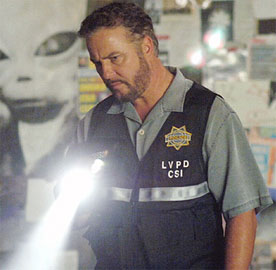
gil-gThere was a refrain frequently heard on early episodes of TV’s CSI: Crime Scene Investigation. Gil Grissom was training rookie crime scene investigators, sharing with them his many years of experience in the field. Grissom would often say, “Follow the evidence…” The understanding was that just following the evidence would lead to the perpetrator of the crime. Following the evidence would lead to the truth.

In the world of TV crime scene investigation, this might usually work as a sound philosophy. Even there, occasionally writers and producers have explored the possibility that the evidence can be tainted by factors related to those investigating it. The evidence is not always interpreted objectively and thus conclusions (right or wrong) can still ultimately be reached on the basis of prejudice or gut feeling. The philosophy sounds good in principle, but it doesn’t always work out in practice.

Moving into the real world, the principle of “follow the evidence” is the basic philosophy behind much of Christian apologetics today. Walk into a vanilla Christian bookstore these days and if they have an apologetics section, likely everything there will be based on this principle. Lee Strobel is popular with his The Case for a Creator, The Case for Faith, and The Case for Christ. I won’t discount everything he writes in these books, but it should be noted that his basic principle is the same as CSI Grissom: follow the evidence. The same is true for the majority of others writing on the subject of apologetics today. For that reason alone, this principle needs critical evaluation.

Yet there is another reason why we should pause for careful reflection. We’re in the throes of debate on the compatibility of Christianity and evolution.  We ought not to kid ourselves, these issues are not going away. If the historical experience of the Christian Reformed Church is any indication, we should expect proponents of theistic evolution to keep trying until they not only make room for their position, but also gain converts to the point of having their position as the dominant one.

In this discussion, the allegation has been made that young university students have been sent into turmoil when encountering the evidence for evolution. As the story has it, these students were taught creation science at home, church, and school. They were told that the evidence made it clear that God had created the world ex nihilo (out of nothing) in six ordinary days some thousands of years ago, not millions or billions. Arriving at university, they encounter a different batch of evidences not previously considered. This sends their faith into a tailspin and, so the story goes, some of them even end up committing suicide.

On a superficial level, we can join in bemoaning this approach to such issues. Here is some common ground with those attempting to make room for theistic evolution in our churches. We can agree that something has gone awry with those young university students, though we would still likely disagree on the details. From their perspective, the problem rests with creation science which produces faulty evidence because of certain faith convictions regarding creation. From our perspective, staking your faith on extra-biblical evidences is always problematic. Let me explain why.

The Theological Background of Evidential Apologetics    

Evidential apologetics is a philosophy of defending the faith which rests upon the use of evidence. This system of apologetics is usually traced back to Joseph Butler (1692-1752), an Anglican bishop. Butler lived during the time of the Enlightenment, also known as “The Age of Reason.” Serious challenges were being posed against the Christian faith. Rationalism, the belief that reason could provide the basis of all knowledge, had infiltrated not only society, but also many churches. The Enlightenment was a weak period for theology, and Reformed theology was also affected (or better: infected).

Butler recognized that Enlightenment philosophy endangered the Christian faith. In particular, he saw the danger deism posed. Deism is the belief that God is a clockmaker. He created the universe and then wound it up like a clock. He removed himself from it and is no longer intimately involved with it. According to deism, God takes an arms-length approach to the world. Butler rightly saw that this philosophy was in conflict with the teachings of the Bible.

In 1736, Butler published a book entitled The Analogy of Religion. This work was a response to deism. It was a defense of the faith. Butler aimed to show there are no sound objections to the Christian religion. He said all the evidence, especially the evidence in the natural world, points to the very probable truth of Christianity. As long as a person doesn’t ignore the abundance of evidence, he or she should not reject the Bible or any of its teachings. Unprejudiced minds, said Butler, would see the design inherent in the world and almost inevitably reach the conclusion that there is a Creator. A fair evaluation of the external evidence would likely push the open-minded unbeliever to accept the Bible. Butler purposed to demonstrate the truth of the Bible through facts, evidence and logic – and he believed it was not only possible to do this, but also pleasing to God.

When evaluating Butler’s approach, we have to remember the importance of what we call presuppositions. These are our most non-negotiable beliefs or assumptions about the way the world really is. Butler was an Arminian and one of his presuppositions was that man had not fallen so far as to completely corrupt his thinking. He did not confess the doctrine of pervasive (or total) depravity found in the Canons of Dort, but repudiated it. This had consequences for his system of apologetics. So did another related presupposition: the freedom of the will of fallen man. According to Butler and other Arminians, fallen man retains free will to choose for or against God. He need only use his faculties rightly in order to make the right choice.

While Butler saw the dangers of the Enlightenment and wanted to combat deism in particular, the weapons of his warfare were earthly and unscriptural. We might wish that Butler was a mere footnote in the history of Christian apologetics, but unfortunately his approach became widely accepted. Much of what we see today in non-Reformed (“evangelical”) apologetics finds its historical roots in the Arminian apologetics of this Anglican.

Evidential apologetics, historically and in its modern form, makes its case based not only on the evidence (and the nature of evidence), but also on a certain understanding of human nature. According to this system, human nature is not pervasively depraved. The human intellect is not fallen or dead in sin, only weakened or sick. Neutrality is not only possible, but a reality. When confronted with the evidence, and with perhaps a little help from God, the unprejudiced man will recognize the truth and turn to the Bible and believe it. This is Arminian theology applied to apologetics.

Unfortunately, this system has been appropriated by many involved with creation science. Many creation scientists have been Arminian in their theological convictions, so this should not come as a surprise. It is only consistent for Arminians to adopt evidential apologetics, whether in general, or whether specially applied to the question of origins. Inconsistency emerges when Reformed believers adopt this approach. “Following the evidence” is not our way.

A Biblical Approach

When we approach the question of evidence, we need to do so with Reformed, which is to say biblical, presuppositions. There are several of them we could discuss. However, in the interests of time and space, let me restrict our discussion to two of the most important. These are the presuppositions — the non-negotiable beliefs that will govern how we consider the place and use of evidence in apologetics.

The first is our confession regarding the nature of fallen man. As Ephesians 2:1 puts it, the unregenerate person is dead in transgressions and sins. This spiritual death extends to all the parts of a fallen human being: heart, mind, and will are all without a sign of life. When it comes to the Christian faith, fallen man does not have the capacity to interpret the evidence rightly. What the fallen man needs is regeneration. He needs to be made alive by the Holy Spirit. The Holy Spirit needs to open his eyes so that he may see, understand, and believe. The Holy Spirit does this work of regeneration through the Word of God. Therefore, the Word of God, not external evidences, needs to be the focus of our apologetical efforts. From a Reformed perspective, apologetics involves bringing the Word of God to bear on unbelief to expose its futility and to vindicate and commend the Christian worldview.

A second necessary presupposition builds on that. We always start with a belief that the Bible is God’s inspired, infallible, and inerrant Word. Those doctrinal positions are not conclusions that we reach through reasoning and proofs. They are held in faith. We hold to what is called the self-attesting authority of Scripture. That means the Bible attests or confirms its own authority. It does not need to be proven. The Bible claims to be the Word of God and we receive it as such. This is a settled truth for Christians. Therefore, the Bible is the basis and standard for all our apologetics. We are defending the Bible and the biblical worldview, but the Bible is also the guide for how we defend the Bible. The Bible gives us the means and strategies to use in defending the Bible.

Where does that leave external evidences? Well, for one thing, we do not build our system of apologetics upon them. Instead, our system has to be grounded on the Word of God. The Word is the supreme authority, not outside evidence. The Holy Spirit does not promise to regenerate people through external evidences. He does promise to do that through the Scriptures, though it is not inevitable in every case, obviously. What’s more, because evidence is always interpreted evidence, and the interpretation is always done by sinful minds, evidence must always be evaluated according to the supreme standard of the Word of God. Since there are no neutral facts or neutral methods for considering the facts, the Word must always be recognized as standing over the facts. It must be the grid through which the “facts” are sifted.

There is a place for evidence in apologetics and in the debate about origins. Evidence from outside the Bible can corroborate the Bible’s teachings. However, it is not the starting place, nor is it the authority. Moreover, external evidences can be fickle. What was thought to be evidence in one generation can turn out to have been misinterpreted by the next. How do you stay off what one writer called “the evidentialist roller coaster”? How do you stand firm against humanists and theistic evolutionist compromisers? Not by retreating to evidence, but by standing firm on what the Word of God teaches. And by evaluating all evidence in the light of the Word of God. That also means being open to the possibility that external evidences, whether for or against biblical teaching, may be wrongly interpreted. When it comes to evidences, one should retain a level of skepticism. After all, creation scientists and humanists/theistic evolutionists are all human beings, prone to sin and to mistakes. The only firm foundation is the Word of God.

Conclusion

“Follow the evidence” might be acceptable for fictional TV characters, but in God’s world his children can’t accept this procedure when it comes to apologetics. To “follow the evidence,” as if we are all neutral observers of the world is to sell out on our fundamental presuppositions. It’s regrettable that the surge of interest in apologetics has led some in our Reformed community to dabble with evidentialist apologetics. It’s sad too that we have often imbibed these apologetics as mediated to us through some creation scientists and their organizations.

Thankfully, in the last number of years, some creation scientists have adopted a Reformed, presuppositional approach to the question of origins. Most notable are Dr. Jonathan Sarfati and Dr. Jason Lisle, both affiliated with Answers in Genesis. Some time ago I reviewed Lisle’s book, The Ultimate Proof: Resolving the Origins Debate, and I want to take this opportunity to again commend it to you as a good example of how to apply Reformed apologetics to this issue. Some of Lisle’s final words in The Ultimate Proof provide a suitable conclusion: “Our defense of the faith comes from learning to think and to argue in a biblical way. God is logical, and we should be too. God tells us that all knowledge is in him (Col. 2:2-3), so we should train ourselves to recognize this fact” (173).


An earlier version of this article was originally published in Reformed Perspective magazine.  It appears here with their gracious permission.

Is Evolution Unfalsified?

reblogged from bylogos, the site of Dr. John Byl

In  a previous post (The Myth of the Merely Hypothetical) I noted that several Canadian Reformed supporters of the Reformed Academic blog claim that evolution is “as yet unfalsified.” This reflects the widely held notion that evolution has all the evidence in its favour, and none against. Allegedly,  evolution gives a powerful explanation–the only valid explanation–of biological facts, and is essential to understanding the life sciences.
Is this really the case?

First, let’s be clear that evolution here refers to large-scale biological evolution from one kind of animal to another (i.e., macro-evolution). Small changes within kinds (i.e., so-called micro-evolution) are not at issue; these can be observed to happen in the laboratory.

How well established is evolution, particularly the evolution of humans from apes?

1. Evolution versus Biblical facts
A scientific theory is falsified if it contradicts known facts. To Bible-believing Christians, facts include also those historical facts recorded in the Bible. The plain reading of Genesis teaches that creatures were all made “according to their kinds,” over a span of a few days (Gen.1). In particular, Adam, the first man was created from the dust, and Eve, the first woman, from Adam’s rib (Gen.2). These Biblical facts falsify evolution in general, and human evolution in particular.

2. Evolution versus experiment
No plausible process has yet been found that could produce even the simplest cell (which is amazingly complex). Scientists are as far as ever from creating life in the laboratory. It seems impossible that life ever got started via random physical interactions.

Moreover, macro-evolution has never been observed to happen. Biologist Richard Lenski has an ongoing experiment on the Escherichia coli (E. coli). This is a simple single-celled bacterium, with a generation time of only 17 minutes. Starting in 1988, Lenski observed over 60,000 generations of E. coli. He noted some changes in cell size, genetic makeup, and adaptations. But nothing substantially different was ever produced−E. coli cells always remained E. coli cells [J.W. Fox, R.E. Lenski, “From Here to Eternity—The Theory and Practice of a Really Long Experiment,” PLoS Biol 13(6): e1002185 (2015)].

3. Evolution versus useful application
According to evolutionary biologist Jerry Coyne, evolution has little commercial application:

Truth be told, evolution hasn’t yielded many practical or commercial benefits. Yes, bacteria evolve drug resistance, and yes, we must take countermeasures, but beyond that there is not much to say. Evolution cannot help us predict what new vaccines to manufacture because microbes evolve unpredictably. But hasn’t evolution helped guide animal and plant breeding? Not very much. Most improvement in crop plants and animals occurred long before we knew anything about evolution, and came about by people following the genetic principle of ‘like begets like’. Even now, as its practitioners admit, the field of quantitative genetics has been of little value in helping improve varieties. Future advances will almost certainly come from transgenics, which is not based on evolution at all. [Jerry Coyne, “Selling Darwin: Does it matter whether evolution has any commercial applications?,” Nature, vol 442:983-984 (August 31, 2006)].

The evolution that might be applicable is merely the uncontentious micro-evolution.

Consequently, Dr Coyne places evolution’s value not in its commercial application, but in its explanatory power. It is often claimed that evolution is the essential unifying principle in the life sciences, particularly biology.

However, this is disputed by Dr Jerry Bergman (An Evaluation of the Myth That “Nothing in Biology Makes Sense Except in the Light of Evolution” [2012]). He finds that most university textbooks for the life sciences make little substantial mention of macro-evolution, especially not for experimental biology, or practical applications, such as in medicine. A similar assessment was made by Dr Philip Skell (Why Do We Invoke Darwin? The Scientist, Aug. 29, 2005) who finds that most biologists do their work without referring to evolution, and that evolution provides no substantial guidance for experimental biology.

4. Evolution versus explanation
Evolution was constructed to give a naturalistic explanation of how the diversity of life came to be. However, there still remain huge gaps in evolutionary explanations. For example, Casey Luskin (What Are the Top Ten Problems with Darwinian Evolution?) lists the following shortcomings:

1. The lack of a viable mechanism for producing high levels of complex and specified information.
2. The failure of the fossil record to provide support for Darwinian evolution.
3. The failure of molecular biology to provide evidence for a grand “tree of life.”
4. Natural selection is an extremely inefficient method of spreading traits in populations, unless a trait has an extremely high selection coefficient.
5. Convergent evolution appears rampant — at both the genetic and morphological levels, even though under Darwinian theory this is highly unlikely.
6. The failure of chemistry to explain the origin of the genetic code.
7. The failure of developmental biology to explain why vertebrate embryos diverge from the beginning of development.
8. The failure of neo-Darwinian evolution to explain the biogeographical distribution of many species.
9. A long history of inaccurate predictions inspired by neo-Darwinism regarding vestigial organs or so-called “junk” DNA.
10. Humans show many behavioral and cognitive traits and abilities that offer no apparent survival advantage (e.g. music, art, religion, ability to ponder the nature of the universe).

In the ensuing comments, readers suggested also:
11. The problem of the evolution of sex.
12. The problem of accounting for consciousness.

A major problem is that the presumed evolutionary past is no longer directly observable. The well-known evolutionist Ernst Mayr acknowledged:

Evolutionary biology, in contrast with physics and chemistry, is a historical science—the evolutionist attempts to explain events and processes that have already taken place. Laws and experiments are inappropriate techniques for the explication of such events and processes. Instead one constructs a historical narrative, consisting of a tentative reconstruction of the particular scenario that led to the events one is trying to explain.

Historian Gertrude Himmelfarb comments:

Darwin’s essential method was neither observing nor the more prosaic mode of scientific reasoning, but a peculiarly imaginative, inventive mode of argument. It was this that Whewell objected to in the Origin: “For it is assumed that the mere possibility of imagining a series of steps of transition from one condition of organs to another, is to be accepted as a reason for believing that such transition has taken place. And next, that such a possibility being thus imagined, we may assume an unlimited number of generations for the transition to take place in, and that this indefinite time may extinguish all doubt that the transitions really have taken place” [Himmelfarb, Darwin and the Darwinian Revolution (New York: Anchor Books, 1962, 333-335)].

Indeed, many evolutionary explanations are little more than “just-so” stories, hypothetical scenarios that can be concocted to explain almost anything.

5. Evolution versus predictions
According to philosopher Karl Popper, the essence of science is that its theories should be potentially falsifiable. A scientific theory should make clear predictions that can be tested:

In so far as a scientific statement speaks about reality, it must be falsifiable; and in so far as it is not falsifiable, it does not speak about reality [Popper, The Two Fundamental Problems of the Theory of Knowledge (2014 edition)].

The theory of evolution has made numerous predictions, many of which have been falsified. A sample of these can be found at Cornelius Hunter’s site Darwin’s Predictions. Dr Hunter lists 22 fundamental false predictions of evolutionary theory. They cover a wide spectrum of evolutionary theory, reflecting major tenets of evolutionary thought. They were widely held by the consensus. Each prediction was a natural expectation of the theory of evolution, and constituted mainstream evolutionary science.  For example, the following predictions were all found to be false:

● The DNA code is not unique
● Mutations are random to an organism’s needs, not adaptive
● Competition is greatest between neighbours
● The molecular clock keeps evolutionary time
● Similar species share similar genes
● The species should form an evolutionary tree
●Complex structures evolve from simpler structures
● Structures don’t evolve before there is a need for them
● Functionally unconstrained DNA is not conserved
● Nature does not make leaps

6. Is Evolution falsifiable?
The false predictions did not cause mainstream scientists to reject evolution. They merely revised the theory to accommodate the new data. However, these modifications caused evolutionary theory to become much more cumbersome, so that evolution is no longer elegant nor simple.

Evolutionists brush aside evolution’s false predictions because they consider evolution to be the only game in town. They are committed to naturalistic explanations of how life arose and diversified. Supernatural explanations and divine revelation are rejected from the start. Evolution is presumed to be true; it is only the precise method that is up for discussion. Hence, in practice, the basic notion of evolution is not falsifiable because it is driven by a deep metaphysical agenda.

Evolution, the origin myth of our secularized society, is the antithesis of Biblical creation. No wonder therefore that, in the worldview war for human minds–and hearts–evolution is strongly promoted wherever possible in public media, education, and academia. Evolution, the only permissible view, is presented as a proven fact that no rational person would dispute.

Conclusion
To sum up, evolution contradicts Biblical facts, has not been experimentally observed, has few useful applications, fails to adequately explain the origin and diversity of life, and has made many false predictions. In particular, the claim evolution is as yet unfalsified is true only because mainstream science protects evolution from falsification. Whenever evolution is falsified the theory itself evolves, by ad hoc modifications, so as to accommodate any new facts that contradict earlier versions of evolution.