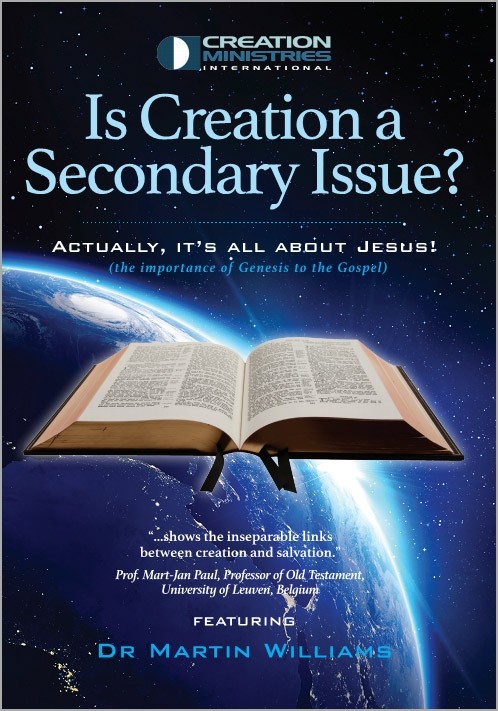
Video Review: Is Creation A Secondary Issue?

The following review is by Walter Walraven.  It originally appeared in the February 2018 issue of Faith in Focus, the official magazine of the Reformed Churches of New Zealand.  It is published here with the author’s permission. 

Is Creation a Secondary Issue?

by Dr Martin Williams and Creation Ministries International

Is creation a secondary issue? That is the question that Dr Martin Williams presents to the viewer in this excellent video produced by Creation Ministries International. Dr Williams has served as a pastor and missionary and is currently Head of Theology and Lecturer in New Testament and Greek at the Reformed Theological College in Melbourne, Australia.

As a pastor, missionary and lecturer, Williams has often heard the comment that “the doctrine of creation is only of secondary importance, and that Christianity is really about salvation through the cross of Jesus Christ”. Because of such sentiments, creation is often de-emphasized in the creation/evolution debate and relegated to the status of secondary importance. Some say “it is an issue that does not relate to how one is made right through faith in Jesus Christ, so why get all hung up on it?”

In this video, Williams contends that the creation account is the TRUE story of history which is proclaimed in the Scriptures. He gives a clear, systematic, logical and easy to understand explanation of the implications of holding to theistic evolution or long age thinking, and explains quite clearly what effect it has on the gospel. He comments further that not many people have thought of creation from the perspective of the cross. He then answers the question of why people die, progressing through to the explanation of why Jesus died, moving through to a logical conclusion.

Williams also brings into play the views of prominent evolutionists such as Darwin, Sagan and Alexander, who promote the view that death is a permanent part of this earth’s history over millions of years. Denis Alexander, who seems to hold to theistic evolution, states, “Nowhere in the Old Testament is there the slightest suggestion that the physical death of either animals or humans, after a reasonable span of years, is anything other than the normal pattern ordained by God for this earth.” Williams correctly asserts that such an idea is clearly contrary to the teaching of Scripture, which teaches that death is actually the result of sin. (Gen 3:17-19)

Maintaining our confidence in the historical narrative of the creation account as presented in Genesis, and understanding why Jesus died according to the Scriptures, is of first importance. It means rejecting evolution or long age thinking, which destroys the gospel.

In closing, I would like to point out, that this is a theological defence of the creation account as it presents itself in the early chapters of Genesis. Williams does not deal with the so-called science of evolution, but with the false view that God as the creator allowed or caused the creation to evolve. I do believe it would be a useful tool for members in our churches in the defence of the gospel when it is attacked at the foundations. The section containing questions and answers is most edifying and worthwhile to view. I wholeheartedly recommend and endorse this video to our readers.

This video can be obtained from Creation Ministries International as a DVD or MP4.

AFTER EVOLUTION: 4 Reformed figures who accepted evolution and kept on moving

What follows are very brief bios of four prominent Reformed figures who have accepted evolution and gone on to accept increasingly unorthodox positions.

Tomorrows-Theology2

Peter Enns

Enns once taught at Westminster Theological Seminary (1994- 2008) from where the Orthodox Presbyterian Church (OPC) gets many of their ministerial candidates. After accepting evolution he now has a very different understanding of the Bible, claiming, “God never told the Israelites to kill the Canaanites. The Israelites believed that God told them to kill the Canaanites.”

Howard Van Till

Van Till taught at the Christian Reformed Calvin College (1967-1998) and was for a time one of the best-known Reformed defenders of evolution.

He no longer holds to the Reformed confessions, and, according to a 2008 piece in The Grand Rapids Press seems to have migrated to some form of pantheism, seeing “God not as a transcendent, separate creator, but an active presence within and inseparable from creation.”

Edwin Walhout

Walhout is a retired Christian Reformed Church (CRC) pastor, and was once the denomination’s Editor of Adult Education. In 1972 he suggested

…it may well be that science can give us insights into the way in which God created man, but it can hardly discover or disclaim that man is an image of God.

In a 2013 Banner article “Tomorrow’s Theology,” he was far more definitive, proposing that in light of evolution the CRC needs to re-examine the doctrines of Creation, Original Sin, the Fall and Salvation, as well as whether Adam and Eve were real historical people.

Deborah Haarsma

Haarsma was a professor at Calvin College from 1999 until 2012. In 2007, along with her husband, she authored a book that discussed various views on origins and, while endorsing none, treated evolution as at least credible.

She is now the president of Biologos, a think tank that aggressively promotes evolution as true and that questions Original Sin, the Flood, the Fall into Sin, and whether Adam and Eve were actually historical people.

Moving in just one direction?

Does this mean that accepting evolution always leads to liberalism? Couldn’t we counter this list by coming up with one made up of Reformed luminaries who have accepted evolution and stayed generally orthodox?

We could come up with such a list and Tim Keller might be at the top of it. But the problem is that twenty years ago Peter Enns might also have been on such a list. He didn’t reject orthodoxy immediately. Any such “counterlist” might simply be a list of evolution-believing Reformed figures who don’t reject orthodoxy yet. Only time will tell.

No, if we’re going to try to make the case that evolution and orthodoxy are a natural fit, then the better counterlist would be that of liberals who, after embracing evolution, moved in a more orthodox direction. That would be a good answer to this list.

But does that ever happen?

This article first appeared in Reformed Perspective and is reprinted here with permission. You can also find a Dutch version of this article here.

Words Can Be Slippery Things

It’s happened many times in church history.  The theologian says that he believes in the resurrection.  But eventually it comes out that he believes that Jesus truly rose from the dead in the hearts of his disciples, but not actually in history.  Another theologian insists that he believes in election.  But eventually we discover that he believes that God chooses believers, not out of his sovereign good pleasure, but on the basis of foreseen faith.

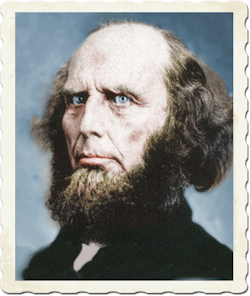
In his book Revival and Revivalism Iain Murray discusses Charles Finney at length because of his role in the Second Great Awakening.  Murray notes on page 262 that Charles Finney spoke of a “vicarious atonement,” which is usually another way of speaking about penal substitutionary atonement, i.e. that Christ took our place on the cross, bearing the wrath of God in our place.  But Finney believed nothing of the sort.  His language was deceptive.  He used the right words, but he meant something completely different.

This strategy gets employed in the debates over origins too.  People will insist that they believe that Adam and Eve were real historical people, that they were the first human beings, created in the image of God.  It sounds orthodox on the surface.  But we need to dig deeper:  what do you mean by human being?  Was Adam ever a baby nestled at his mother’s breast?  Was Eve a toddler at some point in her life?  Did she have grandparents?  What do you mean “created in the image of God”?  What does “created” mean in that sentence?  You say that you believe God created man from the dust of the earth.  Great!  But what do you mean when you say that?  Asking these sorts of questions will usually reveal whether things really are what they seem.  In theology, we need to be precise — and transparent — with our definitions.  It’s not enough just to use the right words, you also have to be holding to the correct understanding of those words.  Without that, the true gospel itself is soon lost.

Many Branches in the Human Family Tree?

A recent discovery in the Rising Star cave system in South Africa appears to support the idea that there were many versions of early humans once walking the earth. At least, that’s the claim that has been made here by Professor Chris Stringer, curator of a new exhibit at London’s Natural History Museum.

The discovery of the bones of at least fifteen individuals was made in 2013 by Rick Hunter of the South African Speleological Exploration Club, and it has been called “one of the most exciting finds in the last one hundred years.” The fossils are believed to be a new species of human – Homo Naledi by name – described as being human, but also having many “primitive” characteristics: small brains, mixtures of “primitive” and “derived” features, including hands that appear to be specially adapted to life lived in the trees.

Dr. Stringer admits that the age of the fossils has not been determined. “We’ve put it in our evolutionary diagram at the beginning,” he states. “But,” he adds, “we don’t know how old it is.” However, it is believed that these bones are from “a very primitive kind of human,” who “probably lies close to the origins of the human genus.”

Researchers have drawn a number of conclusions on the basis of this find. Stringer himself states that “we have to get away from this idea that there is a simple march of progress from an ‘ape-person’ to what we are today.” Homo naledi may be part of one of a number of “streams” in the evolutionary process, and one of Dr. Stringer’s stated goals is to debunk the notion that the evolution of the human species is “the pinnacle of a predestined evolutionary sequence.” He adds, “We want to show that diversity, and the fact that there was nothing pre-ordained about our own evolution and our eventual success.”

There are two interesting points to ponder when it comes to both this find, and the way it is being presented to the public. First of all, the agenda of those who have created this display has been made clear; Dr. Stringer himself declares that he is motivated, at least in part, by a desire to change people’s thinking about the manner in which humans have evolved.

His choice of language in describing the viewpoint he is seeking to challenge is revealing, to say the least. He doesn’t like the idea that we humans are “the pinnacle of a predestined evolutionary sequence,” and he argues that “there was nothing pre-ordained about our own evolution and eventual success.” It appears that, for Dr. Stringer, it is not just the idea of an evolutionary process that must be defended. It is also the belief that there is a design or purpose to that process, or an end-goal to that process, that must be abandoned.

The second point we must consider is the impact that discoveries like this, and particularly the conclusions drawn from them, must have on the thinking of those who hold to evolutionary creation and theistic evolution. We’ve noted in previous articles that there are a number of scholars who consider the Biblical Adam and Eve to be the representatives of an early population of hominids, not literally the first humans, directly created by God. Rather, the representative “first couple” of Scripture were the product of a long process of biological development. They were the first hominids endowed with a “human soul,” so to speak.

Should recent finds lead to the conclusion that there are indeed multiple lines in the human family tree? And does this mean that there are some human beings who are not descended from “Adam and Eve”? Or are the theistic evolutionary conclusions in need of correction and revision once again? Were Adam and Eve the representatives of one particular line, or all of them? And if Adam was the covenantal head of only one branch of the human family tree, what does that say about the Lord Jesus Christ?

The foundational issue here is methodological in nature. In the end, your answers to these questions will flow from your starting point. Our starting point is the Triune God, and his perfect word. His word tells us:

“The God who made the world and everything in it, being Lord of heaven and earth, does not live in temples made by man, nor is he served by human hands, as though he needed anything, since he himself gives to all mankind life and breath and everything. And he made from one man every nation of mankind to live on all the face of the earth, having determined allotted periods and the boundaries of their dwelling place, that they should seek God, and perhaps feel their way toward him and find him. Yet he is actually not far from each one of us…” (Acts 17:24-27).

This word must be our starting point, and it must shape our thinking – about how to interpret the evidence of “Homo Naledi,” and every other fossil discovery – and everything else in the world. Dr. Stringer’s own words prove that there is no such thing as neutrality, even within the sciences that like to claim the neutral ground as their own. Contradictory presuppositions inevitably lead to contradictory conclusions.

But when we start with the unchanging Word of God, our conclusions are firm, and trustworthy. God doesn’t change, and his word doesn’t change. In the end, when we begin to base our conclusions on interpretations of the evidence made by people with a decidedly un- and even anti-Christian agenda, we are building our house on shifting sands.

Keller’s advice to fellow Biologos members

Screen Shot 2016-03-02 at 7.02.16 AM

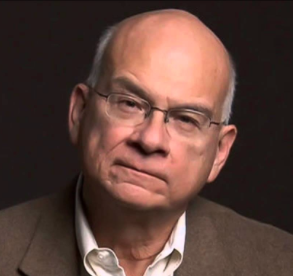
A theological orthodoxy as well-aligned as that of Timothy Keller is hard to find among the increasing numbers of scientists, theologians, and organizations currently urging evangelical Christians to accept biological evolution. He is the pastor of New York’s Redeemer Presbyterian Church (PCA) and is well-known through his writings on apologetics, church planting, and preaching. His 13 page white paper, hosted by Biologos and entitled “Creation, Evolution, and Christian Laypeople,” has been referenced favourably by scientists and theologians in conservative Reformed churches.[1] For example, when Frieda Oosterhoff introduced Keller’s paper some years ago on the Reformed Academic website, she stated,

(Readers of this blog, incidentally, will notice that our blog partner Dr. Jitse van der Meer sees eye to eye with Dr. Kidner in the matter of human evolution, the historicity of Adam and Eve, and the descent of all humans from Adam, and that he affirms the same tentative approach as Kidner and Keller.)[2]

In his paper Keller entertains the real questions of concerned Christians and offers answers as to how to help them integrate evolution with their faith. We have intended to interact with his arguments for some time.

Screen Shot 2016-03-02 at 6.57.28 AM

It’s important to situate accurately our debate with Keller. The debate between us is not whether the Christian faith and current science (or what is claimed to be science) are irreconcilable, for we all agree that in many respects they are reconcilable while in some respects they are not. The debate, rather, is in what particular respects they are and are not able to be reconciled.

The debate between us is not whether evolution is a defensible worldview that gives us the basis of our views on religion, ethics, human nature, etc. We all agree that it is not the “grand theory/explanation of everything.” We all agree that there is a God and he is the God of the Bible—Triune, sovereign, covenant-making, gracious, atonement-providing, and bringing about a new creation. Nor am I debating whether Keller is an old-earth creationist aka progressive creationist or an evolutionary creationist or a theistic evolutionist. His own position is a bit unclear so I will simply deal with what he has published in this paper.[3]

The debate between us is not whether matter is eternal; whether the universe’s order is by sheer chance; whether humans have no purpose but to propagate their own genes; whether humans are material only; whether human life is no more valuable than bovine, canine, or any other life; whether upon death all personal existence ceases; or whether ethics is at root about the survival of the fittest. We all agree that none of these things are the case—Scripture teaches differently. We are not debating these points.

Our differences emerge in the compatibility of Scripture with biological evolution, namely, whether Scripture has room for the view that humans—insofar as they are material beings—have a biological ancestry that precedes Adam and Eve. Is this a permissible view?

The first thing to realize as one reads Keller’s paper is its context and purpose: Delivered at the first Biologos “Theology of Celebration” workshop in 2009, Keller lays out 3 (at first 4) concerns that “Christian laypeople” typically express when they are told that God created Adam and Eve by evolutionary biological processes. Keller advances strategies to help fellow Biologos members allay these fears of Christian laypeople. The context thus is that biological evolution is a permissible view; the scholars just need to figure out how to make it more widely accepted.

Screen Shot 2016-03-02 at 6.55.08 AM

Keller deals with the following “three questions of Christian laypeople.”

  1. If God used evolution to create, then we can’t take Genesis 1 literally, and if we can’t do that, why take any other part of the Bible literally?
  2. If biological evolution is true—does that mean that we are just animals driven by our genes and everything about us can be explained by natural selection?
  3. If biological evolution is true and there was no historical Adam and Eve how can we know where sin and suffering came from?

These are excellent questions! Keller provides summary answers and longer explanations for each question. His short answers to the first two questions seem solid enough on the surface of things, yet his longer explanations deserve careful examination. His short answer to the third question is something we have directly contested on creationwithoutcompromise.com more than once, from the standpoint of Scripture. Here are his three summary answers. You can correlate them with the questions above.

  1. The way to respect the authority of the Biblical writers is to take them as they want to be taken. Sometimes they want to be taken literally, sometimes they don’t. We must listen to them, not impose our thinking or agenda on them.
  2. Belief in evolution as a biological process is not the same as belief in evolution as a world-view.
  3. Belief in evolution can be compatible with a belief in an historical fall and a literal Adam and Eve. There are many unanswered questions around this issue and so Christians who believe God used evolution must be open to one another’s views.

With this introduction in place, we can now interact with Keller’s advice to his fellow Biologos members in his longer explanations of each of these summary answers.

[1] Keller’s paper can be found online at http://biologos.org/blogs/archive/series/creation-evolution-and-christian-laypeople. Accessed 22 Feb 2016.

[2] See http://reformedacademic.blogspot.ca/2010/03/tim-keller-on-evolution-and-bible.html. Accessed 27 Feb 2016.

[3] For this debate see https://adaughterofthereformation.wordpress.com/2012/04/04/is-dr-tim-keller-a-progressive-creationist/. Accessed 27 Feb 2016.