A Retracted Statement?

A proposal is going to Regional Synod East in November which puts forward a change to article 14 of the Belgic Confession. This proposal is designed to clear up the confusion that currently exists in the Canadian Reformed Churches regarding origins. We have those who claim that the Three Forms of Unity in their existing state rule out any notion of human evolutionary origins. On the other hand, we have Reformed Academic asserting, and I quote, “Theistic evolution is not outside the boundaries of the Three Forms of Unity.” There are a fair number who agree with Reformed Academic. Who is right? Our churches urgently need clarity on this question.

The proposal quotes from two outspoken scientists in our churches. They are quoted partly as representatives of the view that theistic evolution should be tolerated – after all, they are founding editors of Reformed Academic, men who stand behind the quote above. One of those scientists is Dr. Jitse Van der Meer. He proceeds beyond the view that theistic evolution should be tolerated. He is quoted in the proposal as writing, among other things, the following:

Fourthly, there is the irreversible hierarchical structure of the classification of living things. If animals living today would have been created by fiat creation rather than by evolutionary creation, there would have been no hierarchical branching pattern unless the Creator would have wanted those who investigate such matters to believe there had been a history which never actually occurred. Since the Creator does not deceive us I am led to the conclusion that He created animals by means of an evolutionary process thereby giving us a real evolutionary history.

Dr. Van der Meer made this statement in a public online discussion with one of the Providence office bearers. You can find the original context here at Reformed Academic – the quotation can be found in the comments of Dr. Van der Meer on January 2.

The use of this quote in the proposal has been disputed. In this blog post, Rev. Bill DeJong alleges that this statement was retracted. Moreover, he claims (under point 9), that this retraction was done publically and the drafters of the proposal completely ignored this. Of course, this calls into question the integrity of the drafters and the credibility of the proposal. Regrettably, others have echoed these claims. These claims therefore deserve some further investigation.

I have searched on Reformed Academic for Dr. Van der Meer’s public retraction of this statement made in response to Providence deacon Herman van Barneveld. I have not been able to find it. Dr. Van der Meer did not retract this statement in the following comments under that blog post, nor did he issue a retraction of that statement in any subsequent blog post on Reformed Academic. One would think that this blog would be the natural place to issue such a public retraction. Moreover, if it was publically retracted, why is the statement still out there on the blog as if it continues to be Dr. Van der Meer’s position? It’s still there, still sowing confusion. If I had made a statement and later learned that I was in error, I would want to make an effort to correct my error. If it was a public error, I would want to make the correction publically and remove the error.

Readers should notice that Rev. DeJong and others have supplied no reference to support their claim. I want to ask Rev. DeJong: where, exactly, did Dr. Van der Meer publically retract that statement made in the context of his response to Herman van Barneveld? Rev. DeJong needs to provide the evidence to support his claim. And then a follow-up question: if Dr. Van der Meer perhaps retracted a similar statement used in a different context, where did he retract that and exactly why? Did he perhaps change his mind? Or was it merely a matter of proof-reading/editing with no real change in his position?

Now I know that my colleague Rev. DeJong wants to promote justice and truth – and I respect him for that. However, these same virtues also behoove him to share with his readers the whole story behind this “retraction.”  Once the entire body of evidence is considered in context, I believe it will be clear that the drafters and adopters of this proposal acted honestly and with the integrity expected of office bearers in Christ’s church.
Adam in the New Testament (review) — Rev. Peter Holtvlüwer

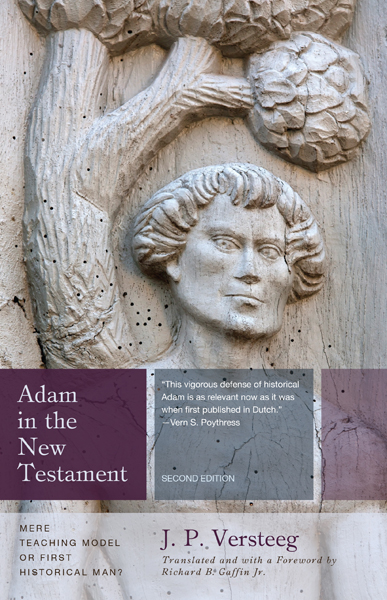
Versteeg_Adam.indd

Today we are pleased to present a review of an important little book first published in Dutch several decades ago.  According to Dr. Vern Poythress, “This vigorous defense of historical Adam is as relevant now as it was when first published in Dutch.”  We couldn’t agree more.  This review by CanRC pastor Rev. Peter Holtvlüwer (Spring Creek CanRC, ON) was first published in Clarion and is republished here with permission.

***************************

Adam in the New Testament: Mere Teaching Model or First Historical Man? by J.P. Versteeg. Translated by Richard B. Gaffin Jr. (Phillipsburg, NJ: P & R Publishing, 2012). First edition 1978. Apprx. $12 from your local Christian book seller.

This is a great book for evangelical and especially Reformed scientists, scholars, teachers and ministers – let me tell you why.

Pressure from Science

Under the pressure of scientific discovery and evolutionary theory, more Reformed scholars and scientists are feeling the academic heat to drop the long-held Christian conviction that the human race began with one man, Adam, as Genesis 1-3 relates. Websites like Biologos (whose authors describe themselves as “evangelical Christians”) openly accept evolution of humans from earlier life forms and consequently think that, at best, Adam and Eve were one pair of humans along the way.

PCA ruling elder and Old Testament scholar Dr. Peter Enns is a leading figure calling for also Reformed Christians to reject the Genesis account of Adam as historical, insisting that God did not intend it to literally describe human origins. For those of us working in a secular scientific or academic environment, such a call is tempting. Why stand against much of what our colleagues believe to be true if we really don’t need to?

But that call is shown by this book to be the Siren calling from the rocks, leading ultimately to the sinking of our faith. This little gem of a book (it’s only 67 pages) speaks as freshly and incisively to the subject as it first did in 1978. Translator Richard B. Gaffin, OPC minister and retired professor of Westminster Theological Seminary, has helped the Reformed and evangelical communities by making this essay of Rev. J.P. Versteeg widely available once again. Rev. Versteeg served as New Testament Professor at the Theological University of the Christelijke Gereformeerde Kerken in Nederland (in Apeldoorn) (sister churches to the Free Reformed Churches of North America). In it he demonstrates that at stake in Adam’s historicity is nothing less than the gospel itself.

Adam a Historical Person?

The beauty of this book is that Versteeg moves the controversy concerning the historicity of Adam away from the immediate context of Genesis 1-3 and looks at it from the perspective of the New Testament. This has the advantage of getting away from the scientific controversies surrounding the origins of the world and of mankind and concentrating instead on what Christ and the Apostles believed and taught about Adam. Since the Bible is its own best interpreter, this approach is surely worthwhile and can be a corrective should current scientific theory press a person to take a wrong turn in Genesis 1-3.

Versteeg’s essay was, naturally, written in his context – the Netherlands in the mid-1970s. But he addresses a teaching then prevalent which is resurfacing in our time on this side of the ocean, namely that Adam was used by the New Testament writers as a sort of “teaching model.” This view teaches that for Paul and the other NT authors, Adam is no more than a pedagogical example to explain some truth about Christ and Christianity. The authors did not assume or need to believe that Adam was a real man, the first man, created in the literal manner described in Genesis 1 and 2. In a careful, judicious and highly readable manner, Versteeg challenges and refutes that claim as he exegetes each passage in the NT where Adam is mentioned by name.

Gaffin on Peter Enns

Another valuable contribution this book makes is Gaffin’s introductory essay in which he outlines the present-day controversy. This helps a reader to get a feel for the various arguments being made today. Gaffin uses the writings of Peter Enns as an example, providing quotations and footnotes and evaluating his writings fairly but firmly. He draws out the dangerous consequences of Enns’ views. It takes courage to publicly address a former colleague (both were professors at Westminster Theological Seminary) on his erroneous teaching (which is also done publicly) but how necessary it is to preserve the church from error! We may thank the Lord for the courage and clarity which Dr. Gaffin has been given and now presents to us in his essay. This essay alone is easily worth the price of the book.

Though others will benefit from this book, I would especially urge every minister, teacher, academic, scholar and scientist in Reformed or evangelical circles to read this book. It may confirm you in the ancient teaching of the church and the historic Reformed conviction concerning Adam or it may gently correct your thinking on the topic. It will certainly educate you on the finer points of exegeting what the Bible itself says about Adam. I hope it will help you withstand pressures to set aside the clear teaching of Scripture in favour of man’s scientific theory. Whatever the case, it definitely won’t leave you unaffected. Edifying and recommended!

No Adam, No Gospel (review)

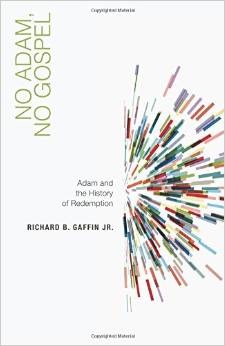
No Adam No Gospel

Why all the fuss? Is theistic evolution, in its various forms, really a going concern? According to Richard Gaffin, absolutely. He writes,

But more recently scientists, biblical scholars, and others who consider themselves evangelical or even Reformed Christians are increasingly calling into question the common descent of all human beings from Adam. Moreover they are persuaded that their doubts about this truth should be accepted as compatible with their Christian commitment (No Adam, no Gospel, 5).

Does this really matter? Gaffin is certain that it does:

Every Christian truly submitted to the Bible’s authority needs to be alert to this relatively recent development. Despite what others may tell us, we need to be clear about the consequences of these doubts and denials. No matter how well intended, they undermine the gospel and will lead to its eventual loss. The truth of the gospel stands or falls with the historicity of Adam as the first human being from whom all other human beings descend (5).

Who is Gaffin? He began teaching New Testament at Westminster Theological Seminary in Philadelphia in 1965 and just recently retired. He had great appreciation for developments in redemptive-historical exegesis in our Canadian Reformed tradition, and loved the work of Geerhardus Vos and John Murray. He is well-known for careful, consistent, and historically-informed biblical exegesis.

Back in 1978 Gaffin translated from Dutch an important work by J. P. Versteeg about Adam in the New Testament. This book was republished in 2012, with the comment of Gaffin that these issues of 50 years ago (from the date Versteeg first wrote) are even more relevant today. The little booklet at hand, No Adam, No Gospel: Adam and the History of Redemption, continues this theme. Gaffin even ends by quoting Versteeg, “There is no danger that theology has more to fear than this danger [that the Word no longer determines everything].”

In the first half of the book Gaffin makes a number of salient points about Adam in Romans 5:12–19 and First Corinthians 15:21–2, 45–9. In the second half he addresses the published views of Peter Enns, who was once a fellow faculty member with Gaffin at Westminster.

Gaffin demonstrates why believers must hold together the historical reality of Adam with the theological reality of original sin, original guilt before God, salvation through Christ, and eternal glory. He deals with the approach that denies Adam’s historicity as well as that which affirms his historicity but denies that he is the first human being who fathered the whole human race. What he doesn’t consider is the position of, for instance, Tim Keller, who tries to maintain Adam’s historicity, his fatherhood of the whole human race, and his biological evolutionary ancestry.

Peter Enns, whose views Gaffin particularly addresses, argues that Christians do not need to believe in a historical Adam in order to maintain the rest of Christian doctrine. Gaffin convincingly proves that this is an unbiblical position. And, in fact, when Enns argues that “a true rapprochement between evolution and Christianity requires a synthesis” (15), it appears that Enns himself realizes that most of the core doctrines of the Christian faith require major renovation if they are to accommodate the theory of evolution. Gaffin demonstrates that Enns’s views on sin, salvation, the purpose of Christ’s death and resurrection, as well as on the end times are all incompatible with the biblical message (15–26). Basically, Enns is offering up nothing but a reworking of the theories of the liberal biblical scholars of the late nineteenth and early twentieth centuries (26).

Most critically, Gaffin adds this:

Finally, not to be missed is the view of Scripture involved in Enns’s historical-critical approach, as it makes contemporary evolutionary theory decisive for interpreting Scripture and so for deciding what in it is or is not valid and relevant today (27).

One could reasonably argue that this fundamental problem afflicts almost every rapprochement between evolutionary theory and the Christian faith, including forms that are not as radical as Enns’s.

This is the sort of booklet that is best read either when your mind is already well engaged in the topic or when you have a quiet spot and an open Bible so that you can read the numerous passages he alludes to, and gain the full benefits from his arguments. It is not an entry-level account. Not that the writing is unclear; rather, the arguments are fairly tight and the requisite prior knowledge fairly significant. But no one can miss the point that when the apostle speaks of Christ as the “second” Adam, he must be no less real that the “first” Adam (10–11). Anyone who wants to play loose with Adam as a real historical being and try to hold onto Scripture can’t do it, and Gaffin convincingly shows why.

Review of Richard B. Gaffin, Jr., No Adam, No Gospel: Adam the History of Redemption (Phillipsburg, NJ: Presbyterian & Reformed, 2015), 29 pp., $4.99.

June 24, 2015


Response to Dr. J. Visscher

Our purpose at Creation Without Compromise is to provide Reformed church members with resources to defend and promote the biblical teaching on origins.  We also aim to provide tools to office bearers to fulfill their subscription vows.  In that light, the CWC team is convinced that the proposal to add some words to article 14 of the Belgic Confession is worthy of careful consideration by all Canadian Reformed office bearers.  This is why you can find the proposal on our website.  The issues need to be studied and weighed carefully.  Objections have been expressed against this proposal.  Most recently, Clarion (June 5, 2015) featured an editorial by Dr. J. Visscher expressing his disagreement with the proposal.  To assist our readers in making a responsible judgment, over the next while we will post several articles related to the proposal.  We begin today with a response to Dr. Visscher.

****************************

I would like to thank Dr. James Visscher for his response to the proposal to make a change to article 14 of the Belgic Confession. This provides an opportunity to address both his concerns and similar ones that have recently been expressed by others. Since most of his concerns are actually dealt with in the proposal itself and its supporting appendices, I will try to be succinct.

There is first an apparent ethical issue: names are named without any apparent due process. In response, the proposal is not about these individuals as such – indeed, they are only mentioned in the first ground of ten to prove that a certain problematic way of thinking exists in our churches. The individuals mentioned have publically written myriads of words. They are outspoken representatives of a way of thinking that either holds theistic evolution as credible, or at least wants to leave room for theistic evolution in our churches. If one pays attention to social media, one soon hears a fair number of these voices in our churches. Moreover, those involved with drafting and adopting this proposal have in fact at various times and places interacted with these brothers. To suggest that anyone has been condemned “rashly and unheard” is hardly, if at all, credible.

Dr. Visscher further notes that one of those mentioned in the proposal has publically claimed that he is not a “theistic evolutionist.” Why did he then allow his name to be included and remain on an online list of evangelical Christians who believe that evolution is true? Readers should further remember that, to his dying day, Jacob Arminius claimed to be faithful to the Belgic Confession and Heidelberg Catechism. More to the point, in the 1990s in the CRC, Dr. Howard Van Till also claimed that he was not a theistic evolutionist.

Finally under the heading of ethical concerns, Dr. Visscher mentions a case brought before a Regional Synod East. This discipline matter was dealt with in closed session and I fail to see how it can be discussed publically without the consent of all parties involved. What if one of the parties plans to appeal to General Synod? Moreover, if we are going to publically comment on decisions made in closed session by a Regional Synod, why not go all the way and actually share with readers the full text of the decision? As it stands, readers are only hearing one side of the story (see Prov. 18:13 & 17).

Dr. Visscher’s next set of concerns are about whether doctrinal issues should be addressed by a change to the Confession. He disagrees with the proposal’s approach. In response, I would ask Dr. Visscher how serious and widespread a theological error would have to be before the church federation rises to some kind of action and then, what action should she take? Dr. Visscher is long on critique and short on a constructive alternative. Moreover, in ground 2, the proposal proves that the error being addressed is not only unbiblical, but also an attack on the very gospel itself. As is documented in Appendix 3, the Reformed churches have in the past responded to these types of grave challenges with confessional additions (the Canons of Dort) or amendments (Belgic Confession art. 22). There are precedents. Finally, Dr. Visscher anecdotally mentions some of his professors who warned against “tampering” with the confessions. Again, I would direct readers to Appendix 3 for published quotes to the contrary from some of our theological forefathers, including Dr. J. Faber and Dr. K. Schilder. These men committed themselves in writing to the very opposite view that Dr. Visscher mentions. Why doesn’t he interact with this material?

Then there is “the textual issue.” Dr. Visscher feels that the existing confessions address the problem of theistic evolution quite adequately. This is precisely the point at issue. Reformed Academic asserts, and I quote, “Theistic evolution is not outside the bounds of the Three Forms of Unity.” Dr. Visscher and others say that it is; Reformed Academic claims that it isn’t and they have others who agree with them. Who is right? This is the question this proposal has been drafted to answer as it (hopefully) is discussed at General Synod 2016.

The last issue Dr. Visscher raises is about our sister-church relationships, especially those with whom we share the Belgic Confession. It should first be noted that the Canadian Reformed Churches already have their own unique edition of the Confession – again, readers should refer to Appendix 3 for the evidence. The Belgic Confession we have in our Book of Praise is not the Belgic Confession as originally written by Guido de Brès in 1561, nor is it the exact Confession of, say, the RCUS or URC. This has never been an issue. Moreover, at Classis Ontario West of March 11, 2015 there were fraternal delegates from the OPC, URC, and RCUS present as this proposal was discussed. They contributed to the discussion and all encouraged us to proceed in this direction. Contrary to the belief of Dr. Visscher (and others who share his opinion), we should expect that our faithful sister churches would be more concerned about our tolerating theistic evolution than about us making a change to the Belgic Confession to address theistic evolution. They would be far more concerned about us taking no action than taking this action. Finally, the proposal does leave the door open for Synod to decide that this is a substantial change (requiring discussion with sister churches) rather than a clarification (see Process, point 5).

Reactions like that of my colleague give the impression of being conservative. However, this type of reaction will end up sacrificing biblical orthodoxy on the altar of maintaining a human document as an immutable historical artifact. This is a “conservatism” that does not serve the ongoing defence and maintenance of biblical truth. Our confessions need to be living documents, expressing the biblical faith of the church and also, where necessary, responding to the most egregious errors of our day.

In conclusion, I urge readers to study the proposal for themselves — you can find it by clicking here. Also, please study carefully the three appendices (find them here) – these contain important supporting material. All of this is available online right here at creationwithoutcompromise.com

What’s at Stake? The Gospel Is at Stake (Tim Challies)

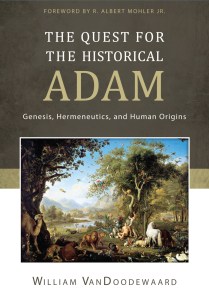
HistoricalAdam5__70127.1421354609.1280.1280

Tim Challies recently interviewed Dr. William Van Doodewaard about his new book The Quest for the Historical Adam.  With his kind permission, we are republishing it here on Creation Without Compromise.  The original post on Challies.com can be found here.

*******************************

There is always one truth or another that is being disputed. There is always some doctrine or another that is under attack. And speaking personally, I find it hard to keep up. Sometimes it is best to recruit some help, and I did that very thing recently. I keep hearing about differing views on the historical Adam, with more and more people moving away from a strictly literal understanding that Adam was divinely created by God on the sixth day of creation. Knowing that William Vandoodewaard had just written a book on the subject (The Quest for the Historical Adam), I asked if he would help me sort it all out. He did that in this brief but helpful Q&A.

Me:  Can you briefly (and as objectively as possible) lay out the different options when it comes to the historical Adam? What are the predominant views?

William:  There are really five possible views:

  1. Adam was specially created by God on the sixth day, as understood by the literal interpretation of the Genesis text. Adam is created without ancestry, apart from any evolutionary processes. He is the first human.
  2. Adam was specially created in the manner that Genesis describes (out of the dust, life breathed into him), but without the time frame of six days of ordinary duration—it occurred at some unknown point in the ancient past. Adam is created without ancestry, and apart from any evolutionary processes. He is the first human.
  3. Adam was created through a combination of natural processes and supernatural, divine intervention at some unknown point in the ancient past. Evolutionary processes played a part in Adam’s creation, he had animal ancestry, but God intervened, doing something special in his conception, or making him human after birth, even though his biological parents were not. Some argue that God’s intervention included changing Adam’s physical constitution; others argue that it was only God’s gift of a spiritual constitution or soul that set Adam apart from his animal ancestors.
  4. Adam developed the same way as in #3, but he was simply an individual whom God entered into relationship with, making Adam religious. The immediate change that made Adam “human” was relational, not constitutional.
  5. There was no Adam. Adam is simply a figure or type for early humanity as a category.

While these are the five main categories, it is helpful to be aware of their place and proportion. The historic, mainstream understanding of the Christian church is view #1. Despite continuing efforts to the contrary it remains the predominant view among evangelical Christians. By contrast, view #2, rooted in post-Enlightenment geological theories, is actually a minority stream. Views #3–5, while trendy, very vocal, and on the evangelical edge (where broad evangelicalism merges into theological liberalism), actually represent an even smaller fringe than view #2.

Ongoing round-tables and “four views on Genesis and origins” type books produced by parts of evangelical academia are misleading. They give the impression that the literal understanding of origins is a minority when it actually remains an overwhelming majority commitment, much to the chagrin of its opponents.

Me:  What is really at stake here? What does the church stand to lose if we widely accept an alternate view of the historical Adam?

William:  The teaching of God’s Word is at stake here. God’s character is at stake. The gospel of Jesus Christ is at stake. Accepting an Adam with evolutionary origins immediately impacts what it means to be human, created by God in His image. It opens a Pandora’s box of theological problems—from Adam’s relationship with his animal parents and surrounding community, to the doctrine of sin and the fall, to God’s holiness, goodness, and justice. It immediately impacts the doctrine of Christ as the One by whom all things were created, as well as His incarnation and work of salvation. It’s an issue that touches so many others: from soteriology to race relations to sexual ethics to the new creation at the second coming. Those who take the logically consistent step beyond an evolutionary Adam to a figurative Adam join a line of thinkers including Voltaire and Kant.

Me:  Do you think there is an inevitability here? Do you think that those who deny a historical Adam are necessarily on a slope to full-out theological liberalism?

William:  The denial of a historical Adam is already theological liberalism, beyond the bounds not only of evangelicalism, but also historic Christianity. There is an inevitability of further decline, not always in the case of the individual who departs further from Christian orthodoxy, but almost always in the next generation, and in any institution or church that allows this. The underlying problem is the capitulation to reading Scripture through the lens of this world’s culture and thought, rather than reading culture and thought through the lens of Scripture.

Me:  Are all 4 of the alternatives to the literal reading of Genesis 1 equally dangerous? Or do you think there is room within Christian orthodoxy for some or all of them?

William:  I don’t believe that we should ever say there is room in Christian orthodoxy for “lesser” error: if something is unscriptural we should not give it a pass. Christian orthodoxy should not be viewed as the “core concepts” of biblical Christianity; orthodoxy is the whole counsel of God’s Word. Our job is to be committed to being conformed to Christ, to the Word, in all things. This should be our passion and joy, pursued in love for Christ, His church, and a world in desperate need of the complete gospel.

But Christians are at various points in their spiritual growth, so, as one theologian said, “a man may be in error, and yet not be a heretic.” Someone may hold to an error at some point and still be a Christian. Understood this way, the first alternative view on human origins is the least problematic: you can hold to view #2 and retain an orthodox view of Adam, but it is nonetheless error requiring correction because it requires hermeneutical choices which set the stage for worse alternative views, in Genesis and elsewhere. Views #3 and #4 move significantly further into error. #5, with its flat out denial of Adam, brings one into the realm of heresy. The Quest for the Historical Adam details the historical realities and theological consequences of each of these in contrast to the coherence and orthodoxy of the literal understanding of our origins.

Me:  Should the average Christian church-goer get informed about this issue, or is it one where we can allow the scholars to work it out?

William:  Average Christian church-goers cannot afford to ignore this issue. Its erosive impact is continuing, if not gathering steam, in American evangelicalism. It may impact you directly through the minister you call or the elders you ordain: discernment here is essential for the church’s life and future.

Our children are likely to face the denial of the historical Adam at many Christian colleges—under the guise of Christian education. The issue is not just for us, but for our children’s future in the faith and for the continued expansion of the kingdom of Christ. Despite the naysayers who say “there is no slippery slope,” church history shows over and over that those who buy into alternate views of human origins are getting on the road that leads to complete abandonment of biblical Christianity.

I believe the best way to be informed is not found in immersing ourselves in books that present various views of the creation account, but by understanding Scripture’s richness, beauty, and cohesiveness on our origin, taught by faithful expositors and theologians for millennia. We must begin recapturing the marvelous reality of the literal understanding of our origin, all it entails, and how it applies to our lives. This was a key part of my aim in The Quest for the Historical Adam. When we understand the reality of what God has said and done, we will not trade our birthright for a pot of stew. We will worship our Creator and Redeemer.

William:  Yes, I would recommend two recent books: Richard Gaffin’s No Adam, No Gospel (P&R, 2015), and the collected essays in the volume God, Adam and You (P&R, 2015).