 Dr. Jason Lisle, author of The Ultimate Proof of Creation, is blogging at the Biblical Science Institute. He’s written a really insightful post about how “deep time” functions as an idol in our day. You can check it out here: Deep Time: the god of our Age.
My Father the Artist
It must have been 1979. I was six years old and living in Whitehorse, in the Yukon Territory. My mom and dad took my sister and me to the nearby Takhini Hot Springs. After an afternoon’s swim we were in the cafeteria waiting for an order of French fries. Dad grabbed a tray liner, flipped it over, and began doodling. He showed me how you could quickly draw a little beach scene with sea gulls wheeling around. His sea gulls were merely glorified versions of the letter “M,” but to a little kid this was enough to impress me with my father’s artistic ability.
As the years went on, I soon came to realize that my father wasn’t exactly Robert Bateman. Dad has many other great abilities, but art doesn’t rank. I’ve inherited his artistic talents, although I certainly do appreciate beautiful art.
I have the opportunity to do that almost every day. One of the best things of living here in Australia is the freedom to walk year round. Even in the winter, there’s no snow or ice with which to contend. I enjoy a daily walk year round and, as I do so, I encounter artistry every single time.
As I walk along one of Launceston’s main thoroughfares, I see these beautiful flowers. They’re present all year long — even in the Tasmanian winter. These flowers come in two different varieties: white and pink/mauve.


It turns out that these plants aren’t native to Tasmania. They’re called Osteospermum and they originate from South Africa. Though I don’t recall ever seeing them, I’m told that they can grow in Canada as well.
The thing that gets me when I see these flowers is not only the fact that they’re blooming in winter, but also the symmetry and the stunning combination of colours. There is beauty with Osteospermum — there is artistry! Every time I see these flowers, year round (!), I’m faced with the fact that my Father is an amazing artist.
In this world, there are exhibits of symmetry and beauty that defy explanation from a Darwinist perspective. In Darwinism, every feature of the natural world requires an explanation related to natural selection. There must be a clear advantage for a given plant or animal to be one way versus others. But in reality there are many features that are just beautiful and have no clear natural selection advantage. What evolutionary advantage accrues from combining white, blue and purple in the Osteospermum flower? None. It’s just simply beautiful. It’s simply artistry. It testifies to the fact that my Father has an eye for beauty.
If you’d like to see more examples of this, check out this 20 minute video:
My earthly father may not be much of an artist, but my heavenly Father leaves me in awe every day!
The Secrets of Insect Flight
 Busy bees. Dazzling dragonflies. Meddlesome mosquitoes. They all have the most amazing flying abilities. How do they do it? We are happy to offer a new article about God’s marvellous creation which explains some of the secrets of insect flight, supplied to us by Mr. Martin Tampier.
Martin is a professional engineer and energy consultant in Laval, Quebec. He is also a hobby photographer fascinated by insects, as the amazing close-ups of flying insects in the article demonstrate. He has already published elsewhere on God’s amazing creation. We thank him kindly for this article and trust that readers will praise God as they learn more about how insects fly.
Martin concludes,
Research around insect flight is on-going and many mysteries still need to be solved. However, some of the complicated features of insect wings are already being copied for man-made technology, including the development of micro-aerial vehicles—ironically modelled after the ‘primitive’ flying of dragonflies.
So while they may not recognize insects as divinely designed, researchers are confirming that they are incredibly complex and use extremely sophisticated physical mechanisms. To date, even the most amazing modelling software is insufficient to properly show how they achieve all of their amazing feats.

To read the entire article and enjoy the exquisite photographs, click here.
Follow the money…
 In my previous post, I examined the roots of the Templeton Foundation, the philosophy of its founder, Sir John Marks Templeton, and the way in which his philosophy is being disseminated through the Foundation’s ongoing efforts. In that post, the BioLogos Foundation and the Canadian Christian and Scientific Affiliation are mentioned as groups that receive Templeton Foundation funding to support their work.
A little research shows the incredible reach that the Foundation’s money has. And an examination of the nature of the grants that the Foundation provides, as well as the purpose behind these grants, is telling indeed. One of the Foundation’s main funding areas is “public engagement,” and a representative sample of grants (ranging from tens of thousands to millions of dollars) clearly shows the Foundation’s goals. Here is a small sample of grants that have been made over the past three years:
-
Vatican Observatory Foundation – “Building a bridge between faith and astronomy”
-
John Carroll University – “Integrating science into college and pre-theology programs in U.S. Roman Catholic seminaries”
-
Union Theological Seminary – “Project to develop a spiritual worldview compatible with and informed by science”
-
Cambridge Muslim College – “Developing religious leaders with scientific awareness”
-
American Association for the Advancement of Science – “Engaging scientists in the science and religion dialogue”
-
Luther Seminary – “Science for youth ministry: The plausibility of transcendence”
-
Christianity Today – “Building an audience for science and faith”
Other grants have been made to train Roman Catholic teachers and preachers to engage the dialogue between science and religion, to promote science engagement in rabbinic training, and to measure science engagement in Roman Catholic high schools and seminaries. Further investigation in the nature and purpose of these grants reveals a common thread. For example, La Jolla Presbyterian Church received a grant from the Templeton Foundation for a program that “seeks to engage young adults (college and post-graduate) in a discussion of science and faith with leading scientists who are Christians.”
The McGrath Institute for Church Life at Notre Dame University received a $1.675 million grant for their Science and Religion Initiative, which “seeks to frame science education within the broader context of Catholic theology.” According to the Institute’s director, “The perceived conflict between science and religion is one of the main reasons young people say they leave the Catholic church… this grant allows us to address this misperceptions and help high school teachers create pedagogies that show that science and religion – far from being incompatible – are partners in the search for truth.”
Multnomah Biblical Seminary has received a Templeton grant (as well as a grant from the American Association for the Advancement of Science, itself supported by the Templeton Foundation), to “equip pastoral studies majors to become more effective in engaging our scientific age.” Among a number of other Christian theologians, Niels Henrik Gregersen, professor of Systematic Theology at the University of Copenhagen, received a Templeton research grant for his work on the constructive interface between science and religion.
Another recent recipient of the Templeton Foundation’s largesse is Regent College in Vancouver, which this year received a grant funding a program called “Re-faithing Science at Regent College.” The program will seek, over the next two years, to address this question: “How can the relationship between Christian faith and scientific endeavour be conceptualized and communicated in a way that effectively engages diverse audiences?”
The detailed description of this particular grant on the Templeton Foundation website is insightful:
“Sir John Templeton recognized that science and spirituality should be neither sealed in separate boxes nor positioned at opposite ends of a battlefield, yet even a cursory glance at contemporary culture reveals that the supposed incompatibility and even hostility between faith and science is something of a truism in much of Western society. Regent College believes that this widespread perception is a significant threat to the development of theology and science alike, as well as to the spiritual and intellectual flourishing of countless individuals.”
So, utilizing Templeton’s funds, Regent College’s project team will “propose an alternative model for the relationship between faith and science: mutual coinherence, or existence within one another.” Their goal is to communicate this proposal “in an accessible form” that will encourage and enable further exploration of science, theology, and their interaction, using academic publications, public lectures, graduate-level courses, and an online presence, to “target different audiences with the same basic narrative, a story of one world, created by one God, who can be known and worshipped through both theology and science – and who is best known and best worshipped when theology and science work together.”
What can we learn from all of this? If we were unaware of the foundational principles behind the Templeton Foundation, perhaps all of this would appear to be somewhat innocuous. After all, who could argue against Christians being involved in the sciences? Why oppose efforts aimed at developing “scientific awareness”? Certainly we shouldn’t want to bury our heads in the sand, and ignore what the sciences have to offer, as if science were somehow “off-limits” to the faithful Christian, should we?
But remember this important fact: the Templeton Foundation has a very clear agenda – a utopian, panentheistic philosophy that has an ecumenical goal of uniting the religions of the world around a synthesis of “science” and religion, with “science” seated firmly in the driver’s seat in this relationship. This agenda is being promoted by the lavish dispersal of funds to Islamic, Roman Catholic, Jewish, and other religious organizations, including, sadly, many evangelical Christian groups, many of which are making their influence felt in Reformed churches as well.
Two popular sayings come to mind: “Follow the money,” and “He who pays the piper calls the tune.” The money trail leads us to Sir John Marks Templeton. And clearly, Templeton’s agenda is making headway in many places, although it is also clear that this agenda faces many obstacles.
First of all, there is reluctance to accept the premises of this movement among religious organizations, as can be seen from the numerous grants being made to support efforts to decrease the resistance of religious leaders and members of religious groups, including evangelical Christians, to this religious/scientific paradigm. But that reluctance is being overcome, as the Templeton agenda makes inroads through a judicious use of funding. Efforts to reach youth, and those who teach the young, are effective means of dissemination for any propaganda effort, whether political, cultural, or religious in nature. Young people are more easily influenced, and they are most definitely being targeted, in a well-funded, concerted effort.
But there is also resistance from the other side – from unbelieving scientists who reject all religion, any idea of transcendence, and the idea that anything exists beyond the physical. This group is also being addressed by the outreach efforts of the Templeton Foundation, as it works toward fulfilling its long-term goals.
A spiritual war is being waged against God’s people, using that ancient question, “Has God really said?” This is not novel; every generation of Christians faces this reality, in different ways at different times in history. The battle is being played out in a world in which money talks, and a lot of money talks loudly. We cannot afford to be naive on this issue. We need to be on our guard against the influence of the Templeton Foundation’s money, even if it’s being spent by organizations that may have been respected among us. That money is being spent to promote an agenda that is radically different from the agenda of God’s kingdom. Our allegiance to the One True God must lead us to reject alliances with organizations like the Templeton Foundation, whose agenda is completely incompatible with that of our great God and Saviour, Jesus Christ.
“The Humble Approach”
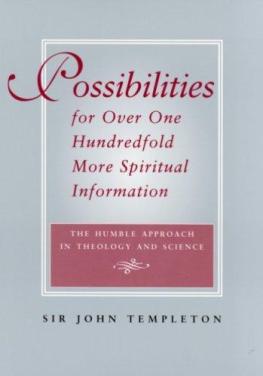 Possibilities For Over One Hundredfold More Spiritual Information: The Humble Approach in Theology and Science. Sir John Templeton. Templeton Foundation Press. Philadelphia and London. 2000.
Sir John Marks Templeton (1912-2008) is best known as the creator of the Templeton Growth Fund, an investment fund established in 1954, which made him a very wealthy man. Two years before his death in 2008, Templeton, who was born in Tennessee and later became a British citizen, found himself in 129th place on the Sunday Times‘ “Rich List.” But Templeton was not only an investor and a money-maker; he was also well-known as a philanthropist, through the work of his charitable organization, the Templeton Foundation. Established in 1987, the Templeton Foundation offers over seventy million dollars’ worth of research grants each year. The Foundation is currently headed by Templeton’s daughter, Heather Templeton Dill, and it is an important source of funding for a number of individuals and organizations, including the BioLogos Foundation and the Canadian Scientific and Christian Affiliation.
One of the Templeton Foundation’s purposes is to advance what Templeton called “Humility-In-Theology” – “helping spiritual information to multiply over 100 fold about every two centuries, especially by encouraging people of all religions to become enthusiastic (rather than resistant) to new additional spiritual information, especially through science research, to supplement the wonderful ancient scriptures” (Templeton, 180).
“Humility” was an important word for Sir John Templeton, as can be seen from the title of this book, as well as throughout its pages. Templeton’s philosophy of humility, and the way it shaped his thinking and his philanthropically efforts, is central to his thinking. For example, Templeton writes, “Although we seem to be the most sophisticated species at present on our planet, perhaps we should not think of our place as the end of cosmogenesis.” We must resist the pride that might tempt us to think that we are creation’s final goal, and seek to become “servants of creation or even helpers in divine creativity.” We may be “a new beginning, the first creatures in the history of life on earth to participate consciously in the ongoing creative process” (p. 41).
Templeton argues that theologians need to be “humble and open-minded,” and that most of the world’s religions exhibit a “tendency for dogma or hierarchy to stifle progress.” Humility should lead religious leaders to “re-form dogma in a more open-minded and inquiring way as a beginning point for continual improvements” (p. 41). Templeton claims not to want to quarrel with any theologian, and that we must “happily admit” that a particular theologian may be right. “But,” he writes, “let us listen most carefully to any theologian who is humble enough to admit also that he may be wrong – or at least that the door to great insights by others is not closed” (p. 50).
The great problem, for Templeton, is egotism, which has led to many mistaken ideas throughout history – including the notions that the stars and the sun revolve around mankind, and that humanity is as old as the universe. “Egotism is still our worst enemy… Only by being humble can we learn more,” Templeton writes (p. 59).
So where did this understanding of “humility” lead Sir John Templeton? Sadly, it led him to practically reject the Bible as the completed Word of God, his perfect self-revelation. The Bible, which Templeton includes as simply one of the “ancient scriptures” of all the world’s religions, was written in a different context than today. We now know that the universe is much larger, much older, and far more complex than the ancients believed. And so we are confronted with a challenge: “to enrich understanding and appreciation for the old with a welcoming of concepts and perspectives which may represent truly new insights and creative improvements, which can leverage the power of the past into a forward-looking adventure of learning more and more about the wonders of god and his purposes through ongoing creativity.” Since our understanding of the universe has been “vastly enlarged,” we should no longer be limited in our expression of spiritual truths to “obsolete words, limited concepts, and ancient thought patterns.” The tremendous development in human understanding, Templeton writes, allow us a “fuller and wider interpretation of divine revelation today” (p. 47-48).
Ideas have consequences. While Templeton was an elder in a Presbyterian congregation (Presbyterian Church – USA), and even sat on the Board of Princeton Theological Seminary, he did not “limit” himself to the doctrines of orthodox Christianity. His “humble approach” led him to declare, “I have no quarrel with what I learned in the Presbyterian Church. I am still an enthusiastic Christian,” and then to ask, “But why shouldn’t I try to learn more? Why shouldn’t I go to Hindu services? Why shouldn’t I go to Muslim services? If you are not egotistical, you will welcome the opportunity to learn more” (http://www.christianitytoday.com/ct/2008/julyweb-only/128-31.0.html). The sad fact is, however much one claims to be “an enthusiastic Christian,” believing that the teachings of religions that deny Christ can be positively appropriated by a Christian makes one, for all intents and purposes, anything but.
And this unfortunate truth is also clearly revealed in Templeton’s book. While Templeton denied being a pantheist (one who believes that the universe is God, and God is the universe), his understanding of the nature of God can only be described as a form of panentheism, which declares that God and the universe are distinct, but that the world is “in” God. Traditional pantheism serves a useful purpose, in Templeton’s mind, but he admits that it is incompatible with the Christian understanding of God. And so he turns to the teaching of the Unity School of Christianity for his conception of God: “God is also me: and I am a little part of him.” As little parts of God, “we may realize the mutual unity of god and his creation. We may conceive that our own divinity may arise from something more profound than merely being ‘god’s children’ or being ‘made in his image'” (p. 86; note that the use of the word “god” as written is in the original).
At this point, it must be said that, for all his self-proclaimed “humility,” Templeton’s foundational beliefs are, in Christian perspective, anything but humble; they are, in fact, blasphemous. True humility is expressed in Psalm 8:
“O LORD, our Lord, how majestic is your name in all the earth! You have set your glory above the heavens… When I look at your heavens, the work of your fingers, the moon and the stars, which you have set in place, what is man, that you are mindful of him, and the son of man that you care for him?” (Ps. 8:1,3, ESV).
True humility is expressed in humble submission to the LORD, the Creator, who has revealed himself clearly and completely in his Word – those “ancient Scriptures” which we humans have not outgrown, or surpassed, with all of our scientific understanding.
True humility is acknowledging our origins as the direct creation of God, acknowledging the reality of the Fall into sin, and its enduring impact on humanity and all of creation, God’s provision of a Way of salvation, and the fact that we can do nothing in ourselves to merit that salvation. We are created in God’s image. That image has been badly marred by sin. But in Christ, that image is being restored among God’s people.
True humility is submitting ourselves to Jesus Christ, who declared that he, and only he, is the Way, the Truth, and the Life.
Templeton’s “humility” is, at bottom, and however unwittingly, the height of human arrogance and pride in disguise. In refusing to submit to God’s perfect Word, Templeton set a man on the throne in God’s place. And now, through the work of his Foundation, Templeton’s utopian vision for human society, based in anything but the Word of God, is continuing to be spread.
Templeton foresaw a “glorious” future, and thanks to his great financial savvy, his legacy lives on. His Foundation has three billion dollars in its reserve fund, and that money is being spent to promote that legacy, with a very definite, and very long-term, goal in mind. Templeton’s vision of the future is summed up in two citations in his book. He first cites Marceline Bradford:
“…Millions of intellectuals the world over have become disenchanted with backward-looking religious institutions… In order to recapture the great thinking minds of the world, the clergy must turn their heads 180 degrees from past to future. With feet planted squarely in the present and eyes directed to the future, leaders can find factual bases in science for viable, solid, dynamic doctrines. For science and rationality are enemies not of religion – only of dogmatism” (Templeton, p. 47).
Next, he cites Ralph Wendell Burhoe, who was awarded the Templeton Prize in 1980:
“…At several points in the next few years and decades the traditional theological and religious communities will find the scientific revelations a gold mine, and… by early in the third millennium A.D. a fantastic revitalization and universalization of religion will sweep the world. The ecumenical power will come from a universalized and credible theology and related religious practices, not from the politics of dying institutions seeking strength in pooling their weaknesses. I cannot imagine a more important bonanza for theologians and the future of religion than the information lode revealed by the scientific community… It provides us with a clear connection between human values, including our highest religious values, and the cosmic scheme of things. My prophecy, then, is that God talk… will in the next century increasingly be fostered by the scientific community” (Templeton, 103).
In the conclusion of his book, Templeton lists a number of the “founder’s favourite charities,” which also provides real insight into Templeton’s agenda. They include the promotion of education about free competition, entrepreneurship, and the enhancement of individual freedom and free markets; supporting research and publications in genetics; supporting education and other help in voluntary family planning; supporting character development research, and also:
“Supporting the publication and dissemination throughout the world of the religious teachings of the Unity School of Christianity… and of closely similar organizations, provided that major support for such organizations shall continue only so long as the Trustees of the Foundation… determine that such organizations adhere to the concepts of (i) usually pioneering in religion and theology with little restrictive creed, (ii) usually teaching that god may be all of reality and man only a tiny part of god and (iii) generally accentuating the positive ideas and attitudes and avoiding the negative” (Templeton, 183).
Such were the goals of Sir John Marks Templeton, and such are the goals of his foundation. A serious examination of Templeton’s guiding philosophy, and the philosophy of the Templeton Foundation, in the light of Scriptural principles, should lead us to a sense of genuine concern about any organization that the Foundation chooses to support financially, to question the ultimate motivation behind this support, and the fruits that this foundation is bearing in the numerous organizations that receive its funding. “The Humble Approach” of Sir John Marks Templeton has absolutely nothing in common with the genuinely humble approach of the Lord Jesus Christ. His utopian vision has nothing in common with the eschatological vision of God’s Word.
My concluding thought is this: those who receive large amounts of financial support from the Templeton Foundation may do so “with no strings attached,” and perhaps some recipients may be unaware of the totality of the Foundation’s founder’s spiritual vision. But could it be that they are unwitting victims of a larger, and more nefarious, agenda, which has at its base a desire to proclaim a different gospel, by denying the explicit teachings of the Lord Jesus Christ and his exclusive claims?
 Creation Without Compromise