QA 7 of the Heidelberg Catechism — the first German edition in 1563.
Creation Without Compromise exists because of concerns about origins in our Reformed churches. In the “About” tab on this website, we state that we are “committed to the historic Reformed understanding of Genesis.” In the November 6, 2015 issue of Clarion, Rev. Peter Holtvluwer wrote a review of our website and under the heading of “Improvements,” he suggested we fill out the meaning of that statement. What do we understand by “the historic Reformed understanding of Genesis”?
Essentially, what we mean is the consensual understanding of the first chapters of the Bible that prevailed amongst confessionally Reformed and Presbyterian churches especially prior to Darwin. In the Reformation era, our theologians agreed in emphasizing the literal understanding of Genesis as the ground for doctrine — this was coupled with an emphasis on careful methods of interpretation. Hence, prior to Darwin, there was a definite consensus regarding how to read the first chapters of the Bible. Occasionally there were dissenters from that consensus, but this dissent was not encouraged or tolerated. After Darwin, we recognize that this consensus was challenged in significant ways. Yet it must be remembered that the Reformed consensus was maintained in the church courts even after Darwin. For example, we think of synodical decisions against Rev. J.B. Netelenbos and Dr. J.G. Geelkerken in the Reformed Churches in the Netherlands (1920 and 1926) and Dr. Ralph Janssen in the Christian Reformed Church of North America (1922).
What are some of the features of this historic consensus? First and foremost would be the insistence that the first chapters of Genesis describe history in a literal and straight-forward fashion. While they may have some literary features, these chapters are not metaphorical or mythical, but plainly historical and should be interpreted as such. What follows from that is creation in six ordinary days. When Genesis 1 speaks of “days,” it means days more or less as we experience them today. Moreover, if we take Genesis at face value, Adam was created from actual, physical dust of the earth by God. He was the first human being. He became a living being when God breathed life into him. He did not have a biological father or mother, human, hominid or whatever else. The first woman Eve was created by God from Adam’s rib. She did not have biological parents either. Together, they were the first human beings and the parents of all human beings who have since lived. God also created all other kinds of creatures in the six day creation period – and these were created by his Word. More could be said about what follows in Genesis – a literal snake speaking to Eve, a fall into sin, a worldwide flood, etc. – but I trust readers get the picture. Everything I have said up to here was the historic consensus view in Reformed theology.
Some elements of this historic consensus have found their way into the Reformed and Presbyterian confessional heritage. On the matter of creation days, we can think of the Westminster Confession’s statement in chapter 4.1 that “it pleased God…to create or make of nothing the world…in the space of six days, and all very good.” In article 12 of the Belgic Confession, we confess that “the Father through the Word, that is, through his Son, has created out of nothing heaven and earth and all creatures, when it seemed good to him, and that he has given every creature its being, shape, and form…” Article 14 goes on to say that “God created man of dust from the ground.” Heidelberg Catechism QA 7 confesses that our depraved nature comes from “our first parents” Adam and Eve. Other elements of the historic consensus are not found in our confessional heritage, arguably because they were considered to be so self-evident from Scripture as to not require such codification. When most of the Reformed confessions were first written, the challenges that we face today regarding origins were virtually unthinkable.
Since this is just a short blog post, I’m not going to lay out all the evidence for the existence of this historic consensus. William VanDoodewaard has done that for us at length in his excellent book The Quest for the Historical Adam (see my review here) and I refer readers to his research. Amongst others, VanDoodewaard discusses John Calvin, Wolfgang Capito, Girolamo Zanchi, Lambert Daneau, William Perkins, William Ames, the Leiden Synopsis, Thomas Goodwin, Thomas Manton, John Owen, Bernard Pictet, Herman Witsius and Wilhelmus à Brakel. According to VanDoodewaard, figurative interpretations of Genesis existed even before Darwin, but they were found amongst Roman Catholics, Socinians, and Anabaptists. Reformed and Presbyterian churches would not countenance such interpretations. He writes, “Anything that contradicted or failed to cohere with the literal reading of the Genesis text was rejected as subversive to God’s revelation.” (p.86)
Now the big question is: why do we think that “the historic Reformed understanding of Genesis” is so important to maintain and defend? It’s not because we’re conservative and just want to hold on to old-fashioned things because old-fashioned must be better. No, it’s simply because we are convinced that the old consensus is biblical. Old-fashioned often is better, but only when it lines up with God’s Word. That’s where we stand.
“Thus says the LORD: ‘Stand by the roads and look, and ask for ancient paths, where the good way is; and walk in it, and find rest for your souls…’” Jeremiah 6:16a
A recent discovery in the Rising Star cave system in South Africa appears to support the idea that there were many versions of early humans once walking the earth. At least, that’s the claim that has been made here by Professor Chris Stringer, curator of a new exhibit at London’s Natural History Museum.
The discovery of the bones of at least fifteen individuals was made in 2013 by Rick Hunter of the South African Speleological Exploration Club, and it has been called “one of the most exciting finds in the last one hundred years.” The fossils are believed to be a new species of human – Homo Naledi by name – described as being human, but also having many “primitive” characteristics: small brains, mixtures of “primitive” and “derived” features, including hands that appear to be specially adapted to life lived in the trees.
Dr. Stringer admits that the age of the fossils has not been determined. “We’ve put it in our evolutionary diagram at the beginning,” he states. “But,” he adds, “we don’t know how old it is.” However, it is believed that these bones are from “a very primitive kind of human,” who “probably lies close to the origins of the human genus.”
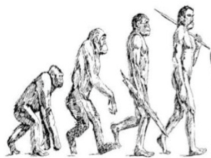
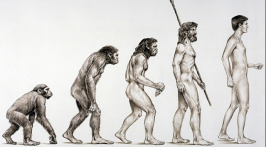
Researchers have drawn a number of conclusions on the basis of this find. Stringer himself states that “we have to get away from this idea that there is a simple march of progress from an ‘ape-person’ to what we are today.” Homo naledi may be part of one of a number of “streams” in the evolutionary process, and one of Dr. Stringer’s stated goals is to debunk the notion that the evolution of the human species is “the pinnacle of a predestined evolutionary sequence.” He adds, “We want to show that diversity, and the fact that there was nothing pre-ordained about our own evolution and our eventual success.”
There are two interesting points to ponder when it comes to both this find, and the way it is being presented to the public. First of all, the agenda of those who have created this display has been made clear; Dr. Stringer himself declares that he is motivated, at least in part, by a desire to change people’s thinking about the manner in which humans have evolved.
His choice of language in describing the viewpoint he is seeking to challenge is revealing, to say the least. He doesn’t like the idea that we humans are “the pinnacle of a predestined evolutionary sequence,” and he argues that “there was nothing pre-ordained about our own evolution and eventual success.” It appears that, for Dr. Stringer, it is not just the idea of an evolutionary process that must be defended. It is also the belief that there is a design or purpose to that process, or an end-goal to that process, that must be abandoned.
The second point we must consider is the impact that discoveries like this, and particularly the conclusions drawn from them, must have on the thinking of those who hold to evolutionary creation and theistic evolution. We’ve noted in previous articles that there are a number of scholars who consider the Biblical Adam and Eve to be the representatives of an early population of hominids, not literally the first humans, directly created by God. Rather, the representative “first couple” of Scripture were the product of a long process of biological development. They were the first hominids endowed with a “human soul,” so to speak.
Should recent finds lead to the conclusion that there are indeed multiple lines in the human family tree? And does this mean that there are some human beings who are not descended from “Adam and Eve”? Or are the theistic evolutionary conclusions in need of correction and revision once again? Were Adam and Eve the representatives of one particular line, or all of them? And if Adam was the covenantal head of only one branch of the human family tree, what does that say about the Lord Jesus Christ?
The foundational issue here is methodological in nature. In the end, your answers to these questions will flow from your starting point. Our starting point is the Triune God, and his perfect word. His word tells us:
“The God who made the world and everything in it, being Lord of heaven and earth, does not live in temples made by man, nor is he served by human hands, as though he needed anything, since he himself gives to all mankind life and breath and everything. And he made from one man every nation of mankind to live on all the face of the earth, having determined allotted periods and the boundaries of their dwelling place, that they should seek God, and perhaps feel their way toward him and find him. Yet he is actually not far from each one of us…” (Acts 17:24-27).
This word must be our starting point, and it must shape our thinking – about how to interpret the evidence of “Homo Naledi,” and every other fossil discovery – and everything else in the world. Dr. Stringer’s own words prove that there is no such thing as neutrality, even within the sciences that like to claim the neutral ground as their own. Contradictory presuppositions inevitably lead to contradictory conclusions.
But when we start with the unchanging Word of God, our conclusions are firm, and trustworthy. God doesn’t change, and his word doesn’t change. In the end, when we begin to base our conclusions on interpretations of the evidence made by people with a decidedly un- and even anti-Christian agenda, we are building our house on shifting sands.
Over on our articles page we have added a Clarion editorial from some years ago. In it Rev. George van Popta comments on one of several statements that the Vatican has made in support of the theory of evolution.
What drew our attention to his editorial was the description of how the pope at that time attempted to reconcile the message of Genesis 1 & 2 with evolutionary theory.
Although he wants to maintain that the spiritual soul is created by God without any means, the human body may well have had its origin in living matter which pre-existed . . . According to him theology must explain the origin of the soul whereas science tells us about the origin of the body (74–75).
If this sounds familiar, that may be because it is basically the position taken by many evolutionary creationists in the evangelical camp. It allows them to assert that God did indeed create “Adam” by a direct and immediate act, for God directly created the soul that as such constituted Adam as Adam. But God also used a very long evolutionary process to “create” the body that would become Adam. The body that pre-existed was not Adam, but a body that lacked a rational soul. This is their clever way of adopting biological evolution into the Christian faith and claiming that it does not contradict Scripture.
The problem is that it is a bit too clever, for it doesn’t at all square with God’s Word. As van Popta also writes,
It is indeed remarkable that the man who claims to be the Vicar of Christ has closed the Word of God—or, at best, lets ideas which have progressively taken root in the minds of researchers control his interpretation of the Word of God (75).
Lord willing, we may in the future pay more attention to the Roman Catholic position on evolution. For now, you can read Rev. van Popta’s article.
This is the fourth and final instalment in the series on Keller’s white paper in which he answers the real questions of Christians when they are told that evolution is compatible with the Christian faith.
Keller words this “layperson” question as follows, “If biological evolution is true and there was no historical Adam and Eve how can we know where sin and suffering came from?” He responds in short, “Belief in evolution can be compatible with a belief in an historical fall and a literal Adam and Eve. There are many unanswered questions around this issue and so Christians who believe God used evolution must be open to one another’s views.”
Keller finds the “concerns of this question much more well-grounded” than the first two questions. With reference to the first two, he summarizes, “I don’t believe you have to take Genesis 1 as a literal account, and I don’t think that to believe human life came about through EBP you necessarily must support evolution as the GTE” (7). But as regards this third question he wants to maintain that Adam and Eve were historical figures and not mere symbols. In this regard he differs from those who are more liberal with the text of Genesis 1–3.
In part agreeing with Keller
As with the last question Keller entertained, I again find him making some strong and valid points but ultimately proposing solutions that don’t work. He is concerned that if the church abandons belief in a historical fall into sin, this might “weaken some of our historical, doctrinal commitments at certain crucial points (7). Two such points are the trustworthiness of Scripture and the scriptural teachings on sin and salvation (7–10). He correctly asserts that “the key for interpretation is the Bible itself.” He adds that he doesn’t think Genesis 1 should be taken literally because he thinks the author himself didn’t intend this. However, we have earlier weighed his case and found it wanting. His principles sound good, but he doesn’t practice them. Moreover, he fails to talk about the ultimate author of Scripture, the Holy Spirit.
When Keller favourably quotes Kenneth Kitchen to the effect that the ancients did not tend to historicize myth, that is, think that their myths really were history, but rather tended to turn their history into myths, celebrating actual persons and events “in mythological terms,” we can again agree. This supports the view that the original message is the truth we find in Genesis, and that the myths of the surrounding nations adulterated this (8).[1]
The Derek Kidner model
In 1967 Derek Kidner, a British Old Testament scholar ordained in the Anglican Church, published a commentary on Genesis in which he surmised that the creature into which God breathed life (Gen 2:7) could have belonged to an existing species whose “bodily and cultural remains” (fossils, bones, cave drawings, I presume) show that they were quite intelligent but were not up to the level of an Adam. Keller concludes, “So in this model there was a place in the evolution of human beings when God took one out of the population of tool-makers and endowed him with the ‘image of God’” (11). However, a problem arises regarding all the other tool-makers. They would have been biologically related to Adam but not spiritually related. Kidner then proposed a second step: “God may have now conferred his image on Adam’s collaterals, to bring them into the same realm of being” (11). Then, if Adam is taken as the representative of all, they might all be considered by God to be included in the fall even though they are not physically descended from Adam and Eve (this sort of move, by the way, has been welcomed by certain Reformed theologians who emphasize Adam’s federal or covenantal headship, though historically Reformed theologians never separated this from his physical headship).
“Let us make man in our image”
What is lacking in Kidner’s account and Keller’s consideration is more attention to the language of Genesis. God did not simply appoint an existing being to be endowed with his image. Rather God conferred within himself and specifically uttered his determination, “Let us make man in our image, in our likeness, and let them rule . . .” (Gen 1:26). Then verse 27 three times uses the word “created,” when it says, “So God created man in his own image, in the image of God he created him; male and female he created them.” Thus, God spoke of “making” and “creating” man in chapter 1, while in chapter 2 the manner of this creating was specified in that God “formed the man of dust from the ground” and “fashioned/constructed a woman from the rib he had taken out of the man” (2:7, 22). Speaking of a mere endowment or bestowal of God’s “image” on an existing hominid, Neanderthal, or whatever it was, doesn’t do justice to such terms as “created,” “made,” “formed,” and “fashioned.”
Suffering and death before the fall?
Moving on to the problem of death before the fall, Keller acknowledges that this is a very prominent question. He doesn’t propose a fulsome answer, but offers a number of points by which his Biologos fellows could help Christians overcome these concerns. He does this by highlighting aspects of the creation which, in his view, show that “there was not perfect order and peace in creation from the first moment” (11, italics added). These aspects include the initial chaos which God had to “subdue” in the successive days of creating, the presence of Satan, the fact that the world was not yet “in a glorified, perfect state” (11) and the view that surely there had to have been some kind of death and decay, else the fruit on the trees would not even have been digestible (12). What response can we give to this?
First, we must emphasize what the Scriptures emphasize, “And God saw all that he had made, and behold, it was very good” (Gen 1:31), the climax of all the other affirmations of the goodness of creation in that chapter (Gen 1:4,9,12,18,21,25). Second, we can agree that good bacteria were present, to digest food, for God gave all the plants for food (Gen 1:30; cf. Gen 9:3) and even in the new creation the tree of life will bear fruit every month and its leaves will be used for healing (Rev 22:2). Although Revelation describes this symbolically, the idea of plant death in some sense is not averse to the new creation (cf. Isa 65:25). Thus digestion and plant death before the fall are something good, not something evil. Third, God did not have to subdue the chaos as though it were an active power against him. Rather, he took six days to form and shape what he had initially produced on the first day so that he would set the pattern of our lives and manifest himself as a God of power, wisdom, order, and love. Finally, the presence of Satan did not make God’s creating work as such incomplete or evil. Rather, Satan had chosen to rebel, had destroyed the peace of heaven, but had not yet instigated our human rebellion. So none of Keller’s points stand and certainly none of them provide any scriptural evidence whatsoever of suffering and death before the fall. We must shun any suggestion that God is the one responsible for sin, evil, and suffering, or that suffering and evil are just natural developments and not a result of our sin.
Spiritual death, not physical?
One final attempt by Keller to find some room for suffering and death before the fall emerges from the distinction between physical and spiritual death. If one treats the threat of death in Genesis 2:17 and the curse of death after the fall as simply indicating spiritual death, then all of the hundreds of thousands of years of animal death before Adam and Eve are no problem. As Keller writes, “The result of the Fall, however, was ‘spiritual death’, something that no being in the world had known, because no one had ever been in the image of God” (12). Note that this is simply a consistent application of the idea that God “bestowed” his image on at least two hominids (or whatever they were) and thereby “elected” them to be humans. Before this all creatures were only animals.
However, this separation of physical and spiritual death is artificial. The refrain of Genesis 5, “and he died,” underlines how the curse on creation was effected in a very physical way. We realize that Adam and Eve did not drop dead physically, the moment they disobeyed. But at that very moment they put themselves on the path of death, rebelling against God, and running from the Author of life. Only in the promise of the Seed could they still find hope—both physical and spiritual.
Conclusion
I don’t think Kidner’s model or Keller’s attempts to provide rhetorical suggestions to his fellow Biologos members have any scriptural weight behind them. These are attempts to accommodate theories that simply do not fit the message of Scripture. Nor do I agree with Keller that the right attitude for the church is to have a “bigger tent” in which we can peacefully discuss together the ways in which we as Reformed Christians might accommodate to Scripture the view that humans descended from other species by evolutionary biological processes. I am convinced that such views are serious errors that need to be kept out of the church of Christ. They disturb the peace. Defending the church against them preserves the peace within.
While I appreciate many of Keller’s writings on apologetics and church planting and have expressed my appreciation in particular for the way in which he pointed out the absurdities of holding to evolution as the “explanation of everything,” I hope that this review essay will help Reformed and Presbyterian churches maintain adherence to their confessional statements.
God created all things good in the space of six days. He made us—from the moment of our existence—as his vice-gerents, representing him to creation and responsible to him. We pledged allegiance to his enemy when we yielded to Satan’s suggestion. Thus we are responsible for sin and death; it is our fault, not God’s. But thanks be to God that his work of grace in Jesus Christ has opened the way for forgiveness, new life, and ultimately, a new creation.
[1] See remarks from E. J. Young in the discussion of the genre of Genesis 1. See https://creationwithoutcompromise.com/2016/03/07/keller-can-we-take-genesis-1-literally-if-we-hold-that-used-evolution-to-create/
Keller’s white paper asks a second “layperson” question, one that really gets at a problem: “If biological evolution is true—does that mean that we are just animals driven by our genes and everything about us can be explained by natural selection?” Keller’s provides this short answer, “No. Belief in evolution as a biological process is not the same as belief in evolution as a world-view.”
Two senses of “evolution”: EBP & GTE
In explaining this question and his response, Keller distinguishes evolution in two senses. The first is the teaching that “human life was formed through evolutionary biological processes” (he gives the acronym EBP for this), and the second is evolution “as the explanation for every aspect of human nature,” which he calls the “Grand Theory of Everything” and refers to as “GTE” (6). We might call this evolution as a worldview. Similarly, some Canadian Reformed authors have argued for the distinction between “evolution” and “evolutionism.”[1]
The problem Keller is addressing is that self-described “evolutionary creationists”—such as those at Biologos tend to be—end up hearing the same critique from both creationists and evolutionists: both argue that you can’t hold the theory of biological evolution without at the same time endorsing atheistic evolution as a whole. Essentially both critics assert that evolution is a package, a worldview, a big-picture perspective, and you can’t just isolate one part of it.
Keller suggests to his fellow Biologos members that most Christian laypeople have a difficult time distinguishing EBP from GTE. They have a hard time understanding that it is possible to limit one’s commitment to evolution to “the scientific explorations of the way which—at the level of biology—God has gone about his creating processes” (6, Keller quoting David Atkinson). “How can we help them?” Keller asks, for “this is exactly the distinction they must make, or they will never grant the importance of EBP.” He simply states that Christian pastors, theologians and scientists need to keep emphasizing that they are not endorsing evolution as the Grand Theory of Everything.
Keller’s helpful critique of evolution as the GTE
To support this, Keller provides a brief but helpful analysis, showing that evolution as the GTE is self-refuting. I’ll explain his point with the help of an online video where he elaborates a bit more. Basically, according to those who hold to evolution as the GTE, religion came about only because it somehow must have helped our ancestors survive (survival of the fittest). In fact, they say, we all know there’s no God, no heaven, no divine revelation. Such things are false beliefs. But if that is the case, argues Keller, then natural selection has led our minds to believe false things for the sake of survival. Further, if human minds have almost universally had some kind of belief in God, performed religious practices, and held moral absolutes, and if it’s all actually false, then we can’t be sure about anything our minds tell us, including evolution as the grand theory of everything. Thus, with reference to itself, evolution as the GTE is absurd.
In the online video that I used to supplement the explanation here, Keller is dealing with the problem that opponents of Christianity and of religion generally try to “explain it away.” He states, “C. S. Lewis put it this way some years ago, “You can’t go on explaining everything away forever or you will find that you have explained explanation itself away.”
Keller, following Lewis, illustrates “explaining away” with “seeing through” things: A window lets you see through it to something else that is opaque. But if all we had were windows—a wholly transparent world—all would be invisible and in the end you wouldn’t see anything at all. “To see through everything is not to see at all.”
How does that apply? Keller asks. He then shows that many universal claims are self-refuting.
If, as Nietzsche says, all truth claims are really just power grabs, then so is his, so why listen to him? If, as Freud says, all views of God are really just psychological projections to deal with our guilt and insecurity, then so is his view of God, so why listen to him? If, as the evolutionary scientists say, that what my brain tells me about morality and God is not real—it’s just chemical reactions designed to pass on my genetic code—then so is what their brains tell them about the world, so why listen to them? In the end to see through everything is not to see.[2]
As usual, Keller is an insightful apologist for the Christian faith. He helps us oppose evolution as the Grand Theory of Everything. Just the same, I heard another prominent evolutionary creationist, Denis Alexander, answering questions at a recent conference (2016) and musing about our lack of knowledge as to when “religiosity” first evolved among our ancestors. So, Keller’s helpful critique notwithstanding, at least one of his co-members at Biologos appears to think that religiosity is an evolved trait (or at least allows for this view).
But not GTE
But Keller doesn’t prove that EBP doesn’t lead to GTE
Although I’ve highlighted something helpful in Keller’s white paper, the main point he needed to do was to prove that one’s commitment to the theory of evolutionary biological ancestry for humans (and all other living things) does not entail holding to evolution as the grand theory of everything. He didn’t do this because the setting in which he spoke was Biologos, an organization which is committed to EBP but wants to avoid GTE because the members are Christians. They’ve already crossed that first bridge. Nevertheless, this is the real point at issue.
Can and will Christians be able to hold to EBP without moving to GTE?
I seriously doubt that Christians can or will be successful in adopting evolution as EBP while avoiding the trajectory that moves toward evolution as GTE. Here’s why, in short.
It seems to me that as soon as one adopts EBP, the following positions come to be accepted (whether as hypotheses, theories, or firm positions):
Adam and Eve had biological ancestors, from whom they evolved (some sort of chimp-like creatures).
These “chimps” in turn had other biological ancestors and relatives, as do all creatures.
In fact, there is an entire phylogenetic tree or chain of evolutionary development that begins with the Big Bang. All living things have common ancestry in the simplest living things, such as plants. At some point before that the transition was made from non-living things to the first living cell (some evolutionary creationists assert that God did something supernatural to make the transition from non-living things to living).[3]
Evolving requires deep time. “Multiple lines of converging evidence” apparently tell us the universe is 14.7 billion years old; the earth is about 4.7 billion, life is about 3 billion, and human life is probably about 400,000 years old (these numbers may vary; I happen to think 6-10 thousand is rather ancient as it is!).
Humans do not have souls; they are simply material beings. This is being promoted by Biologos and other theologians and philosophers.[4] Not all evolutionary creationists would agree; some say God gave a soul when he “made” man in his image, others that the soul “emerged” from higher-order brain processes at some point in the evolutionary history.
The world is on a continual trajectory from chaos to increasing order, or from bad to good to better to best. This creates great difficulties for one’s doctrine of the fall, redemption in Christ, and the radical transition into the new creation.
The earth, as long as it has had animal life, has been filled with violence. Keller admits in his paper how critical this is: “The process of evolution, however, understands violence, predation, and death to be the very engine of how life develops” (2). This presents enormous difficulty for one’s doctrines of the good initial creation, and the fall into sin.
The universe’s order arises mainly due to the unfolding of the inherent powers and structures God must have embedded in that initial singularity called the Big Bang. There is a movement toward Deism inherent in the theory.
Much of what the Bible ascribes to God’s creating power and wisdom actually belongs to his providential guidance, which itself was probably a rather hands-off thing.
God’s nature—particularly his goodness—needs to be understood differently if creation was “red in tooth and claw” from the beginning.[5]
The authority of God’s Word falls under the axe due to the exegetical gymnastics required to accommodate EBP. Scripture apparently no longer means what it appears to mean. This opens up the reinterpretation of everything in the Bible.
Conclusion
In sum, Keller provides a helpful critique of evolution as the Grand Theory of Everything, but fails to demonstrate that holding to evolutionary biological processes does not in itself, very much open one up to evolution as the GTE, and may in fact ultimately make it impossible to avoid more and more of evolution as the GTE. This is surely because for the most part evolution as such depends upon atheistic presuppositions. And in fact, it’s actually quite hard to determine just where the line is between evolution as EBP and GTE. I’m afraid that’s a sliding scale, depending upon which scientist or theologian presents his views. Once the camel’s nose is in the tent . . . you know the rest.
The academic and religious trajectories of scholars who were once orthodox and Reformed show how hard it is to maintain evolution as EBP only. I’m thinking of such men as Howard Van Till (who is now more of a “free thinker”),[6] Peter Enns (who now only holds to the Apostles’ Creed and treats the Bible as arising from the Israelites, not from God),[7] and Edwin Walhout (who advocated rewriting the doctrines of creation, sin, salvation, and providence).[8] There are whole swaths of theologians and scientists associated with Biologos, the Faraday Institute, and the Canadian Scientific and Christian Affiliation who are trying valiantly to hold together their Christian faith with evolutionary science, and the money of the Templeton Foundation will ensure that pamphlets, presentations, conferences, and books, will bring these views to the Christian public. Holding to Dooyeweerdian philosophy’s sphere sovereignty may help some of these Christians compartmentalize their biology, geology, and their faith, but that philosophical school has been subject to severe criticism in our tradition, and on precisely this point.[9] I fear that the dissonance of EBP itself with the historic, creedal Christian faith will prove to make it extremely difficult, if not impossible, for Christians to keep their faith and EBP together. I also doubt that one can very easily maintain evolution as EBP only.
[4] See my essay entitled, “In Between and Intermediate: My Soul in Heaven’s Glory,” in As You See the Day Approaching: Reformed Perspectives on the Last Things, ed. Theodore G. Van Raalte (Eugene, OR: Wipf & Stock, 2016), 70–111.




 Creation Without Compromise