Unlocking the Mystery of Life

Documentary
2003 / 67 minutes
Rating 8/10

This documentary is a couple of decades old now, and it’s more important than ever. When it was released, it had cutting-edge computer graphics unveiling the inner workings of the cell, and it told the story of the origin of life research current to that time. Today, it also serves as a history of the early days of the Intelligent Design (ID) movement, highlighting key figures in it like Phillip E. Johnson, Stephen C. Meyer, Jonathan Wells, William Dembski, Michael Behe, and Dean Kenyon.

Kenyon had previously written a textbook in support of evolution, and Behe had also begun his career as an evolutionist before reassessing after he read Michael Denton’s Evolution: A Theory in Crisis. As he describes it, reading this book made him feel like he’d been cheated; he’d had years of scientific education, was on faculty at Lehigh University, and he’d never once heard of the many problems with evolutionary theory! We get to come along as Behe and Kenyon explain how their eyes were opened.

We also get presented key ID arguments like Irreducible Complexity, which proposes that some biological machines need all their pieces to work, and could never have been formed by evolution’s step-by-step process. This is an issue being as hotly debated today as it was back then.

Other highlights include a look at the bacterial flagellum, which is effectively an outboard motor on a bacteria, propelling it as much as 100,000 rotations a minute. This is a marvel of engineering, evidencing the brilliant Designer behind it.

And we’re shown how biological machines are needed to assemble biological machines, which make the question of how they could have first formed one that evolution seems incapable of answering. It’s a chicken and egg problem: which came first, the Machine A, needed to assemble Machine B? Or was it Machine C, which was needed to assemble Machine A?

Cautions

The ID Movement looks at the origins debate from a philosophical and scientific, but not religious perspective. They argue that evidence outside the Bible makes it clear there is a Designer. On this point, the apostle Paul, writing in Romans 1:20, agrees. But the weakness with ID is that it doesn’t give the glory that is His due specifically to the God of the Bible. ID has a “big tent” approach which includes other religions, and both those who believe in a young Earth and those who believe it is more than 4 billion years old. However, this documentary doesn’t touch on old ages.

Conclusion

While the computer graphics aren’t as cutting edge, they are still amazing. We get a closeup look at the operation of micro machines  we never knew about, but which are in our own cells! This is a must-see for high school science classes, and it could make for fascinating family viewing too with teens and parents.

Speaking of the classroom, Illustra Media has packaged this exact same material, in a slightly different order, in Where Does the Evidence Lead? (2003). There it comes in 6 distinct chapters, all around ten minutes long, making them easy to present one or two at a time in high school or university classrooms. Illustra Media has made that repackaged version available for free online, and you can watch it below.

Part 1 – Life: the Big Question (10 min)

We being with Darwin, his trip to the Gallipolis Islands, and how he developed his theory of Natural Selection.

Part 2 – What Darwin didn’t know (8 min)

We’re introduced to Michael Behe, who explains why he used to be an evolutionist: no one had ever previously presented him with any problems with evolutionary theory. But the more he learned about the cell, and how complex the simplest block of life is, the clearer it became that chance processes couldn’t explain it. One example: the bacterial flagellum motor, which has been called “the most efficient machine in the universe.”

Part 3 – Molecules and mousetraps (12 min)

In Part 3 we’re introduced to the concept of “Irreducible Complexity” which proposes that in biological systems there are some machines that could never have come about by a step-by-step process – they would have to come together all at once. That is a powerful challenge to evolutionary theory, which precisely proposes everything can come about by small incremental steps. Michael Behe illustrates this point using a mousetrap as an example.

In answer, evolutionists have proposed their own theory of “co-option”… which has its own problems.

Part 4 – How did life begin? (11 min)

How did life begin in the first place? Darwin had very little to say on the subject. In recent years scientists have experimented with trying to get some form of “chemical evolution” started by mixing various chemicals together. But it isn’t simply the chemicals that make life happen, but how the chemicals are arranged. Like letters in a sentence, we don’t need just the right sort, but we also need them in the right order. The math here – the odds against even a single amino acid forming by chance – is fascinating!

Part 5 – Language of life (13 min)

Dean Kenyon wrote a best-selling textbook on the evolutionary origins of life. But then one of his students challenged him to explain how the first proteins could have been formed. Kenyon had originally proposed they would self-assemble, but what we were learning was that proteins are formed by other micro-machines, using instructions – there was no self-assembling. So Kenyon started to ask, what was the source of the instructions?

In this part, we also get to look into the cell to see how that information is put to use.

Part 6 – The Design Inference (14 min)

Design has been ruled out at the start – not by the evidence, but by mainstream Science’s anti-Supernatural bias – as a legitimate answer to origins question.

But Man is fully capable of spotting and recognizing design. It is a legitimate field of scientific inquiry.

The Boorish Bassian Thrush

Photo credit: J.J. Harrison via Wikipedia

Last week I completed Tasmania’s epic South Coast Track.  This 85 km track is renowned for its rugged wilderness, unpredictable weather, steep ascents and descents, and knee-deep mud.  It also happens to spotlight some of this Australian state’s wildlife treasures.  For example, it’s thought that there are only about 50 orange-bellied parrots left in the wild.  Yet, soon after stepping off the plane at the trailhead in Melaleuca, we spotted two juveniles.  A couple of days later, trekking through rain forest, we came across several Bassian thrushes.  There’s some remarkable lore around this bird.

The Bassian thrush is a medium-sized relative of the most-well known thrush in North America:  the American robin.   It’s also related to the common or Eurasian blackbird, native to Europe and introduced to Australia.  However, the Bassian thrush is native to Down Under, occurring in the Eastern states from Queensland down to Tasmania.  While it’s not endangered, it is shy and I’d never seen one before until the South Coast Track.

I first heard about it on another Tasmanian walk, the Three Capes Track.  In one of the huts, the Parks and Wildlife Service had left a booklet with fun bits of trivia about Tasmanian wildlife.  It said the Bassian thrush was known for a special hunting technique:  it farts on the ground and then picks off the critters who get scared to the surface.  According to what I read, this was an entirely unique ability amongst birds.

Being the curious type, I’ve done some research to sniff out the truth.  In 1983 a study was published in the South Australian Ornithologist.   J.S.L. Edington reported seeing this behaviour amongst a population of Bassian thrushes in South Australia.  He repeatedly observed “a noise similar to a jet of air and somewhat louder (clearly audible at five metres and lasting less than 0.25 sec.) than the bird’s footfalls was produced immediately after stopping and was in turn, followed by probingor more hopping.”  A follow-up study some years later verified Edington’s findings.

Did we see, hear (or smell) this percussive hunting technique on the South Coast Track?  Regrettably, no.  In fact, some ornithologists doubt they even do it.  Certainly it’s incredibly rare for birds to pass gas.  Besides chickens, no other birds are definitively known to do it.  Digestion usually happens so quickly in birds that there’s no time for gasses to build up.  In Edington’s study, however, he hypothesized that the behaviour was caused by the birds gulping air quickly, rather than expelling gasses related to digestion. 

It could be that this story is just blowing a bunch of hot air.  But if it’s true (I’d like to think it is!), it’s another example of the zany creation around us and the wonderfully creative God behind it.  He’s certainly gifted birds with the ability to sing in beautiful and diverse ways – and perhaps he’s even endowed some to use flatulence to get food in their beaks.

Free videos: Patterns of Evidence: Young Explorers

Docudrama
190 minutes / 2020
Rating 7/10

While this kids docudrama isn’t directly related to 6-day creation, it does tackle the same doubting spirit. When it comes to the Exodus, the “experts” says that Bible must have it wrong. It’s a familiar refrain, and the answer should hopefully be just as familiar: when facts and the Bible conflict, you must have the facts wrong. And so Timothy Mahoney discovers in this film..

This didn’t actually grab me on a first viewing but that’s only become I wasn’t the target audience. I thought I would still test it out on my kids, and I am glad that I did. What’s good-but-not-great for dad turned out to be downright funtastic for the younger set! This 5-episode series is based on filmmaker Timothy Mahoney’s full-length documentary Patterns of Evidence about his search for evidence of Israel’s captivity in Egypt. The original was part mystery, part biblical history and my wife and I both enjoyed it immensely, which is why I ordered this sequel of sorts.

But what initially put me off of the Young Explorers version was the added element of a whole gang of kids helping Mahoney investigate this mystery. This is now not simply a documentary, but a docudrama, with fact and fiction, education and entertainment, all mixed together. The kids were decent actors but still kids, and while I enjoyed the gags and dry humor, it all struck me as just a bit…cheesy.

However, after testing it out on my daughters, I realized what I was bristling against wasn’t cheese so much as enthusiasm, and though the greybeard that I am should know better, I still sometimes succumb to that weird teenage cynicism that believes enthusiasm is the opposite of cool – I was actually faulting Mahoney’s junior investigators for being eager beavers! But watching this with my own kids, then the gangs’ enthusiasm became a key feature of the film: here were 10 keeners sharing their passions, and no one was getting mocked for gushing about this or that. It was a whole group of geeky kids encouraging and cheering each other on. Would that my own kids can be like that (would that I can be like that!). So yes, a cynical, edgy, or critical audience will find plenty to mock here, and consequently won’t be interested in the gang’s big adventure. But if you’ve got geeky kids of your own, then they may just love it!

There’s a lot of love in the more than 3 hours of content. One highlight is the “Exploration Chamber” – a fictitious holodeck that the group can enter to then see and explore Egypt as it once was. Adults will appreciate how we hear directly from the horse’s mouth, with Mahoney often interviewing the very critics he is trying to rebut. On my second viewing with the family I caught how there is humor on two levels here, with pratfalls for the kids, and dry humor for the adults – there are some snort-worthy moments!

The seven episodes in order cover:

  • The adventures begins when the kids hear about Timothy Mahoney’s work and are eager to help (Parts 1/2)
  • They learn that we may know where Joseph lived in Egypt
  • The team searches for signs of captive Israel’s population explosion
  • The Young Explorers go search for signs of the 10 plagues (Parts 1/2)
  • The search continues on into Israel, where the team now investigates the fall of the walls of Jericho

Caution

There are no real content concerns so the only caution I’ll offer is not to take Mahoney’s conclusions as the final word. Mahoney isn’t the only one trying to solve these mysteries, and while his answers are especially compelling, there seem to be some other creationist contenders.

Conclusion

While this isn’t something for dad to watch on his own, it could be some great viewing for the family…if your teens aren’t going through that overly critical phase. Or skip the teens altogether and watch this with your elementary ages kids: they love it…and mom and dad will too. The one downside? It is pricey, running between $30-$45 US. You can buy it for online streaming at Christian Cinema, and Christianbooks.com, or buy it on DVD at PatternsOfEvidence.com.

But there is a free option too, at RedeemTV.com here (you will have to register for a free account). You can check out the trailer below.

This article first appeared on ReformedPerspective.ca where you can find many more movie reviews here.

Is God a Hypothesis?

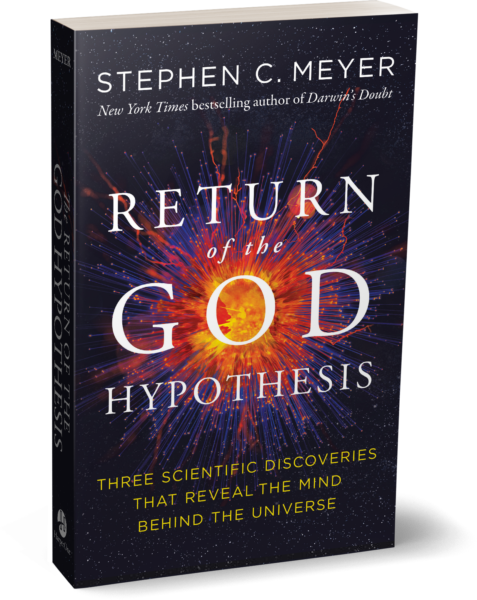
Stephen C. Meyer’s Return of the God Hypothesis continues to receive accolades.  Most recently, World magazine chose it as one of their 2021 books of the year.  On Amazon, it’s currently the #1 best-seller under “Creationism” and #4 under “Science & Religion.”  This is an important and influential book coming out of the Intelligent Design movement.  However, from a biblical perspective, it has several glaring problems. 

The subtitle reads, “Three Scientific Discoveries that Reveal the Mind Behind the Universe.”  Those three “discoveries” are:  the Big Bang, the fine-tuning of the universe, and the existence of highly-detailed DNA information.  Meyer works with these “discoveries” to argue for the eminent plausibility of the “God hypothesis.”

I’m not qualified to evaluate the scientific evidence for the Big Bang.  However, I do know that Big Bang cosmology is not consistent with the biblical account of origins.  Rather than explain the details of how and why myself, I’ll leave that to Christian astrophysicist Dr. Jason Lisle:

A Bible-believing Christian can’t use something that contradicts the Bible in order to argue for the likelihood of the existence of God.  That brings us down to two scientific discoveries. 

When arguing for the “God hypothesis” with DNA information, Meyer makes his case using what’s called “deep time.”  Contrary to what the Bible indicates, Meyer believes the earth has a history involving hundreds of millions of years.  In fact, chapter 10 is entitled, “The Cambrian and Other Information Explosions.”  The Cambrian explosion allegedly took place 530 million years ago.  As the story goes, this involves an explosion of new life forms in the fossil record.  Meyer argues that this also represents an explosion of biological information.  It poses a difficulty for materialistic theories of biological evolution, but could possibly “also provide positive evidence for intelligent design” (p.209).  However, for a Bible-believing Christian, the problem is that God said he created the heavens and the earth at the beginning (Gen. 1:1) – and Jesus said that God created Adam and Eve at the beginning (Matt. 19:4).  If you subsequently take the genealogies of Scripture seriously, even granting some gaps, you’re left with a world with an age on the order of thousands of years, not millions.

Now before I get to the most serious issues with The Return of the God Hypothesis, let me say that Bible-believing Christians can get some value out of it.  Some of the value comes when Meyer is critiquing materialist scientists.  For example, Stephen Hawking is quoted, “Because there is a law of gravity, the universe can and will create itself from nothing.”  But Meyer points out that “causes and scientific laws are not the same things…The laws of physics represent only our descriptions of nature.  Descriptions in themselves do not cause things to happen” (p.371).  There’s yet more value in Meyer’s critique of theistic evolutionists like Deborah Haarsma of BioLogos.  I appreciate his setting the historical record straight on Isaac Newton and his alleged “God-of-the-gaps blunder.”  Finally, Meyer illustrates how materialist scientists and philosophers live contrary to the beliefs they profess to hold.  For example, David Hume put the uniformity of nature into question, yet acted as though he believed in it (p.441).  Alvin Plantinga pointed out how, if evolutionary naturalism is true, “we have significant reason to doubt the reliability of our minds” (p.445).  Yet no one really does.  To do so would ultimately be self-defeating, since we would also have to doubt our beliefs about evolutionary naturalism.  This is a good example of answering a fool according to his folly (Prov. 26:5).     

My two biggest beefs with Return of the God Hypothesis have to do with the method of argumentation and the conclusion which results.  There are these three scientific discoveries mentioned earlier.  Meyer incorporates these discoveries into what’s called an abductive argument for the existence of God.  Such an argument works by way of inference to the best explanation.  It takes this form:

Abductive Schema

Logic:  If A were true, then C would be as a matter of course.

Data:  The surprising fact C is observed.

Conclusion:  Hence, there is reason to suspect that A is true.

Filling it out, it looks something like this:

Logic:  If a personal God existed, then DNA information would be as a matter of course.

Data:  The surprising fact of DNA information is observed.

Conclusion:  Hence, there is reason to suspect that a personal God exists.

One of the crucial things to note here is that the “logic of abduction…does not produce certainty, but instead plausibility or possibility” (p.224).  This tentativeness is reflected throughout Meyer’s book.  His argument is ultimately that “the God hypothesis” is possibly the best explanation of the three scientific “discoveries” discussed.  So:  a personal God quite likely exists.

From a biblical perspective, this is unacceptable.  The Bible doesn’t reveal the existence of God to us as a likelihood, but a certainty.  His existence is real and everyone knows it (Rom. 1:18-20).  Furthermore, the idea that God is a hypothesis to be tested or evaluated by sinful creatures is repugnant to biblical revelation.  The creature ought never to stand in judgment over the Creator or reduce him to a hypothesis.  As I was reading Return of the God Hypothesis, the words of D.A. Carson from this old video clip kept ringing in my ears:

Carson is quite right:  human beings have no right to judge God’s existence.  The whole premise of Meyer’s book flatters people into thinking they do have such a right.  That’s not a minor procedural peccadillo, but a massive misstep, even an affront to the Creator.

Meyer’s conclusion has another problem embedded in it.  He argues for the plausibility of the existence of a personal God.  In chapters 13 and 14, his reasoning excludes pantheism and deism as possibilities.  That leaves him with a God who is personal and involved with his creation, not only at the beginning, but on an ongoing basis.  But the problem is that this is still not the God of the Bible.  Meyer’s God who very likely exists could be the Allah of the Muslims, the God of the Jews, the Jehovah’s Witnesses, or the Mormons.  What we’re left with is plain vanilla theism.  Meyer has argued for a god, but not the Triune God of the Bible, and certainly not for the biblical worldview package.  Meyer professes to be a Christian, but this book could just as well have been written by a Jew. 

Ultimately all the problems in Return of the God Hypothesis trace back to one fundamental difficulty in Meyer’s method:  he doesn’t start with the Word of God.  Instead, he starts with the notion of neutral intellectual ground.  He doesn’t seem to apprehend that the problem with unbelief isn’t intellectual, but moral.  There is no neutrality.  Those who reject the God of the Bible are rejecting him because of the wicked rebellion in their hearts.  It’s this foundational issue that really needs to be addressed.  Meyer doesn’t do that.  In his book, there’s no sin from which unbelievers need to repent.  There’s just errant thinking that needs more information and sounder logic.  In his book, there’s no Saviour to whom unbelievers need to turn, no gospel to deliver from vanity and futility.  There’s just science and logic putting our minds at ease about origins.  I bought Return of the God Hypothesis in a Christian bookstore, but I really don’t know why it was there.  Even if Christians may find some things of value, it’s not a Christian book.     

Note:  for a biblical alternative, I highly recommend Jason Lisle’s The Ultimate Proof of Creation: Resolving the Origins DebateYou can read my review here.

The Perplexing Platypus

Is it a mammal or a reptile?  And why does it have a bill like a duck and a tail like a beaver?  When the first platypus specimens were brought to England from Australia in 1798, scientists thought they were a hoax.  They’d been fooled before by concocted “mermaid” specimens from Asia and that wasn’t going to happen twice.  But eventually credible observations and research proved the reality of this bewildering creature. 

Sadly, many Australians have never seen a platypus in the wild.  Part of that is attributable to their range being limited to the eastern states and Tasmania.  Even many residents of those states have never encountered this duck-billed curiosity.  Being a fly-fisherman means I spend a lot of time in Tasmanian creeks and rivers.  That’s led me to frequent platypus encounters.  On one occasion, a platypus was digging for food in the riverbed almost right at my feet.  Last year, in a tiny little headstream creek I met my first baby platypus.  He could have fit in the palm of my hand.  So platypuses aren’t as rare as you might think – it’s just a matter of being in the right place.

Eventually scientists classified platypuses as mammals.  However, they were placed in a special category known as monotremes.  The only other monotreme is the echidna, another Aussie oddity.  Monotremes have one opening used for both reproduction and elimination of waste.  This opening is called a cloaca, similar to birds.  From this cloaca, again like birds, platypuses lay eggs about the size of an acorn.  However, unlike birds, platypuses nurse their young with milk like mammals.             

The features of the platypus get even stranger.  It’s one of just a few venomous mammals.  The male platypus has a spur on its back legs that it uses to inject venom.  While no humans are known to have died from a platypus encounter, there are dogs that have met their demise in this way.  Regardless, getting spurred by a platypus is reportedly an intensely painful experience.  So, unless you can definitively tell a male apart from a female, resist that temptation to lift a furry platypus out of the water!

And what about that duck bill?  If you have a close encounter with a platypus, you’ll see that it’s covered in pores.  These pores are electro-sensitive.  When small prey move along the riverbed, they create electric currents with their muscles.  Platypuses have eyes, but they’re closed underwater.  Instead, they use their electro-sensitive duck bills to not only find their way around, but also to find their food.

There’s one type of person for whom the platypus is the most perplexing:  the evolutionist.  They just don’t know what to do with this animal.  It has some features like a bird, others like a reptile, and others like a mammal.  How did it evolve?  Where are the transitional forms in the fossil record?  Evolutionists at first believed it to be a “primitive” animal representing a living transitional form between reptiles and mammals.  But when research uncovered the electro-sensitive pores in their bills, they had to conclude that it was, in fact, “highly evolved.” Yet they find platypus specimens in the fossil record which they allege date back millions of years. Research into the platypus genome has uncovered even more perplexities for evolutionists.

For a Bible-believing Christian, the platypus is an amazing example of our God’s creative imagination.  Though he often appears to have used templates for creating certain animal groups, he decided to do something quite different with the platypus, giving it an electro-sensitive duck-bill, webbed front feet, venomous spurs on the hind feet, egg-laying, and a beaver-like tail.  It’s almost as if God meant to create something unconventional just to leave us scratching our tiny human heads.  Beyond perplexed, surely he meant to leave us in wonder at his playful artistry.