A Retracted Statement?

A proposal is going to Regional Synod East in November which puts forward a change to article 14 of the Belgic Confession. This proposal is designed to clear up the confusion that currently exists in the Canadian Reformed Churches regarding origins. We have those who claim that the Three Forms of Unity in their existing state rule out any notion of human evolutionary origins. On the other hand, we have Reformed Academic asserting, and I quote, “Theistic evolution is not outside the boundaries of the Three Forms of Unity.” There are a fair number who agree with Reformed Academic. Who is right? Our churches urgently need clarity on this question.

The proposal quotes from two outspoken scientists in our churches. They are quoted partly as representatives of the view that theistic evolution should be tolerated – after all, they are founding editors of Reformed Academic, men who stand behind the quote above. One of those scientists is Dr. Jitse Van der Meer. He proceeds beyond the view that theistic evolution should be tolerated. He is quoted in the proposal as writing, among other things, the following:

Fourthly, there is the irreversible hierarchical structure of the classification of living things. If animals living today would have been created by fiat creation rather than by evolutionary creation, there would have been no hierarchical branching pattern unless the Creator would have wanted those who investigate such matters to believe there had been a history which never actually occurred. Since the Creator does not deceive us I am led to the conclusion that He created animals by means of an evolutionary process thereby giving us a real evolutionary history.

Dr. Van der Meer made this statement in a public online discussion with one of the Providence office bearers. You can find the original context here at Reformed Academic – the quotation can be found in the comments of Dr. Van der Meer on January 2.

The use of this quote in the proposal has been disputed. In this blog post, Rev. Bill DeJong alleges that this statement was retracted. Moreover, he claims (under point 9), that this retraction was done publically and the drafters of the proposal completely ignored this. Of course, this calls into question the integrity of the drafters and the credibility of the proposal. Regrettably, others have echoed these claims. These claims therefore deserve some further investigation.

I have searched on Reformed Academic for Dr. Van der Meer’s public retraction of this statement made in response to Providence deacon Herman van Barneveld. I have not been able to find it. Dr. Van der Meer did not retract this statement in the following comments under that blog post, nor did he issue a retraction of that statement in any subsequent blog post on Reformed Academic. One would think that this blog would be the natural place to issue such a public retraction. Moreover, if it was publically retracted, why is the statement still out there on the blog as if it continues to be Dr. Van der Meer’s position? It’s still there, still sowing confusion. If I had made a statement and later learned that I was in error, I would want to make an effort to correct my error. If it was a public error, I would want to make the correction publically and remove the error.

Readers should notice that Rev. DeJong and others have supplied no reference to support their claim. I want to ask Rev. DeJong: where, exactly, did Dr. Van der Meer publically retract that statement made in the context of his response to Herman van Barneveld? Rev. DeJong needs to provide the evidence to support his claim. And then a follow-up question: if Dr. Van der Meer perhaps retracted a similar statement used in a different context, where did he retract that and exactly why? Did he perhaps change his mind? Or was it merely a matter of proof-reading/editing with no real change in his position?

Now I know that my colleague Rev. DeJong wants to promote justice and truth – and I respect him for that. However, these same virtues also behoove him to share with his readers the whole story behind this “retraction.”  Once the entire body of evidence is considered in context, I believe it will be clear that the drafters and adopters of this proposal acted honestly and with the integrity expected of office bearers in Christ’s church.
Test of Faith: Challenging Assumptions (2)

In my previous post, I examined Dr. Deborah Haarsma’s assumption that the original audience for the Genesis account of creation was the “ancient Hebrews.” In this post, I will turn to the claims that Dr. Haarsma makes about the ancient Hebrew understanding of the created order – namely, that they believed there was a solid sky dome above the earth.

As a reminder, here is the video to which I am responding. If you haven’t already watched it, please take a moment to do so.

So did the ancient Hebrews believe that there was a solid dome above the earth? And where do we go to find out what they believed? The only source for ancient Hebrew belief is the Bible, so that’s where we’ll turn.

Much of this discussion turns on the meaning of the Hebrew word raqia, which is first found in Genesis 1:6-8:

“And God said, ‘Let there be an expanse in the midst of the waters, and let it separate the waters from the waters.’ And God made the expanse and separated the waters that were under the expanse from the waters that were above the expanse. And it was so. And God called the expanse Heaven. And there was evening and there was morning, the second day” (ESV).

The word raqia is translated in the ESV as “expanse,” which makes sense. In the NIV 2011, it is translated as “vault,” which makes somewhat less sense. The King James Version, however, translates this word as “firmament,” which is completely wrong.

And when we look at the KJV translation of raqia, things get really interesting. The word “firmament” comes from the Latin word firmamentum, which means “a support, a strengthening. That Latin word itself derives from the word firmus, which means “strong, steadfast, or enduring.” The King James translators chose this word to translate raqia because it was used in the Vulgate, the Latin translation of Scripture.

Follow me here, because the trail is twisting and turning – but if you can follow this path, there’s a reward of clarity at the end of it. The Vulgate used the word firmamentum to translate the word stereoma, which was the word used in the Septuagint (the Greek translation of the Old Testament) to translate raqia in Genesis 1. That Greek word means “what is solid and firm.”

So here’s the path we took to get from raqia to “firmament”:

raqiastereomafirmamentum → firmament

We’ve made the journey from Hebrew to Greek to Latin to English, and along the way, a serious error in translation occurred. You see, the word raqia comes from the Hebrew verb raqa. Raqa means “to spread out, to hammer out, or to overlay.” In Syriac, however, raqa means “to make firm or solid.” This is one of the sources of the mistaken (but oft-repeated) view that the ancient Hebrews believed that there was a solid sky dome above the earth.

Context is important here, as always. And there are a number of passages in Scripture that refer to the LORD’s having “stretched out” the heavens, which support the meaning of raqia as “something that has been stretched out, or spread out.”

Isaiah 42:5 – “Thus says God, the LORD, who created the heavens and stretched them out, who spread out the earth and what comes from it, who gives breath to the people on it, and spirit to those who walk in it.”

Isaiah 44:24 – “Thus says the LORD, your Redeemer, who formed you from the womb: I am the LORD, who made all things, who alone stretched out the heavens, who spread out the earth by myself.”

And finally, Job 37:18 – “Can you, like him, spread out the skies, hard as a cast metal mirror?”

Uh… Ahem. Okay. So… now what?

“Hard as a cast metal mirror!” Aha! The solid sky dome makes its appearance at last!! My argument has been defeated!

Or has it been?

I’m not going to reinvent the wheel here. As with most questions, this one too has already been answered elsewhere. To put it simply, Job is speaking metaphorically; the book of Job is filled with poetic language and metaphor, and this is one of many examples of metaphor in that book. Dr. Joseph R. Nally writes:

The picture being painted in the book of Job is that the sky is solid but thin, like a piece of metal being hammered out (Ex. 39:3; Isaiah 40:19). God stretches out the heavens like a tent (Ps. 104:2). Metaphorically speaking, the heavens are being viewed as hammered out at creation (I.e, a spreading out of the sky or an expanse – Gen. 1:7,8) and/or clouds daily changing their shapes or reforming (Job 36:28,29; cf. Gen. 9:13-16; Psalm 18:9-11).

‘Solid’ in the book of Job does not mean impenetrable. Above the firmament are storehouses for rain (Job 36:27-28) and snow and hail (Job 38:22), and there is a place above it for the sun, moon, and the stars (Job 9:7; 22:12; 30:28; 31:26; 37:21; cf. Gen. 1:14-17). Job’s metaphoric picture says the skies are ‘hard as a mirror of cast bronze.’ Glass mirrors were not known until Roman times. In the day and age of Job, mirrors were cast from hardened bronze (copper hardened by the addition of tin). So, metaphorically, God’s skies are durable and strong.

The problem with Dr. Haarsma’s statement is not limited to the idea that the ancient Hebrews believed in that solid sky dome, or in the flatness of the earth. It goes deeper – to a fundamental misinterpretation of the Bible’s symbolic and conceptual descriptions of creation. All human beings and cultures have a conceptual or symbolic understanding of the world, and a way of describing the world that is based in that understanding. The conceptual and symbolic understanding of the “ancient Hebrews” was shaped by God’s Word. The Lord willing, I will follow up on this important point in a subsequent examination of Dr. Haarsma’s assumptions.

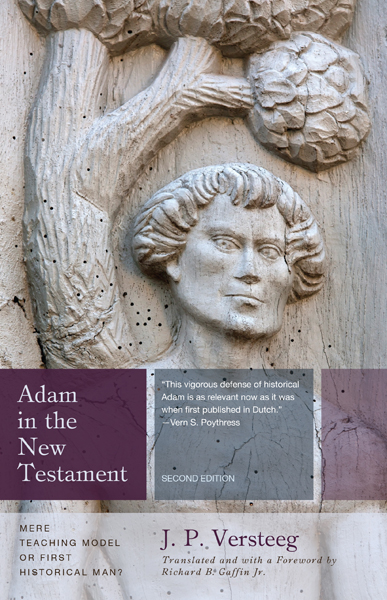
Adam in the New Testament (review) — Rev. Peter Holtvlüwer

Versteeg_Adam.indd

Today we are pleased to present a review of an important little book first published in Dutch several decades ago.  According to Dr. Vern Poythress, “This vigorous defense of historical Adam is as relevant now as it was when first published in Dutch.”  We couldn’t agree more.  This review by CanRC pastor Rev. Peter Holtvlüwer (Spring Creek CanRC, ON) was first published in Clarion and is republished here with permission.

***************************

Adam in the New Testament: Mere Teaching Model or First Historical Man? by J.P. Versteeg. Translated by Richard B. Gaffin Jr. (Phillipsburg, NJ: P & R Publishing, 2012). First edition 1978. Apprx. $12 from your local Christian book seller.

This is a great book for evangelical and especially Reformed scientists, scholars, teachers and ministers – let me tell you why.

Pressure from Science

Under the pressure of scientific discovery and evolutionary theory, more Reformed scholars and scientists are feeling the academic heat to drop the long-held Christian conviction that the human race began with one man, Adam, as Genesis 1-3 relates. Websites like Biologos (whose authors describe themselves as “evangelical Christians”) openly accept evolution of humans from earlier life forms and consequently think that, at best, Adam and Eve were one pair of humans along the way.

PCA ruling elder and Old Testament scholar Dr. Peter Enns is a leading figure calling for also Reformed Christians to reject the Genesis account of Adam as historical, insisting that God did not intend it to literally describe human origins. For those of us working in a secular scientific or academic environment, such a call is tempting. Why stand against much of what our colleagues believe to be true if we really don’t need to?

But that call is shown by this book to be the Siren calling from the rocks, leading ultimately to the sinking of our faith. This little gem of a book (it’s only 67 pages) speaks as freshly and incisively to the subject as it first did in 1978. Translator Richard B. Gaffin, OPC minister and retired professor of Westminster Theological Seminary, has helped the Reformed and evangelical communities by making this essay of Rev. J.P. Versteeg widely available once again. Rev. Versteeg served as New Testament Professor at the Theological University of the Christelijke Gereformeerde Kerken in Nederland (in Apeldoorn) (sister churches to the Free Reformed Churches of North America). In it he demonstrates that at stake in Adam’s historicity is nothing less than the gospel itself.

Adam a Historical Person?

The beauty of this book is that Versteeg moves the controversy concerning the historicity of Adam away from the immediate context of Genesis 1-3 and looks at it from the perspective of the New Testament. This has the advantage of getting away from the scientific controversies surrounding the origins of the world and of mankind and concentrating instead on what Christ and the Apostles believed and taught about Adam. Since the Bible is its own best interpreter, this approach is surely worthwhile and can be a corrective should current scientific theory press a person to take a wrong turn in Genesis 1-3.

Versteeg’s essay was, naturally, written in his context – the Netherlands in the mid-1970s. But he addresses a teaching then prevalent which is resurfacing in our time on this side of the ocean, namely that Adam was used by the New Testament writers as a sort of “teaching model.” This view teaches that for Paul and the other NT authors, Adam is no more than a pedagogical example to explain some truth about Christ and Christianity. The authors did not assume or need to believe that Adam was a real man, the first man, created in the literal manner described in Genesis 1 and 2. In a careful, judicious and highly readable manner, Versteeg challenges and refutes that claim as he exegetes each passage in the NT where Adam is mentioned by name.

Gaffin on Peter Enns

Another valuable contribution this book makes is Gaffin’s introductory essay in which he outlines the present-day controversy. This helps a reader to get a feel for the various arguments being made today. Gaffin uses the writings of Peter Enns as an example, providing quotations and footnotes and evaluating his writings fairly but firmly. He draws out the dangerous consequences of Enns’ views. It takes courage to publicly address a former colleague (both were professors at Westminster Theological Seminary) on his erroneous teaching (which is also done publicly) but how necessary it is to preserve the church from error! We may thank the Lord for the courage and clarity which Dr. Gaffin has been given and now presents to us in his essay. This essay alone is easily worth the price of the book.

Though others will benefit from this book, I would especially urge every minister, teacher, academic, scholar and scientist in Reformed or evangelical circles to read this book. It may confirm you in the ancient teaching of the church and the historic Reformed conviction concerning Adam or it may gently correct your thinking on the topic. It will certainly educate you on the finer points of exegeting what the Bible itself says about Adam. I hope it will help you withstand pressures to set aside the clear teaching of Scripture in favour of man’s scientific theory. Whatever the case, it definitely won’t leave you unaffected. Edifying and recommended!

Clarifying what we’ve always confessed

14On March 11, Classis Ontario West adopted an unusual proposal from Hamilton’s Providence Canadian Reformed Church: Providence wants an addition made to the Belgic Confession.

As they explain in their proposal, our confessions differ from Scripture in that they aren’t perfect or sacred…so they can be amended or edited. That has happened in the past: for instance, at the 1905 General Synod of the Reformed Churches in the Netherlands a number of words were deleted from Belgic Confession Article 36 “in an effort to better conform to biblical teachings on the role of civil government.”

But why would a change need to be made now? Because “the Canadian Reformed Churches presently face a significant doctrinal challenge in the area of origins.”

What change does Providence propose? They want to replace the first line of the Belgic Confession’s Article 14 with the following to clarify “our confessional and biblical stance on human origins” (new wording is italicized):

We believe that God created the human race by making and forming Adam from dust (Gen. 2:7) and Eve from Adam’s side (Gen. 2:21-22). They were created as the first two humans and are the biological ancestors of all other humans. There were no pre- Adamites, whether human or hominid. God made and formed Adam after his own image and likeness, good, righteous, and holy.

As the proposal notes, many believe that our confessions are already quite clear on this topic. However, the fact is some Canadian Reformed academics have joined together to argue that the confessions leave room for a great diversity of views on how mankind came to be. This group, Reformed Academic, includes some very prominent figures: Dr. Arnold Sikkema, Dr. Jitse Van der Meer and Dr. F.G. Oosterhoff. They have a diversity of views amongst themselves, and it can be hard to figure out just what they each believe about Man’s origins. On the group’s blog they have allowed their most outspoken (and clearest) member, Dr. Jitse Van der Meer, to outline what he considered strong evidence for the possibility that man and chimpanzees have a common ancestor.

Does that mean Dr. Van der Meer is affirming the evolution of man from some relation of chimps? Well, there is a nit that can be picked here: relating strong evidence for evolution is not necessarily the same thing as affirming evolution. As Dr. Sikkema noted in a response to the proposal, even a creationist like Dr. Todd Wood has acknowledged that there are strong evidences for evolution.

But, of course, there is acknowledging and there is acknowledging. While both Reformed Academic and Dr. Wood acknowledge the evidence for evolution only Dr. Wood acknowledges that God created Man over six literal days and not via a process that involved pre-Adamites and millennia upon millennia of death, disease, and disaster, which He thereafter declared “good.” Context is key.

In his response to the proposal Dr. Sikkema argued that Providence Church had misrepresented him in supporting materials by labeling him a “theistic evolutionist”:

I don’t “believe in evolution.” It’s not about belief. I don’t believe in Einstein’s theory of gravity either, but I do believe in a good, loving, and covenantally faithful Triune God…

Dr. Sikkema uses the term “belief” here in the sense of “place my hope in.” In that sense he believes in God, but not evolution or Einstein’s theory of gravity. However, no Christian anywhere “places their hope” in evolution, so if that is what it means to “believe in evolution” it is not surprising Dr. Sikkema rejects the label “theistic evolutionist.” As he has redefined the term it can’t be applied to anyone at all.

But what if we give the term a more reasonable definition? What if we say a theistic evolutionist is “someone who argues that God-directed evolution is a legitimate possibility”? Then the term applies. In a joint blog post (responding to the charge that, “evolution falls outside the tent of the Reformed confessions” Dr. Sikkema and the other members of Reformed Academic wrote:

…God-directed evolution does not exclude the direct creation of Adam, because everything that happens is under God’s direct control. Therefore, theistic evolution is not outside the boundaries of the Three Forms of Unity [i.e. the Heidelberg Catechism, the Canons of Dort, and the Belgic Confession].

Other objections have already been raised, some of note (an edit will be needed to acknowledge that Eve, too, was made in God’s image), but very few of which wrestle with what is at stake here. To paraphrase Douglas Wilson, did Adam bring death into the world (Romans 5:12) or did millions of years of death and dying bring Adam into the world? Providence’s proposal specifically and clearly rejects the latter and calls upon our churches to do the same.

The proposal’s critics are going to fall into one of two camps. There will be:

  1. Those who argue it isn’t necessary because they believe the Confession already rules out pre-Adamites.
  2. Those who argue it isn’t necessary but who won’t rule out pre-Adamites.

If the critics all fall into the first camp, Providence’s proposed addition isn’t needed. Conversely, if there are any who fall into the second camp, that will highlight why we need to clarify our Confession.

There will also be some who make a show of being in the first camp with carefully parsed statements such as, “it could be argued that the Confession already rules out evolution.” While that sounds very first camp-ish, it can be a clever way of saying, “some people – not necessarily me, mind you – could argue…” We should view such critics who won’t be clear as strengthening the case for Providence’s clarifying proposal.

Lots of work, research, and thought has gone into Providence’s proposal, and you should read it for yourself. Along with the supporting appendices, you can find it here.

A version of this post originally appeared in the March 2015 issue of Reformed Perspective.

Test of Faith: Challenging Assumptions

In this and subsequent posts, my plan is to critically examine the assumptions made in a video that has been made available on the “Test of Faith” channel on YouTube. Before reading these responses, take a few minutes to watch this video:

In this presentation, Dr. Deborah Haarsma, president of the BioLogos Foundation, and former professor and chair of the physics and astronomy department at Calvin College, makes a number of claims that we must examine critically before either accepting or rejecting them.

The first statement that I would like to examine is this one:

God didn’t bother to teach the ancient Hebrews that the world was actually round. He didn’t bother to teach them that it was actually atmosphere in the sky instead of a solid sky dome. He let them keep believing that. He accommodated the message to where they were at.”

There are a number of unproven claims in Dr. Haarsma’s discussion of the relation of science and Scripture in this video, several of which are heard in this statement alone. Here they are:

  1. The ancient Hebrews did not believe that the world was round.
  2. The ancient Hebrews believed that there was a solid sky dome over the earth (the “firmament”).
  3. God accommodated the message of Scripture to “where they were at,” in their lack of precise scientific knowledge, and their beliefs about the form of the heavens and the earth.

But before we even begin examining these claims, we need to deal with an assumption that goes unmentioned, an assumption that must necessarily be true if Dr. Haarsma’s claims actually have a bearing on how we interpret the Genesis account of creation. And that assumption is a simple one: that the original audience of the creation account was “the ancient Hebrews.”

I’d like to begin by questioning the assumption that the creation account was originally written by Hebrews for Hebrews – that Moses (or a later author) tailored his message to his audience, speaking to them specifically on a level that they could understand. Many modern scholars have actually concluded that Genesis was written much later than the time of Moses, in which case the author or editor would have been addressing a different culture with different concerns.

Why question those assumptions? Isn’t Genesis one of the “five books of Moses”?

Yes, it is, and there’s no reason to conclude that Genesis was written by someone else, much later than the time of Moses, as many critical scholars now assert. But rather than assuming that Moses wrote Genesis “from scratch,” wouldn’t it make sense that he used previously existing documents, perhaps even documents passed down from ancient times, and used them as his source material?

The book of Genesis is divided into eleven sections, which are marked off by the words, “These are the generations of…”. They’re often referred to as the “toledoths,” because of the Hebrew word for generations. The first toledoth is found in Genesis 2:4, “These are the generations of the heavens and the earth,” and the last in Genesis 37:2, “These are the generations of Jacob.”

Many scholars believe that these statements are headings – that they introduce the chapters that follow. Some, however, believe that they are colophons – that they conclude the sections that precede them. So, in the case of Genesis 2:4, we can read, “These are the generations of the heavens and the earth” as referring to the preceding passage – Genesis 1:1 to Genesis 2:3. In the same way, Genesis 5:1, “This is the book of the generations of Adam,” would refer back to Genesis 2:5 to Genesis 4:26.

Why does this make any difference at all? Because especially if they are colophons, they may serve to indicate previously existing written works that Moses used as his source material in putting the book of Genesis together into its final form. Who knew the story of creation better than any other human? Of course Adam did. Adam lived 930 years. Could he have developed a system of writing during those ninety-three decades of life? I think it highly likely that he would have. Could he have written down what the LORD revealed to him, and what he had experienced during his life, to preserve that message for future generations? He certainly could have.

Whenever God wanted to preserve his message, he had it written down. It is often assumed that oral transmission over generations was central to bringing God’s message from generation to generation. But since written transmission of information is far less subject to error and amendment than oral tradition, it makes sense that these things would have been written down, to preserve the message for generations yet to come.

A number of examples in Scripture reveal that literacy rates were higher, even among common people, than is often assumed (Deut. 24:1-3; Num. 21:14; Deut. 6:8,9; 11:18-20). The terms used in Genesis 26:5, for example, provide evidence that God had his word written down long before the time of Moses; the LORD says about Abraham in this verse that he “obeyed my voice and kept my charge, my commandments, my statutes and my laws.” The Hebrew word for “statutes” in this verse has a root meaning “to mark for oneself; from the base meaning of carving or engraving is by extension the act of writing; the communication itself, regulation.” Those statutes were very likely written statutes!

In the end, my point is this: we cannot simply assume that the ancient Hebrews were the original “target audience” for the creation account. This account had been extant for centuries before the first ancient Hebrew appeared on the scene, and that knowledge was not limited to the descendants of Abraham. Now consider the fact that the earliest humans enjoyed incredibly long lives in comparison to our own, and that they had not suffered from generations of genetic mutations which would surely impede intellectual growth and development. These ancient humans were likely very intelligent individuals, with centuries of life experience, learning, and experimentation to draw on.

Our way of thinking about ancient humanity has been highly influenced by the evolutionary paradigm. When we think about Adam, and Cain and Abel, and Enoch and Methuselah, we may think of “cavemen” type humans – struggling to understand how to make a fire, working with simple tools, assuming that the world was flat, not knowing anything about the world outside of the very limited area in which they lived.

We need to discard that assumption; Adam was an intelligent man, the first scientist, who named and classified the animal kingdom, who probably travelled widely. Even after the fall into sin, he must have retained his original intelligence, and with the years of life that were allotted to him, he would have developed an astounding array of knowledge, which he had opportunity to pass down to his children, grandchildren, great-grandchildren, great-great grandchildren, and so on.

So I call this first assumption into question, and that means I also call the conclusions that follow from that assumption into question. In short, we cannot assume that the original audience of the creation account as we have it in Genesis 1 and 2 was in fact the “ancient Hebrews.”

And following from that, we cannot assume that this original audience was ignorant about the physical nature of the heavens and the earth, and that God accommodated his account to their ignorance. There is no doubt that many people fell into ignorance, unbelief, and disobedience after the fall; this is what led to the destruction of humanity in the flood. And after the flood, sin and rebellion against God also led to widespread idolatry, ignorance, and rejection of God’s Word.

But throughout it all, God preserved his Word from generation to generation. We have this Word in Genesis and the other 65 books of the Bible. We must examine critically our own assumptions, and the assumptions of others, as we seek to understand its message.