The Rationalistic Attack on Scripture (Louis Praamsma) — 1

Dr. Louis Praamsma was the pastor of the Fruitland Christian Reformed Church, near Hamilton, Ontario.  By 1979, he was officially retired.  However, he continued to write and especially to contribute to the fight for orthodoxy in the CRC.  In the late 1970s, men such as Allen Verhey and Harry Boer were undermining biblical inerrancy and the CRC tolerated it.  It was in this context that Louis Praamsma wrote a pair of articles for The Outlook.  There he interacted with Harry Boer’s rejection of the doctrine of reprobation.  That happened in the second article published in the January 1980 issue of The Outlook.  In his first article (December 1979), he took on Boer’s attack on Scripture and specifically his accusation that the doctrine of biblical inerrancy is rationalistic.  Though our contemporary context is not exactly the same, there are some parallels and for that reason I think it’s worthwhile to revisit what Dr. Praamsma wrote on this.  This is especially because there is often correlation between an undermining or denying of biblical inerrancy and compromising on creation.  This four-part series was originally published on Yinkahdinay.  Here’s part 1:

********************************

“Rationalism” an Old Charge

Calvinism has often been accused of rationalistic tendencies, of attaching too high a value to reason and indulging too much in reasoning.  Such charges started already with Luther who accused Zwingli of rationalizing about the mystery of the Lord’s Supper, and they continued with persons who called themselves genuine Lutherans (Gnesio-Lutherans) who mercilessly attacked Calvin on the same ground, although Calvin had taken issue with Zwingli and clearly taught the mystical union with Christ at His table.  Calvin and the Calvinists have also been accused of reasoning too much in the area of predestination; the Arminians of the first hour and their most recent successors have never stopped saying that Calvin built a colossal system, starting with an eternal decree of God, and ending with consigning some of the creatures made in His image to heaven, but most of them to hell.  That system, it is said, was not founded on Scripture but a product of the logical arguments of the scholar of Geneva.

Finally, Calvin and the Calvinists have been accused of rationalistic tendencies in the area of revelation; liberal, modern, and neo-orthodox theologians have asserted time and again that Calvinists are the people of a book-religion; that they have included the living Word of God in a book with propositional truths; that they have applied all their logical acumen in order to harmonize the disconnected and discordant words of that book.  One of the last ones (to my knowledge) to make this kind of accusation has been Dr. Harry Boer, when he wrote, “We have learned that reprobation exegesis in the Reformed tradition is an unprincipled, ruthless exercise that bends any desired Scripture in its foreordained meaning” (Acts of Synod of the CRC, 1977, 678).

It is at this point that I would ask the question: rationalism – on which side?  Bending of Scripture – on which side?  And I would like to point out two things that are presently under discussion among us and are referred to as ‘problems’ nowadays, firstly that of the authority of Holy Scripture and secondly that of predestination (election and reprobation).

Historic Faithfulness to Scripture

As far as the first point of doctrine is concerned, I would stress the fact that Calvinism in general and the Christian Reformed churches in particular, thus far have been marked by their faithfulness to Scripture.  Without any hesitation the Bible was called an ‘infallible rule’ (BC article 7), and faith was considered ‘a sure knowledge,’ whereby I hold for truth all that God has revealed to us in His Word (HC QA 21).  Even more significantly, our churches owe their identity to, have been fathered and mothered by courageous men and women who seceded from larger and heterogeneous churches, because the latter were infested by eighteenth- and nineteenth-century criticism of Scripture.

One thing was certain beyond any doubt: we stood upon the solid rock of Scripture and that Scripture could not be broken.

Click here to continue to part 2.

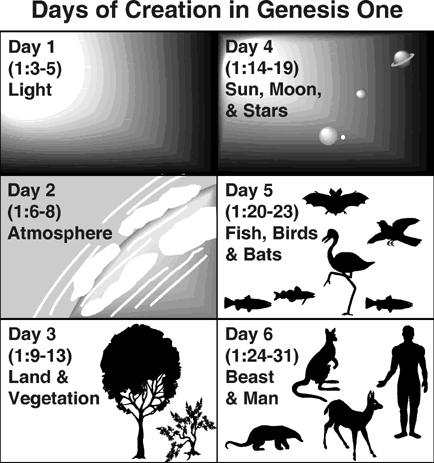
Dr. C. Van Dam: What did the days of the “creation week” consist of?

diagdIt’s common to hear Christians argue that God’s creative work should not be thought of in terms of six normal days.  Instead, we’re told that we should open to the possibility that these days were much longer periods of time, perhaps even billions of years.  These arguments have been around for a while.  In today’s featured article (which first appeared in 1989), Dr. C. Van Dam addresses these arguments and demonstrates how Scripture can and must be taken at face value on this matter.  You can find the article here.

Readers interested in a more detailed treatment of this topic should check out Rev. Paulin Bédard’s book In Six Days God Created.  The book can be purchased at this link and a review of it can be found here.  Highly recommended!

Dr. C. Van Dam: The First Day

Dr. Cornelis Van DamWe’ve just added another helpful article by Dr. C. Van Dam.  First published in 1989 in Clarion, this article looks at the nature of the first day.  Specifically, Van Dam looks at whether it is impossible to believe that there was light before there were light-giving or light-reflecting objects like the sun, moon, and stars.  After all, according to Genesis 1, these celestial objects didn’t appear until the fourth day — and yet light is said to have been created on the first.  Here too, the Word of God is completely trustworthy.  You can find the article under our “Articles” tab, or by clicking right here.

Follow the Evidence?

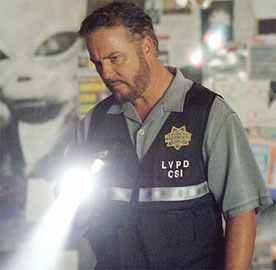
gil-gThere was a refrain frequently heard on early episodes of TV’s CSI: Crime Scene Investigation. Gil Grissom was training rookie crime scene investigators, sharing with them his many years of experience in the field. Grissom would often say, “Follow the evidence…” The understanding was that just following the evidence would lead to the perpetrator of the crime. Following the evidence would lead to the truth.

In the world of TV crime scene investigation, this might usually work as a sound philosophy. Even there, occasionally writers and producers have explored the possibility that the evidence can be tainted by factors related to those investigating it. The evidence is not always interpreted objectively and thus conclusions (right or wrong) can still ultimately be reached on the basis of prejudice or gut feeling. The philosophy sounds good in principle, but it doesn’t always work out in practice.

Moving into the real world, the principle of “follow the evidence” is the basic philosophy behind much of Christian apologetics today. Walk into a vanilla Christian bookstore these days and if they have an apologetics section, likely everything there will be based on this principle. Lee Strobel is popular with his The Case for a Creator, The Case for Faith, and The Case for Christ. I won’t discount everything he writes in these books, but it should be noted that his basic principle is the same as CSI Grissom: follow the evidence. The same is true for the majority of others writing on the subject of apologetics today. For that reason alone, this principle needs critical evaluation.

Yet there is another reason why we should pause for careful reflection. We’re in the throes of debate on the compatibility of Christianity and evolution.  We ought not to kid ourselves, these issues are not going away. If the historical experience of the Christian Reformed Church is any indication, we should expect proponents of theistic evolution to keep trying until they not only make room for their position, but also gain converts to the point of having their position as the dominant one.

In this discussion, the allegation has been made that young university students have been sent into turmoil when encountering the evidence for evolution. As the story has it, these students were taught creation science at home, church, and school. They were told that the evidence made it clear that God had created the world ex nihilo (out of nothing) in six ordinary days some thousands of years ago, not millions or billions. Arriving at university, they encounter a different batch of evidences not previously considered. This sends their faith into a tailspin and, so the story goes, some of them even end up committing suicide.

On a superficial level, we can join in bemoaning this approach to such issues. Here is some common ground with those attempting to make room for theistic evolution in our churches. We can agree that something has gone awry with those young university students, though we would still likely disagree on the details. From their perspective, the problem rests with creation science which produces faulty evidence because of certain faith convictions regarding creation. From our perspective, staking your faith on extra-biblical evidences is always problematic. Let me explain why.

The Theological Background of Evidential Apologetics    

Evidential apologetics is a philosophy of defending the faith which rests upon the use of evidence. This system of apologetics is usually traced back to Joseph Butler (1692-1752), an Anglican bishop. Butler lived during the time of the Enlightenment, also known as “The Age of Reason.” Serious challenges were being posed against the Christian faith. Rationalism, the belief that reason could provide the basis of all knowledge, had infiltrated not only society, but also many churches. The Enlightenment was a weak period for theology, and Reformed theology was also affected (or better: infected).

Butler recognized that Enlightenment philosophy endangered the Christian faith. In particular, he saw the danger deism posed. Deism is the belief that God is a clockmaker. He created the universe and then wound it up like a clock. He removed himself from it and is no longer intimately involved with it. According to deism, God takes an arms-length approach to the world. Butler rightly saw that this philosophy was in conflict with the teachings of the Bible.

In 1736, Butler published a book entitled The Analogy of Religion. This work was a response to deism. It was a defense of the faith. Butler aimed to show there are no sound objections to the Christian religion. He said all the evidence, especially the evidence in the natural world, points to the very probable truth of Christianity. As long as a person doesn’t ignore the abundance of evidence, he or she should not reject the Bible or any of its teachings. Unprejudiced minds, said Butler, would see the design inherent in the world and almost inevitably reach the conclusion that there is a Creator. A fair evaluation of the external evidence would likely push the open-minded unbeliever to accept the Bible. Butler purposed to demonstrate the truth of the Bible through facts, evidence and logic – and he believed it was not only possible to do this, but also pleasing to God.

When evaluating Butler’s approach, we have to remember the importance of what we call presuppositions. These are our most non-negotiable beliefs or assumptions about the way the world really is. Butler was an Arminian and one of his presuppositions was that man had not fallen so far as to completely corrupt his thinking. He did not confess the doctrine of pervasive (or total) depravity found in the Canons of Dort, but repudiated it. This had consequences for his system of apologetics. So did another related presupposition: the freedom of the will of fallen man. According to Butler and other Arminians, fallen man retains free will to choose for or against God. He need only use his faculties rightly in order to make the right choice.

While Butler saw the dangers of the Enlightenment and wanted to combat deism in particular, the weapons of his warfare were earthly and unscriptural. We might wish that Butler was a mere footnote in the history of Christian apologetics, but unfortunately his approach became widely accepted. Much of what we see today in non-Reformed (“evangelical”) apologetics finds its historical roots in the Arminian apologetics of this Anglican.

Evidential apologetics, historically and in its modern form, makes its case based not only on the evidence (and the nature of evidence), but also on a certain understanding of human nature. According to this system, human nature is not pervasively depraved. The human intellect is not fallen or dead in sin, only weakened or sick. Neutrality is not only possible, but a reality. When confronted with the evidence, and with perhaps a little help from God, the unprejudiced man will recognize the truth and turn to the Bible and believe it. This is Arminian theology applied to apologetics.

Unfortunately, this system has been appropriated by many involved with creation science. Many creation scientists have been Arminian in their theological convictions, so this should not come as a surprise. It is only consistent for Arminians to adopt evidential apologetics, whether in general, or whether specially applied to the question of origins. Inconsistency emerges when Reformed believers adopt this approach. “Following the evidence” is not our way.

A Biblical Approach

When we approach the question of evidence, we need to do so with Reformed, which is to say biblical, presuppositions. There are several of them we could discuss. However, in the interests of time and space, let me restrict our discussion to two of the most important. These are the presuppositions — the non-negotiable beliefs that will govern how we consider the place and use of evidence in apologetics.

The first is our confession regarding the nature of fallen man. As Ephesians 2:1 puts it, the unregenerate person is dead in transgressions and sins. This spiritual death extends to all the parts of a fallen human being: heart, mind, and will are all without a sign of life. When it comes to the Christian faith, fallen man does not have the capacity to interpret the evidence rightly. What the fallen man needs is regeneration. He needs to be made alive by the Holy Spirit. The Holy Spirit needs to open his eyes so that he may see, understand, and believe. The Holy Spirit does this work of regeneration through the Word of God. Therefore, the Word of God, not external evidences, needs to be the focus of our apologetical efforts. From a Reformed perspective, apologetics involves bringing the Word of God to bear on unbelief to expose its futility and to vindicate and commend the Christian worldview.

A second necessary presupposition builds on that. We always start with a belief that the Bible is God’s inspired, infallible, and inerrant Word. Those doctrinal positions are not conclusions that we reach through reasoning and proofs. They are held in faith. We hold to what is called the self-attesting authority of Scripture. That means the Bible attests or confirms its own authority. It does not need to be proven. The Bible claims to be the Word of God and we receive it as such. This is a settled truth for Christians. Therefore, the Bible is the basis and standard for all our apologetics. We are defending the Bible and the biblical worldview, but the Bible is also the guide for how we defend the Bible. The Bible gives us the means and strategies to use in defending the Bible.

Where does that leave external evidences? Well, for one thing, we do not build our system of apologetics upon them. Instead, our system has to be grounded on the Word of God. The Word is the supreme authority, not outside evidence. The Holy Spirit does not promise to regenerate people through external evidences. He does promise to do that through the Scriptures, though it is not inevitable in every case, obviously. What’s more, because evidence is always interpreted evidence, and the interpretation is always done by sinful minds, evidence must always be evaluated according to the supreme standard of the Word of God. Since there are no neutral facts or neutral methods for considering the facts, the Word must always be recognized as standing over the facts. It must be the grid through which the “facts” are sifted.

There is a place for evidence in apologetics and in the debate about origins. Evidence from outside the Bible can corroborate the Bible’s teachings. However, it is not the starting place, nor is it the authority. Moreover, external evidences can be fickle. What was thought to be evidence in one generation can turn out to have been misinterpreted by the next. How do you stay off what one writer called “the evidentialist roller coaster”? How do you stand firm against humanists and theistic evolutionist compromisers? Not by retreating to evidence, but by standing firm on what the Word of God teaches. And by evaluating all evidence in the light of the Word of God. That also means being open to the possibility that external evidences, whether for or against biblical teaching, may be wrongly interpreted. When it comes to evidences, one should retain a level of skepticism. After all, creation scientists and humanists/theistic evolutionists are all human beings, prone to sin and to mistakes. The only firm foundation is the Word of God.

Conclusion

“Follow the evidence” might be acceptable for fictional TV characters, but in God’s world his children can’t accept this procedure when it comes to apologetics. To “follow the evidence,” as if we are all neutral observers of the world is to sell out on our fundamental presuppositions. It’s regrettable that the surge of interest in apologetics has led some in our Reformed community to dabble with evidentialist apologetics. It’s sad too that we have often imbibed these apologetics as mediated to us through some creation scientists and their organizations.

Thankfully, in the last number of years, some creation scientists have adopted a Reformed, presuppositional approach to the question of origins. Most notable are Dr. Jonathan Sarfati and Dr. Jason Lisle, both affiliated with Answers in Genesis. Some time ago I reviewed Lisle’s book, The Ultimate Proof: Resolving the Origins Debate, and I want to take this opportunity to again commend it to you as a good example of how to apply Reformed apologetics to this issue. Some of Lisle’s final words in The Ultimate Proof provide a suitable conclusion: “Our defense of the faith comes from learning to think and to argue in a biblical way. God is logical, and we should be too. God tells us that all knowledge is in him (Col. 2:2-3), so we should train ourselves to recognize this fact” (173).


An earlier version of this article was originally published in Reformed Perspective magazine.  It appears here with their gracious permission.

Alternatives to Changing the Belgic Confession?

14Theistic evolution is a significant doctrinal challenge facing the Canadian Reformed Churches. When I say “theistic evolution” I mean such ideas as the biblical Adam and Eve sharing an ancestry with primates. I mean such ideas as God bringing Adam and Eve into existence in the wombs of hominid (human-like creatures) females, instead of through immediate creation with physical dust of the earth. These ideas exist in the Canadian Reformed Churches and to allow them to continue will spell the death of biblical orthodoxy for us.

There is a proposal circulating at the moment which targets this false teaching. The proposal seeks to do that by having General Synod 2016 make a change to article 14 of the Belgic Confession. This change would explicitly rule out the ideas mentioned above, making clear that these notions have no place in Reformed churches which submit to God’s Word.

It is fair to say that a majority of Canadian Reformed members would agree that this teaching is wrong and dangerous. Were a survey to be conducted, I am confident that most of our people would agree that theistic evolution should have no place in the Canadian Reformed Churches. Yet, as the proposal illustrates, we have this situation where it currently does have a place. We have a problem in that this teaching has been allowed to go on and consequently more people are being confused or led astray by it. But how do we deal with this serious issue? For whatever reason, there is some reluctance to change the Belgic Confession. We would rather pursue other alternatives first before doing something as momentous as what this overture is proposing. In this post, I want to briefly explore four of the most commonly mentioned alternatives. At the end, it will be clear that, realistically speaking, there is no other choice.

Discipline?

Some have argued that a change to the Belgic Confession should not be necessary. Instead, what needs to happen is that those who are teaching theistic evolution should be placed under discipline. The confessions are clear enough as they are and it’s obvious that this teaching is unorthodox. Churches just need to muster the courage to discipline the members who are denying what we confess. This argument was made by Irish pastor Martyn McGeown in a recent issue of the Protestant Reformed magazine, The Standard Bearer, as he commented on the BC 14 proposal adopted by Classis Ontario West of March 11, 2015. It’s easy for Rev. McGeown to stand on the sidelines across the pond and make this argument. Rev. McGeown isn’t Canadian Reformed and doesn’t understand the gravity of the situation in which we find ourselves here. I doubt any outsider can comment responsibly on what we’re facing.

We are facing a situation where there is now considerable confusion about whether this teaching conflicts with the Three Forms of Unity. This uncertainty exists even amongst some who are office bearers. In my last installment, I quoted from a Canadian Reformed pastor who affirmed that we need to have ecclesiastical clarity on whether theistic evolution is outside the bounds of the Three Forms of Unity. At least one other pastor has publically opined that those accused of teaching this are not really teaching this at all, thus there’s no problem that needs to be addressed. How can discipline take place when there is so much confusion and uncertainty in our churches about whether the promotion of theistic evolution is happening and whether it warrants discipline? Moreover, discipline does not address others who, while themselves not amenable to theistic evolution, think it should be tolerated within our Reformed churches. Finally, the proposal itself mentions that discipline has limitations when dealing with a widespread doctrinal challenge: in our churches, discipline is typically dealt with in closed session at ecclesiastical assemblies and decisions rendered are often considered to be binding only in that particular case – after all, how can a discipline decision made in closed session be publically binding upon the whole federation? (See Van Oene, With Common Consent, pages 154 & 213). Even if one only takes into account the office bearers and their awareness of these sorts of decisions made in closed session, what happens when a discipline case is only appealed up to the classis or regional synod level? Only the office bearers in that classical or synodical region might be aware of the decision, and then only the currently serving office bearers. This approach simply does not work in our context. We need an official binding statement made in public that applies right across the federation.

A Doctrinal Statement?

Others might be inclined to say that we should have a doctrinal statement from Synod, rather than a change in the Belgic Confession. What this alternative involves is Synod issuing a statement or position paper which condemns the false teachings we’re currently faced with. One could perhaps envision Synod 2016 coming out with a point by point refutation of the errors of theistic evolution, and a corresponding point by point statement of what the Bible teaches about human origins.

All I really need to say here are two words: “Nine Points.” If those words don’t ring a bell, the Nine Points of Schererville were issued by a URCNA Synod in response to the false teachings of the Federal Vision movement. These Nine Points (followed later by Fifteen Points at the next URC Synod) created confusion and controversy in the URCNA, and consternation amongst many in our churches. Many CanRC observers thought that this “extra-confessional” statement was all too reminiscent of what happened in the Netherlands before and during the Liberation of 1944.  Extra-confessional synodical statements were made binding and this was a major cause of the Liberation.

In view of the reception of the Nine Points among us, it is really reasonable to expect a CanRC synod to issue a doctrinal statement or position paper? If that should somehow happen, would it actually bring clarity? What would be the status of such a statement? Would office bearers be expected to subscribe to it? Would it be confessional or not? If not, could it still be used to prosecute false teachers in our churches?

All of the questions asked about the Nine Points would be asked here too and we would be faced with an unhelpful quagmire. This is obviously a non-starter for our churches. We have to be realistic. Because of our history, we just don’t “do” doctrinal statements or position papers. Moreover, there are many issues that might warrant a position paper: divorce and remarriage, homosexuality, Christian education, and so on. There’s really only one issue that would truly benefit from a change to our confessions, and that’s this issue of theistic evolution.

A Footnote?

Similar to the doctrinal statement approach is the idea of a footnote added to article 14, or perhaps article 12. Rev. Clarence (a.k.a. “Klaas”) Stam floated this idea in an article in the April 20, 2015 issue of Clarion. At first glance this sounds like a fine way to avoid changing the text of the Confession while still bringing clarity to the issue at hand. However, it actually confuses things even more and raises more questions than it answers. Questions like: what would be the status of such a footnote? Does anybody know what the status of our one existing footnote is (in BC 36)? When office bearers sign the Form of Subscription, would they subscribe to this new footnote? When members of the congregation make Public Profession of Faith, do they express commitment not only to the Three Forms of Unity, but also to this proposed footnote? Can a member be placed under discipline for teaching something contrary to a footnote? If it’s proposed to make such a footnote binding in any way, wouldn’t it die under the protest of “extra-confessional binding”?

All those questions need clear answers before a footnote is a reasonable alternative. I think we can all recognize that, like a doctrinal statement, any footnote proposal is not going to be well-received in the Canadian Reformed Churches. Not only are there all those questions, but there really is no precedent for it — the one existing footnote (in BC 36) did not appear in response to a serious doctrinal challenge. There is, however, a precedent for responding to false teaching by amending the Confession. Doing this leaves absolutely no ambiguity in terms of status. It really is the only way forward for the Canadian Reformed Churches.

A Study Committee?

Making a substantial change to the Belgic Confession is not a light matter – it should never be done recklessly or on a whim. Adding or taking away from articles should be done soberly and with careful reflection. Consequently, some might say that this proposal is moving too quickly. Rather than make a change right now, Synod 2016 should appoint a committee (perhaps a church) to study the matter and then report to Synod 2019 with analysis and recommendations.

In response, this proposal was not developed on a whim. Those involved with producing it (myself included) have been addressing these issues for several years already. We’ve had to do that because this false teaching has been circulating in our churches for no short period of time. There is an urgent need to address this unbelief sooner rather than later. Appointing a study committee will allow yet more time for these wrong ideas to dig deeper roots in our circles. Rather than giving that time, the appropriate response is to take action now by making this well-considered change to the Confession.

Furthermore, appointing a study committee dignifies this teaching and could give the impression that it is one where Christians might legitimately disagree with one another. It could be perceived as saying that Scripture is not really clear on the matter. However, there are certain issues where the biblical lines are clear and discussion is inappropriate. An analogy might help to make this clear.

Imagine if a group of people in our churches started teaching that celibate homosexual relationships fall within the bounds of the Reformed faith. After all, there is no place in our Reformed confessions that explicitly and obviously rule out such relationships. Should we appoint a study committee to look into this? Isn’t Scripture clear that such relationships are unacceptable in the sight of God? Why would we dignify an unbelieving approach to Scripture by appointing a study committee on such a matter? This is what our Dutch sister churches did by appointing a study committee on women in office. If Scripture is clear, there is nothing to study. There is only the call to believe what God’s Word plainly says. It is as clear from God’s Word that Adam and Eve were created from literal dust (with no evolutionary history) as it is that homosexual relationships are illicit.

Conclusion

Should this proposal (or another like it) find its way to Synod 2016, it will be assigned to an advisory committee. It could happen that the advisory committee looks at this sort of proposal and decides that it is not the best answer to the problem facing us. An advisory committee could advance a different approach. However, I maintain that there is no other viable or helpful way to address the issue of theistic evolution at this stage of the debate in the Canadian Reformed Churches. What we need is a stand that is both clear and unambiguous in its status in our churches — and we need it sooner rather than later. In short, we must make this change to article 14 at Synod 2016.