Keller: Can we take Genesis 1 literally, if we hold that God used evolution to create?

As I explained in the last blog entry, Keller entertains the real questions Christians ask when they are told that biological evolution is compatible with the Bible. The first “layperson” question considered by Keller is, “If God used evolution to create, then we can’t take Genesis 1 literally, and if we can’t do that, why take any other part of the Bible literally?” Keller’s short answer is, “The way to respect the authority of the Biblical writers is to take them as they want to be taken. Sometimes they want to be taken literally, sometimes they don’t. We must listen to them, not impose our thinking or agenda on them.”

At first glance this is a solid answer—the Bible has authority! But I’ll have more to say about that below.

Genre and intent

Keller expands upon his answer first by delving into the genre of Genesis 1 because “the way to discern how an author wants to be read is to distinguish what genre the writer is using” (3). “How an author wants to be read” is a bit ambiguous, but I’ll take it to refer to authorial intent (Keller’s point is going to be whether or not the author wants us to read Genesis 1 literally and chronologically). The link he proposes between genre and authorial intent, however, is not straightforward. Consider this example: If I use poetry to communicate to my wife how much I love her, my intentions are just the same as if I had written it out prosaically. Even if I used a syllogism, “All my life I have loved you; today is a day of my life; therefore I love you today,” my intentions would still be the same (though she’d call it a silly-gism). It’s true that in poetry I’m more likely to use figures of speech but those as such don’t remove historicity from the poetry. See Psalm 78 for a good example of poetry replete with historical truth.

Genre of Genesis 1

Keller next asks what genre Genesis 1 is and starts his answer with the conservative Presbyterian theologian Edward J. Young (1907–1968) who, he says, “admits that Genesis 1 is written in ‘exalted, semi-poetical language.’” Keller correctly notes the absence of the telltale signs of Hebrew poetry. Yet he also points out the refrains in Genesis 1 such as, “and God saw that it was good,” “God said,” “let there be,” and “and it was so,” and then adds, “Obviously, this is not the way someone writes in response to a simple request to tell what happened” (4). He completes this part of the arguments with a quotation from John Collins that the genre of Genesis 1 is “what we may call exalted prose narrative . . . by calling it exalted, we are recognizing that we must not impose a ‘literalistic’ hermeneutic on the text” (4). Thus this argument is now complete: the genre of Genesis 1 prohibits us from reading it literally.

Screen Shot 2016-03-07 at 5.06.26 AM.png

Misleading appeal to E. J. Young

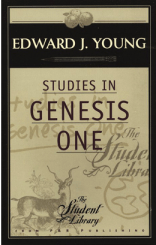
However, if we follow the trail via Keller’s footnote to E. J. Young’s, Studies in Genesis One, we discover that Keller sidestepped Young’s real point. Here’s the fuller quote, “Genesis one is written in exalted, semi-poetical language; nevertheless, it is not poetry” (italics added). Young continued by pointing out what elements of Hebrew poetry are lacking and by urging the reader to compare Job 38:8–11 and Psalm 104:5–9 to Genesis 1 in order to see the obvious differences between a poetic and non-poetic account of the creation. Prior to this paragraph Young had written,

Genesis one is a document sui generis [entirely of its own kind]; its like or equal is not to be found anywhere in the literature of antiquity. And the reason for this is obvious. Genesis one is divine revelation to man concerning the creation of heaven and earth. It does not contain the cosmology of the Hebrews or of Moses. Whatever that cosmology may have been, we do not know . . . Israel, however, was favoured of God in that he gave to her a revelation concerning the creation of heaven and earth, and Genesis one is that revelation (82).

 In note 80 of the same page Young elaborates further,

For this reason we cannot properly speak of the literary genre of Genesis one. It is not a cosmogony, as though it were simply one among many. In the nature of the case a true cosmogony must be a divine revelation. The so-called cosmogonies of the various peoples of antiquity are in reality deformations of the originally revealed truth of creation. There is only one genuine cosmogony, namely, Genesis one, and this account alone gives reliable information as to the origin of the earth (82n80).
Screen Shot 2016-03-07 at 5.09.15 AM.png

With these words of Young guiding our hearts, we turn back to Keller’s statement that it is “obvious” that someone would not compose an account in the exalted style of Genesis 1 “in response to a simple request to tell what happened.” But what if the things therein described happened exactly in that exalted way? Of course we are reading “exalted prose”—precisely because the things described are so wonderful! The literary style not only fits but even reflects the miraculous events. God is glorified repeatedly, all the more because it is literally true.

An old canard: Genesis 1 versus Genesis 2

Keller’s second reason—and strongest, he says—why he thinks the author of Genesis 1 didn’t want to be taken literally is based on “a comparison of the order of creative acts in Genesis 1 and Genesis 2” (4). This argument is a bit more complicated and deserves closer scrutiny than I will give it here. But the basic point is that Genesis 2:5 apparently speaks about God not putting any vegetation on the earth before there was an atmosphere or rain or a man to till the ground. This, says Keller, is the natural order. Genesis 1 is the unnatural order, so it’s not literal. His argument is an old canard, but really it is a lame duck.

Screen Shot 2016-03-07 at 5.21.27 AM.png

Let’s examine it: Keller says that Genesis 1 has an unnatural order because light (day 1) came before light sources (day 4) and vegetation (day 3) came before an atmosphere and rain (day 4). However, he reads the text too quickly here, for the separation of waters above and below occurs on day 2, allowing rain before vegetation. On day 4 God set the light sources in the firmament that was already there on day 2. Further, the old light vs light bearers problem is far from sufficient to jettison the chronological order of the creation events in Genesis 1. And, finally, a normal day without light or water wouldn’t kill these plants anyway.

To continue: the order of events in Genesis 2, especially verse 5, is not in the least contrary to Genesis 1. Rather, whereas Genesis 1:1–2:3 refers only to “God” and focuses on the awesome Creator preparing and adorning the earth for man, Genesis 2:4–25 focus on this God as “Yahweh” who lovingly and tenderly creates the man and the woman, prepares a beautiful garden for them, and who thereupon enters into a loving relationship with them. Each chapter makes its own contribution to the story, with chapter 2 doubling back in order to more fully explain the events of the sixth day. This is a common occurrence in Hebrew prose. Further, we can easily fit 2:4–25 chronologically in between 1:26, “Let us make man in our image” and 1:27, “So God created man in his image . . . male [Adam] and female [Eve] he created them.”

Screen Shot 2016-03-07 at 5.14.16 AM.png

Finally, Genesis 2:4 begins the first “toledoth” or “generations of” statement, which after this becomes a structural divider in Genesis, occurring nine more times. Young argues that we should translate “toledoth” as “those things which are begotten” (59). If we follow this suggestion, we see that Genesis 2:4ff tell us about the things begotten of the heavens and the earth, such as the man, who is both earthly (his body) and heavenly (his spirit), or the garden, which is earthly, yet planted by God. When Genesis 2:5 states that “no shrub of the field” had yet grown and “no plant of the field” had yet sprouted, it portrays a barrenness which sets the stage for the fruitful garden (2:8–14) and the fruitful wife (2:18–25). Further, the “shrubs” and “plants” of the field likely point to cultivated plants that require human tending. Adam will be a farmer. If so, the point of 2:5 is not the lack of vegetation altogether, but the lack of certain man-tended kinds, such as those Yahweh God would plant in the Garden of Eden.

Therefore, we ought to conclude the very opposite of Keller. Whereas he argues that we cannot read both chapter 1 and chapter 2 as “straightforward accounts of historical events” and that chapter 2 rather than chapter 1 provides the “natural order” (5), we most certainly can read both as historical and literal.

Keller pulls together both the genre and the chronology arguments and concludes,

So what does this mean? It means Genesis 1 does not teach us that God made the world in six twenty-four hour days. Of course, it doesn’t teach evolution either . . . However, it does not preclude the possibility of the earth being extremely old (5).

However, both of Keller’s grounds for not taking Genesis 1 literally have been exposed as weak at best.[1] In contrast, E. J. Young’s strong arguments for the literal, historical reading of Genesis 1, a few of which we reviewed here, remain firmly in place. Exalted prose indeed, and true!

Whose authority?

Finally, a word about the authority of the text: Keller states that we must “respect the authority of the Biblical writers.” His wording is similar to John Walton’s in his speeches at a conference I attended in September 2015.[2] Walton frequently spoke of “the authority of the text” and stated that it rested in the original meaning “as understood by the people who first received it.” But missing from both Keller and Walton is the recognition that all Scripture is breathed by God (2 Tim 3:16) and that therefore the primary author is the Holy Spirit (2 Pet 1:21). We are not called just to respect the authority of human writers or of the text, but of God himself! There are passages of Scripture for which the first intention of the human writer—as far as we can discern it—does not reach as far as the divine intention (for example, certain Messianic Psalms such as 2 & 110, or the injunction about the ox not wearing a muzzle as it treads out the grain (Deut 25:4; cf. 1 Cor 9:9; 1 Tim 5:18). In fact, Peter tells us that the Old Testament prophets searched with great care to find out the time and circumstances of the things they prophesied about Christ—implying that the prophecies went beyond the knowledge of the prophets themselves. He adds that these are things into which even angels long to look (1 Pet 1:10–12). Thus, it’s clear that the primary author of Scripture is the Holy Spirit and that the authority of the text resides in his intentions first of all. This is why one of the primary rules of interpretation is to compare Scripture with Scripture. This book alone is God’s Word!

Let us take great care in handling the Word of God, greater care than Keller does on this point. And let us conclude that the text of Genesis 1 itself clearly indicates it is to be read literally, historically, and chronologically (Keller, at least, has not proven otherwise).

[1] In addition, Keller’s note 17 on page 14, linked to a different section of his paper, asserts that prose can use figurative speech and poetry can use literal speech. It appears, then, that he undercuts his own argument.

[2] See my blog entry at https://creationwithoutcompromise.com/2016/02/03/the-lost-world/.

Keller’s advice to fellow Biologos members

Screen Shot 2016-03-02 at 7.02.16 AM

A theological orthodoxy as well-aligned as that of Timothy Keller is hard to find among the increasing numbers of scientists, theologians, and organizations currently urging evangelical Christians to accept biological evolution. He is the pastor of New York’s Redeemer Presbyterian Church (PCA) and is well-known through his writings on apologetics, church planting, and preaching. His 13 page white paper, hosted by Biologos and entitled “Creation, Evolution, and Christian Laypeople,” has been referenced favourably by scientists and theologians in conservative Reformed churches.[1] For example, when Frieda Oosterhoff introduced Keller’s paper some years ago on the Reformed Academic website, she stated,

(Readers of this blog, incidentally, will notice that our blog partner Dr. Jitse van der Meer sees eye to eye with Dr. Kidner in the matter of human evolution, the historicity of Adam and Eve, and the descent of all humans from Adam, and that he affirms the same tentative approach as Kidner and Keller.)[2]

In his paper Keller entertains the real questions of concerned Christians and offers answers as to how to help them integrate evolution with their faith. We have intended to interact with his arguments for some time.

Screen Shot 2016-03-02 at 6.57.28 AM

It’s important to situate accurately our debate with Keller. The debate between us is not whether the Christian faith and current science (or what is claimed to be science) are irreconcilable, for we all agree that in many respects they are reconcilable while in some respects they are not. The debate, rather, is in what particular respects they are and are not able to be reconciled.

The debate between us is not whether evolution is a defensible worldview that gives us the basis of our views on religion, ethics, human nature, etc. We all agree that it is not the “grand theory/explanation of everything.” We all agree that there is a God and he is the God of the Bible—Triune, sovereign, covenant-making, gracious, atonement-providing, and bringing about a new creation. Nor am I debating whether Keller is an old-earth creationist aka progressive creationist or an evolutionary creationist or a theistic evolutionist. His own position is a bit unclear so I will simply deal with what he has published in this paper.[3]

The debate between us is not whether matter is eternal; whether the universe’s order is by sheer chance; whether humans have no purpose but to propagate their own genes; whether humans are material only; whether human life is no more valuable than bovine, canine, or any other life; whether upon death all personal existence ceases; or whether ethics is at root about the survival of the fittest. We all agree that none of these things are the case—Scripture teaches differently. We are not debating these points.

Our differences emerge in the compatibility of Scripture with biological evolution, namely, whether Scripture has room for the view that humans—insofar as they are material beings—have a biological ancestry that precedes Adam and Eve. Is this a permissible view?

The first thing to realize as one reads Keller’s paper is its context and purpose: Delivered at the first Biologos “Theology of Celebration” workshop in 2009, Keller lays out 3 (at first 4) concerns that “Christian laypeople” typically express when they are told that God created Adam and Eve by evolutionary biological processes. Keller advances strategies to help fellow Biologos members allay these fears of Christian laypeople. The context thus is that biological evolution is a permissible view; the scholars just need to figure out how to make it more widely accepted.

Screen Shot 2016-03-02 at 6.55.08 AM

Keller deals with the following “three questions of Christian laypeople.”

  1. If God used evolution to create, then we can’t take Genesis 1 literally, and if we can’t do that, why take any other part of the Bible literally?
  2. If biological evolution is true—does that mean that we are just animals driven by our genes and everything about us can be explained by natural selection?
  3. If biological evolution is true and there was no historical Adam and Eve how can we know where sin and suffering came from?

These are excellent questions! Keller provides summary answers and longer explanations for each question. His short answers to the first two questions seem solid enough on the surface of things, yet his longer explanations deserve careful examination. His short answer to the third question is something we have directly contested on creationwithoutcompromise.com more than once, from the standpoint of Scripture. Here are his three summary answers. You can correlate them with the questions above.

  1. The way to respect the authority of the Biblical writers is to take them as they want to be taken. Sometimes they want to be taken literally, sometimes they don’t. We must listen to them, not impose our thinking or agenda on them.
  2. Belief in evolution as a biological process is not the same as belief in evolution as a world-view.
  3. Belief in evolution can be compatible with a belief in an historical fall and a literal Adam and Eve. There are many unanswered questions around this issue and so Christians who believe God used evolution must be open to one another’s views.

With this introduction in place, we can now interact with Keller’s advice to his fellow Biologos members in his longer explanations of each of these summary answers.

[1] Keller’s paper can be found online at http://biologos.org/blogs/archive/series/creation-evolution-and-christian-laypeople. Accessed 22 Feb 2016.

[2] See http://reformedacademic.blogspot.ca/2010/03/tim-keller-on-evolution-and-bible.html. Accessed 27 Feb 2016.

[3] For this debate see https://adaughterofthereformation.wordpress.com/2012/04/04/is-dr-tim-keller-a-progressive-creationist/. Accessed 27 Feb 2016.

Who Misunderstands Evolution?

I was recently made aware of an excellent Internet resource that I had not come across before – Creation/Evolution Headlines, the website of David Coppedge. David Coppedge is a former employee at NASA’s Jet Propulsion Laboratory. His website is an excellent resource for keeping up with current issues regarding, as its title says, creation and evolution.

I would like to direct you to one article in particular which I found to be particularly helpful: Who Misunderstands Evolution? In this article, Coppedge examines an evolutionist’s explanation as to why large numbers of people continue to not accept evolution as a reasonable explanation for the origin of the world as we know it – and finds that explanation more than just a little wanting.

In previous articles here, we’ve explained some logical fallacies employed by theistic evolutionists in their argumentation. In the article linked above, Coppedge’s explanation of the logical fallacies involved in the evolutionist’s argumentation is thorough and insightful. He has also produced a timely resource for an era in which logic is often poorly understood and under-utilized: the  “Baloney Detector” (Coppedge has a tendency to call a spade a spade). Here he lists the various kinds of logical fallacies and poor argumentation that are often employed in the context of many different arguments, as well as how they can be tackled.


The Lost Wor(l)d

William Van Doodewaard, author of The Quest for the Historical Adam (RHB, 2015), has written a critical review over at Reformation21 of another book published in 2015 by John Walton. We highly recommend that you read the review.

Screen Shot 2016-02-03 at 10.05.55 PM.png

Walton’s book, The Lost World of Adam and Eve explains his views on Genesis 2 and 3 whereas his earlier book, The Lost World of Genesis One, lays out his interpretation of Genesis 1. If you’re not familiar with Walton’s views, Van Doodewaard’s review will help as might this interview, but don’t be surprised if it feels a bit mind-bending, for Walton’s approach truly is unique.

Screen Shot 2016-02-03 at 10.04.33 PM.png

After reading J. Richard Middleton’s blog last September, I attended a conference on September 18–19, 2015 entitled “Genesis Recast: The War with Science is Over” where Walton gave two lengthy speeches, one representing each book. The event was hosted by an evangelical megachurch in New York State and sponsored by Biologos and other organizations. Walton opened the first evening and was first up to speak the next day. His role was to try and open the minds of the evangelical audience to the idea that perhaps we have been misunderstanding Genesis 1, 2, and 3 for centuries, if not millennia. He kept emphasizing that all he was doing was reading the text for what it is; he didn’t have an agenda to make room for evolution or some other theory. The audience could have been forgiven for doubting this, for one of the presentations that followed Walton’s was by Stephen Schaffner, a Christian physicist. He opened by asking what genetics tells us about where humans come from? His short answer: Through evolutionary biology. We were then shown branches of the evolutionary “tree of life” in which all living organisms have their place, beginning with the simplest life forms and evolving to homo sapiens over aeons of time. In Schaffner’s view the number of people on the earth has never been smaller than about 5000 and all people of European ancestry have at least 2% Neanderthal DNA.

So much for a historical, literal Adam and Eve as the one human pair from whom all humans descend.

I have neither the expertise nor the time to critique Schaffner’s presentation (you could look here, however). My point is just to make clear that Walton’s views fit into a context and are being used—whether designed for this purpose or not—to open the way for acceptance among Christians of most or all of the theory of evolution.

Schaffner ended with a quotation from the Russian Orthodox biologist Theodosius Dobzhandsky,

It is wrong to hold creation and evolution as mutually exclusive alternatives. I am a creationist and an evolutionist . . . Creation is not an event that happened in 4003 BC; it is a process that began 10 billion years ago and is still underway.

Dobzhandsky is, of course, merely applying the definition of the word “evolution” to “creation.”

The conference included a special lunch reserved for persons in ministry which I attended and which allowed us to ask Walton some questions. The first question was, “How would you teach this to children in Sunday School?” Walton responded that he would emphasize the positive aspects of the account: general things like God is the Creator and the one who gives order. But children, of course, will want to know whether the things described in Genesis actually happened the way they are described. Telling them there really is a Santa Claus but adding that his handwritten note from the North Pole doesn’t mean what you think it does, will leave them puzzled, unsatisfied, and uninterested in Santa Claus.

The advertising for the conference highlighted the idea that the war with science is over; Scripture, the Christian faith, and science are all in agreement. The conference made clear that this meant a wholesale reinterpretation of Genesis with virtually no challenge asserted against modern scientific theories and interpretations. Christians are hearing this more often, and can rest assured that the message is going to be repeated frequently. Walton was on a circuit, giving his speeches at many different venues. Other organizations such as this one (as well as a few evangelical universities and seminaries) have also written successful grant proposals to the Templeton Foundation, Biologos, the Faraday Institute, etc. and will be hiring personnel, putting on local seminars, creating brochures, establishing student scholarships, etc. They are out to change the mind of the church regarding God’s miracle of creation in six days.

The work that Van Doodewaard has done in his 2015 book and in the review we’ve introduced here will truly help equip us to stand firm upon the Word of God.

The “Problem” of Cain

Who did Cain marry? And who exactly was he afraid of?

In an article published on the Logos Bible Software blog in March 2014, Tremper Longman (Biblical studies professor at Westmont College, Santa Barbara, CA), lists several views on how Adam and Eve are to be understood. One of the views he cites is that of the British New Testament scholar N.T. Wright. Longman writes:

“Now Wright’s view, as I understand it from conversations with him, is that… Adam and Eve are a kind of a representative couple within that breeding population. They’re not alone. And actually, that helps explain certain features of Genesis 1-11, like who Cain married, who Cain was afraid of, and those kind of things. So that’s his view: they were an actual representative couple, like the queen and the king. Or we could conceive of them as the priest and the priestess, since Genesis 1 and 2 also talk about the cosmos using a kind of temple language.”

Longman goes on to state that he would “allow for the possibility” that Adam and Eve weren’t that original couple (one pair of many), but that they were “representative of that original couple.”

There are many things that could be said about Longman’s view on the subject of the historicity of Adam and Eve, but I want to focus on only one aspect of what he says in this article. Namely, his statement that N.T. Wright’s view of Adam and Eve “helps explain certain features of Genesis 1-11, like who Cain married, who Cain was afraid of, and those kind of things.” He has in view Wright’s ideas that Adam and Eve were representatives of a larger population of human beings, and not the only two human beings alive in the beginning.

My question about this statement is this: Why is it necessary to go in search of another explanation for these features of the text, when the answer is actually clear, simply working with the account of Genesis itself?

First of all, who was Cain afraid of? Cain and Abel are the first two sons of Adam and Eve mentioned in Scripture. In Genesis 4:25, we’re told that Eve bore a son and named him Seth, “for she said, ‘God has appointed for me another offspring instead of Abel, for Cain killed him.’” In Genesis 5:3, we’re told that Seth was born “when Adam had lived 130 years,” and that birth, presumably, occurred relatively soon after Abel’s death, not too long after the time when Cain said, “I shall be a fugitive and a wanderer on the earth, and whoever finds me shall kill me” (Gen. 4:14), and within the same period in which “Cain knew his wife, and she conceived and bore Enoch” (Gen. 4:17).

Cain and Abel were Seth’s older brothers. They may have been the first two sons born to Adam and Eve, but that is not necessarily the case. But even if we assume that they were, it is entirely possible that Eve could have given birth to sixty-five children before Seth was born (and that’s a conservative guess on my part, assuming single births happening every two years – the numbers could have been much higher). I’m not a mathematician nor the son of a mathematician, and I never took statistics. Therefore, my personal attempt at making some calculations on the population growth possibilities “in the beginning” ended up being, to say the very least, a little rough. But assuming the same rate of reproduction (one child every two years born to adult women), the population of the world by the time Seth was born would have already been in the thousands.

So that answers one question – of whom was Cain afraid? He was afraid of his siblings and their children, his nephews and nieces, grand-nephews and grand-nieces, and so on. Remember the long lifespans that Scripture records about the people who lived before the flood – many generations of one family would have been alive at the same time, and population would grow exponentially. If we take the information given to us in Scripture seriously, and work with that information, it all seems fairly straightforward.

But what about the second question – whom did Cain marry? And again, the answer to that question is straightforward, and, dare I say, obvious. He married his sister. Or perhaps he married his niece, in which case, one of his brothers must have married his sister. Remember, the proscriptions against incest were not given until the time of Moses (Leviticus 20:17, etc). In fact, we’re told that Abraham and Sarah were half-siblings (Genesis 20:12). Given the fact that the population began with a perfect, error-free genetic stock, this needn’t have been a problem until generations had passed, with the resultant genetic deterioration. For these first generations of the human population, consanguinity would have been a complete non-issue.

So, there’s no need, on the basis of these supposedly problematic questions, to go in search of explanations elsewhere. There’s no need to posit the existence of another branch of humanity apart from Adam and Eve and those descended from Adam and Eve. There’s no need to imagine that Adam and Eve were merely the representative leaders of a much larger population group, whether they were their king and queen, or their priest and priestess. And there’s no need to imagine that they stand even further removed from actual history, as representatives of those representatives (whatever that might mean). Adam and Eve had children, and they probably had a whole lot of them. Those children married each other and had (a whole lot of) children, who married each other, and so on.

It seems to me that bringing these issues into the discussion, as Tremper Longman does, only serves to muddy the waters. I’m far from the first person to have addressed these issues, and there are many others who have addressed them in far greater detail than I have in this short blog post. I’m certain that Longman, as an Old Testament scholar, is well aware of those explanations. Tremper Longman and others who deny the actual historical existence of Adam and Eve must admit that their denial is, in reality, not based in any “problem” in the Biblical account.

The “problem” of Cain, when it comes right down to it, turns out not to be a problem at all.