Dr. Geoff Downes is the director of Forest Quality Pty. Ltd., a private research company in Tasmania seeking to develop and apply technology for non-destructive evaluation of wood properties in trees. His Ph.D. is from the University of Melbourne in Wood Science and Forest Nutrition. He works on a voluntary basis for Creation Ministries International. The Free Reformed Church of Launceston recently welcomed Dr. Downes to speak on the topic of “Creation/Evolution: Ideas Have Consequences.”
Theistic Evolution and the Creation of “Human Beings”
 Back in late 2009, some ministerial colleagues and I were discussing with concern the apparently growing influence of evolutionary thinking in the Canadian Reformed Churches. What could we do about it? Five of us decided to collaborate on an article, “Ten Reasons Why Evolution is Dangerous and Evil.” Authored by Walter Geurts, George van Popta, John van Popta, Jim Witteveen and yours truly, this was published in the January 1, 2010 issue of Clarion. You can find it online here.
At the beginning of March 2010, an 11-part series of responses began to be published on the Reformed Academic blog. It’s not my intent to interact with those responses as such. Rather, I want to point out one particular point of response. It relates to something I’ve read more recently.
One of the “ten reasons” was that “Evolution must regard Genesis 2:8 as mythical.” Rev. John van Popta argued that the creation of Adam was a special act of God. Adam was created from literal dust as the first human being. Genesis 2:8 gives us history, not myth or allegory.
In their response, Reformed Academic (RA) insisted they agree: “We fully affirm the main point of this paragraph, namely that man is a special creation.” They pointed that there are those who “lend credence” to the theory of common ancestry who also affirm “the clear Biblical teaching of the soul, and that the human person is made uniquely and specially in the image of God.” RA maintained that they do not join with those who regard Adam as a-historical. At first glace, all of this may seem quite palatable and encouraging.
What was sometimes not recognized in the early stages of this debate was that some words were being used equivocally. What we meant by “Adam as the first human being created specially by God from the dust in history,” did not necessarily mean the same thing as what they meant by that. People can say that and yet lend credence to the theory of common ancestry. One way is by positing the existence of pre-Adamite hominids. These are human-like creatures supposed to have existed before and with Adam. There could have been hundreds of generations of these hominids which had evolved over millions of years. But no human beings! No, Adam is still the first human being. God selects a pair of hominids, pulls them out of their lowly origins (“dust”), and bestows on them his image. At that point, they become human beings with souls. It’s important to realize: in this view, this really happens at some point in history. So everything is preserved intact: the possibility of biological macro-evolution (common ancestry), Adam as the first human being specially created by God in his image, and Genesis as an actual historical record.
In the thick tome Theistic Evolution: A Scientific, Philosophical and Theological Critique, Wayne Grudem has a 54-page essay entitled, “Theistic Evolution Undermines Twelve Creation Events and Several Crucial Christian Doctrines.” Grudem makes many valid points. However, I can imagine some theistic evolutionists reading it and offering a similar critique to what RA offered on some of our ten reasons. Let me mention a few examples.
Grudem states that, according to theistic evolution, “Adam and Eve were not the first human beings (and perhaps they never even existed).” But a theistic evolutionist could put his hand up and say, “Wait a moment, Dr. Grudem. With you, I do believe that Adam and Eve were the first human beings. There were no human beings before this historical couple. Your critique doesn’t apply to me, even though it’s true that I lend credence to the theory of common ancestry.”
For another example, Grudem writes that proponents of theistic evolution state that “Adam and Eve were born from human parents.” Again, we could imagine an evolutionist protesting: “No, I don’t believe Adam and Eve came from human parents.” Hominid parents, perhaps, but definitely not humans. After all, Adam and Eve are the first human beings. We all agree on that!
One more example: “Human death did not begin as a result of Adam’s sin, for human beings existed long before Adam and Eve and they were always subject to death.” “No, Dr. Grudem, with you I believe that human death came from the fall into sin in Genesis 3. There was no human death before Adam and Eve, because there were no human beings before them.” If we talk about hominid death, that’s a different topic, but not relevant in the theistic evolutionist’s mind. With us they can insist there was no human death before Adam and Eve.
This is a significant weak spot in Grudem’s essay. Perhaps he hasn’t encountered these kinds of counter-arguments. It’s but one more demonstration that we need to be carefully dissecting these matters and not always taking everything at face value. Just because someone says they believe Adam and Eve to be real historical figures doesn’t mean they mean what you mean. You have to ask; you have to dig deeper. Just because someone says they believe Adam and Eve to be the first human beings doesn’t mean common ancestry/evolution is out of the question. You have to ask probing questions like: as a biological creature, was the individual later called Adam brought into physical existence by the meeting of a sperm with an egg? Or: as a biological creature, was the individual later called Eve ever nourished at the breasts of a creature which had given birth to her? Then you might find out what you’re really up against and be able to formulate arguments which will better get to the heart of the matter.
On DNA and how “things are seldom what they seem”
by Margaret Helder
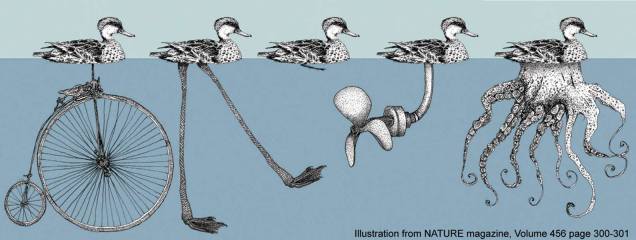
Sometimes we forget that scientists like to be amused just as much as other individuals, and the illustration in the November 20/08 issue of Nature is certainly amusing. You see five ducks swimming serenely in a row. Above the water line, they are all identical but below the surface one duck is propelled along by a massive tricycle, one has extremely long legs with webbed feet, one has normal legs, one is propelled by a motorized propeller and the last one sits serenely on top of a gigantic octopus.
It all makes one think of the sentiments expressed by “Little Buttercup” in the English operetta H.M.S. Pinafore. She warbles:
Things are seldom what they seem,
Skim milk masquerades as cream…
Black sheep dwell in every fold
All that glitters is not gold.
The amusing illustration in the Nature article, was actually promoting a similar idea. Organisms may look similar on the outside, it declares, but on the inside, their genetic information may be vastly different.
Why does this matter? Well, it is certainly contrary to evolutionary expectations.
DEFYING EXPECTATIONS
As scientists first started building up a database of DNA coding in various organisms, they knew what they expected to find. Based on evolution theory, they expected that organisms that seemed to have a close evolutionary relationship would exhibit similar DNA codes, and those with a remote connection would show much different collections of code.
In previous generations, scientists looked for similarities in form and function among organisms to draw conclusions about evolutionary relationships. Thus catlike animals would all be placed in the same group. Obviously the experts expected that the results of DNA coding studies would reflect the relationships already established on the basis of similarity in shape and biology. But often that’s not what happened.
The illustration of the ducks, so similar above the water line, represents the form and function of organisms. The vastly different controlling mechanisms below the water represent the here-to-fore hidden differences in the DNA controls inside organisms.
The first sign of unfulfilled evolutionary expectations was when the DNA from a spectrum of organisms was compared. Often the most similar DNA coding was not found among organisms that looked the most similar.
SIMILAR APPEARANCE ≠ SIMILAR DNA?
This discovery can also be compared to an adult assembling two children’s toys. The first box is opened and various component parts fall out along with an instruction sheet. The brave parent duly sets to work and assembles the toy.
Now imagine a second box is opened and a similar toy needs to be assembled. The parent thinks this one should be easy, but alas, he discovers the component parts are all differently shaped and the instructions are different too.
However in due course the second toy is assembled, and it looks and works much like the first toy. If the parent didn’t know that the insides of the two toys were very different, he might have thought they came from the same company. But after seeing the instruction sheet and all the parts, the parent realizes that these two toys must have come from totally separate sources. Even if the first company had wanted to produce a slightly more elaborate model, it would not change the basic components and instructions. It would merely modify the initial program as required.
It is the same with DNA coding in an organism’s cells. Even if the end result looks and works the same, if the instructions and component parts in the cell are very different, we suspect that the organisms have entirely separate sources, or lines of descent.
SIMILAR DNA ≠ SIMILAR APPEARANCE
The response of the scientific community to this unfulfilled expectation was to change the groupings of organisms so that the pattern of DNA differences once again gave a picture of gradual change.
The problem with this solution however is that the new groupings did not make much sense. Now creatures were grouped together as closely related, in an evolutionary sense, that did not have much in common at all. Hence we now have a classic “conflict between molecules and morphology [shape].” As a result, over the past twenty years, we have seen a “radical re-ordering of relationships” among many animal groups (Nature Feb. 12/09 pp. 812 and 816). The same holds true for plants.
So scientists have rearranged their groupings, often in illogical ways, to make the DNA fit an evolutionary scenario. The ducky illustration, however, applies more closely to other problems for evolution theory.
Biochemists firstly noticed that many creatures which have few characteristics in common, nevertheless have many genes which are “virtually identical” (Nature Nov. 20/08 p 300). This can be made to fit both evolution theory and design. Evolutionists interpret this as showing lines of common descent, even if very remote. Meanwhile creationists understand this as showing God’s choosing to use some similar elements in otherwise very different creatures.
But at the same time, the experts have found “closely connected species can connect up their genes in very different regulatory networks while keeping the end result deceptively unchanged” (p. 300). Not only have the scientists found that similar organisms may use genes in different ways, but they may even use entirely different genes to produce the same result (p. 301).
This discovery of very different codes in organisms that appear so similar is, of course, not predicted by evolution theory. Naturally these experts are looking for explanations that will still fit their theory. Thus:
“Now researchers are trying to understand how evolution finds the solutions it does, and why. Some think that this ‘underground’ variation was selected for. Some think it appeared by chance” (p. 300).
When scientists appeal to chance for an explanation, it means that they have no explanation.
WHAT’S YOUR PRESUPPOSITION?
The article in Nature declares that the situation “feels very counter-intuitive.” But is it?
It all depends upon one’s basic premises. If evolution is the basis for one’s interpretation of nature, then the results do not make sense: very similar organisms (often microorganisms) using very different molecules to achieve the same result.
It is obvious that many DNA data do not fit evolutionary expectations. However, the scientists involved simply look for alternative evolutionary explanations. It seems evident that this irregular pattern of DNA coding better fits an explanation involving intelligent choices by God the Creator.
The evolutionist may retort that this does not prove the case for creation. Fair enough. There is no proof to be had in science. The evolutionists claim that all data can be accommodated within their worldview – this is not proof, but preference. Similarly we insist that all data fit Biblical revelation. In the case of DNA, the information from nature does not fit evolutionary expectations very well at all. It does fit the creation model better.
Don’t expect ducks, however, to show the scale of internal diversity illustrated in the Nature article. That was merely for purposes of illustration. However, if anyone sees a duck driven by a propeller, let me know!
This is an edited version of an article that first appeared in September 2009 issue of Reformed Perspective under the title “On ducks and DNA.” Dr. Margaret Helder is the author of No Christian Silence in Science, a book every Christian teen considering a career in Science should read before heading off to university.
WONDERFUL WHALES: Design on a gigantic scale
by Margaret Helder
When we look at nature, we can hardly miss the design that is everywhere so apparent in living creatures. We recognize it every time we see aspect of an organism that are elegant, beautiful and useful. There are many famous examples of design in nature, traits that are not only beautiful, but which work beautifully as well….but one can look anywhere! Some examples are more interesting to us than others, but all are worth considering.
DESIGN DONE BIG
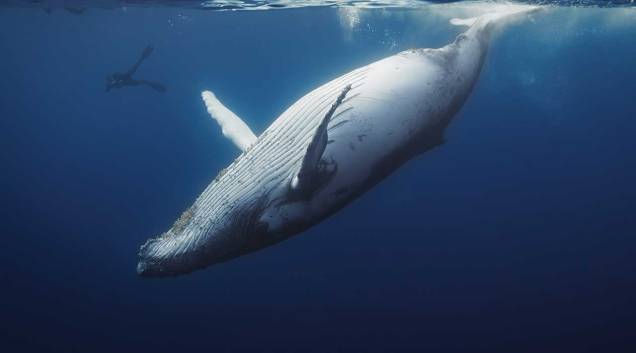
Consider for example the difficulties that the largest animals on earth, the rorqual whales must overcome to obtain enough food. The blue whale is the most famous and largest example of a rorqual. Another is the humpback. Such big animals are not going to be good at chasing smaller more agile prey. Their solution is to find very thick schools of small fish, and then to lunge forward and gulp in a huge mouthful of water containing lots of fish.
The whales engulf the water and fish before the latter have a chance to panic and escape. The whales then push the water back out of their mouths through a special filtering system like venetian blinds, which in this case is called baleen. What is left in the mouth, the whale swallows.
It all sounds relatively uncomplicated, but it is not. Without a number of special and unique design features, these whales would starve.
1. Pleated throats
The rorqual whales are named for their specially pleated throats (extending from mouth to navel) which can expand tremendously to accommodate 60 – 80 cubic meters of water and prey, “a volume equal to or greater than that of the individual rorqual itself” (Pyenson et al. Nature, 2012 p. 498, emphasis mine).
2. Filtration system
The prey must now be separated out from all that water. What the whale does is push the water out of its mouth through a sieve-like structure which replaces teeth. This filtering system or baleen, consists of keratin, like our fingernails and hair.
The baleen whale’s “suspension feeding system” – which involved feeding on, and straining out, suspended food particles from water – is unique among mammals and the pleated throat of the rorquals is unique to this even smaller group of baleen whales. That is not the end of the story. Without further special design features these whales would still be “dead in the water.”
No group other than the rorqual whales engulfs a massive volume of water in a single gulp. In order to do this, the animal lunges forward, accelerating to high speed, and then gulping in that huge volume of water, all within six seconds. But how does the whale know what volume of water to engulf? And how does it manage to engulf a volume larger than its own body? How does it know what water to gulp? If the whale just went around gulping random volumes of water, it would certainly starve – schools of fish are patchy in their distribution, and thus cannot be found in any old place.
3. The hair of their chinny chin
For a start, the whale has bristles on its chin which function sort of like whiskers. These allow the animal to identify schools of fish that are sufficiently dense. Now the whale must take advantage of this dense concentration of fish. To do this, the rorqaul must control the rate of mouth opening and throat-pouch expansion so as to maximize the intake volume. All this must happen while the whale is lunging forward at high speed.
4. Jaw that splits down the middle
We now discover more unique design features of the rorquals. The lower jaw consists of left and right halves which are only loosely connected by fibres, and also are only loosely connected to the skull. This allows for great flexibility of the mouth opening. As the rorquals lunge forward, they rotate the components of the jaw so that the opening is close to 90 degrees at the peak of the lunge. The tongue becomes convex and the throat pleats expand. Soon the jaws clamp around a huge volume of water and the whale begins the process of expelling the water and retaining the fishy harvest.
5. Always new wonders to find
New research has shown that the rorquals enjoy the benefits of yet another design feature which enables them to be successful in this unusual life style. In the centre of the lower jaw (between the two loosely connected halves) is a special and completely unique sensory organ. In its basic design it is something like the semicircular canals in our inner ear which allow us to figure out the orientation of our bodies. Inside the canals in our ears, there is clear gel and particles which occupy one position or another.
Similarly in the jaws of these whales there is a structure which has papillae (soft projections) surrounded by a gel-like matrix. This seems much like the mechanoreceptors in our inner ears. Apparently this organ in the whale jaw informs the animal as to the extent of the rotation of the jaws and the expansion of the pleats during mouth opening. The rorquals alone possess this organ between the unfused halves of the lower jaw.
Scientists consider that this sensory organ plays a fundamental role in the extreme feeding method of these largest animals on earth.
CONCLUSION
It is evident from details of the lifestyle of the rorquals that even apparently uncomplicated methods of feeding require special design features. The rorquals are certainly an example of irreducible complexity. Even with baleen instead of teeth, if they didn’t have the unique unfused lower jaw, pleats in the throat, the special sensory organ in the jaw, and the sensitive bristles on their chin, these largest of animals could never survive. Evolutionists have no adequate explanations for how these unique features could have developed through spontaneous processes.
This is an excerpt from Dr. Margaret Helder’s “No Christian Silence on Science” which you can buy here. This article first appeared in Reformed Perspective.
I Believe in Theistic Evolution
I recently realized I believe in/affirm theistic evolution. Depending on your perspective, have I sold out or have I finally come to my senses? Neither. Let me explain.
It has long perturbed me that those who affirm or allow for Darwinian macroevolution to be compatible with a biblical worldview will sometimes call themselves “creationists” or will claim to believe in/affirm biblical creation. They do this knowing that biblical creation is usually understood to refer to a view that holds to God having created in six ordinary days on a timescale of some thousands (rather than millions or billions) of years ago. By claiming to believe in creation they lay concerns to rest, whereas all they have really done is disguise their true position.
Stephen C. Meyer has helped me to see I could do the same thing with theistic evolution. Meyer wrote the “Scientific and Philosophical Introduction” to Theistic Evolution: A Scientific, Philosophical, and Theological Critique, a massive volume published in 2017 by Crossway. He notes that theistic evolution can mean different things to different people, as can “evolution” without the modifier “theistic.” For example, it can refer to common or universal common descent or to the creative power of the natural selection/random variation (or mutation) mechanism. But evolution can also just simply mean “change over time.” And if one believes that God causes “change over time,” then that can be understood as a form of theistic evolution. With that, Meyer contends, no biblical theist could object (p.40). He concludes, “Understanding theistic evolution this way seems unobjectionable, perhaps even trivial” (p.41). So, in the sense of believing or affirming that there is change over time directed by God, I am a theistic evolutionist — and I suspect you are too!
But what’s the problem with this? Let’s say I were to (miraculously) get myself invited to a BioLogos conference as a speaker who affirms theistic evolution. It appears I’m on board with the BioLogos agenda. The conference organizers are a little doubtful, but I insist that I affirm theistic evolution and they take me at my word and welcome me in their midst. Then I give a talk where I evidence that I’m actually a six-day creationist who believes Darwinian macroevolution to be a fraud. “But you said you hold to theistic evolution!” “Oh, but you didn’t ask me what I meant by that. I believe that God causes change over time — that’s how I’m a theistic evolutionist.” Would anyone blame the conference organizers for thinking me to be lacking in some basic honesty?
Integrity is really the heart of the matter. If I say, “I read a book and I realized I’m a theistic evolutionist,” most people will hear that and conclude that I still believe in God, but I also affirm Darwinian evolution. And that is not an unreasonable conclusion. Furthermore, what would be my purpose for making such a claim? Would it be to tell something designed to mislead so as to advance my cause? Does the end justify the means?
If you affirm Darwinian macroevolution as the best explanation for how life developed on earth and you believe God superintended it, then man up and say so. Honestly say, “I am a theistic evolutionist.” As for me, believing that God created everything in six ordinary days on the order of some thousands of years ago, I will say directly, “I am a biblical creationist” or “six-day creationist,” or “young earth creationist.” But let’s all be honest with one another.
Biblical creationists also have to stop being naive. Just because someone says they believe in biblical creation doesn’t mean they actually believe the biblical account as given in Genesis. They can fill out those terms with their own meaning. So we have to learn to ask good questions to ferret out impostors. Questions like:
- Do you believe God created everything in six ordinary days some thousands of years ago?
- Was the individual designated as Adam in Genesis ever a baby creature nestled at his mother’s breast?
- Was the individual designated in Genesis as Eve a toddler at some point in her life?
- Do you believe it biblically permissible to say that, as creatures, the figures designated in Genesis as Adam and Eve at any point had biological forebears (like parents/grandparents)?
- What does it mean that God created man from the dust of the earth?
These are the types of questions churches need to be asking at ecclesiastical examinations for prospective ministers. These are the types of questions Christians schools need to be asking prospective teachers at interviews. True, even with these sorts of questions, there are no guarantees of integrity, but at least we will have done our due diligence.
 Creation Without Compromise